
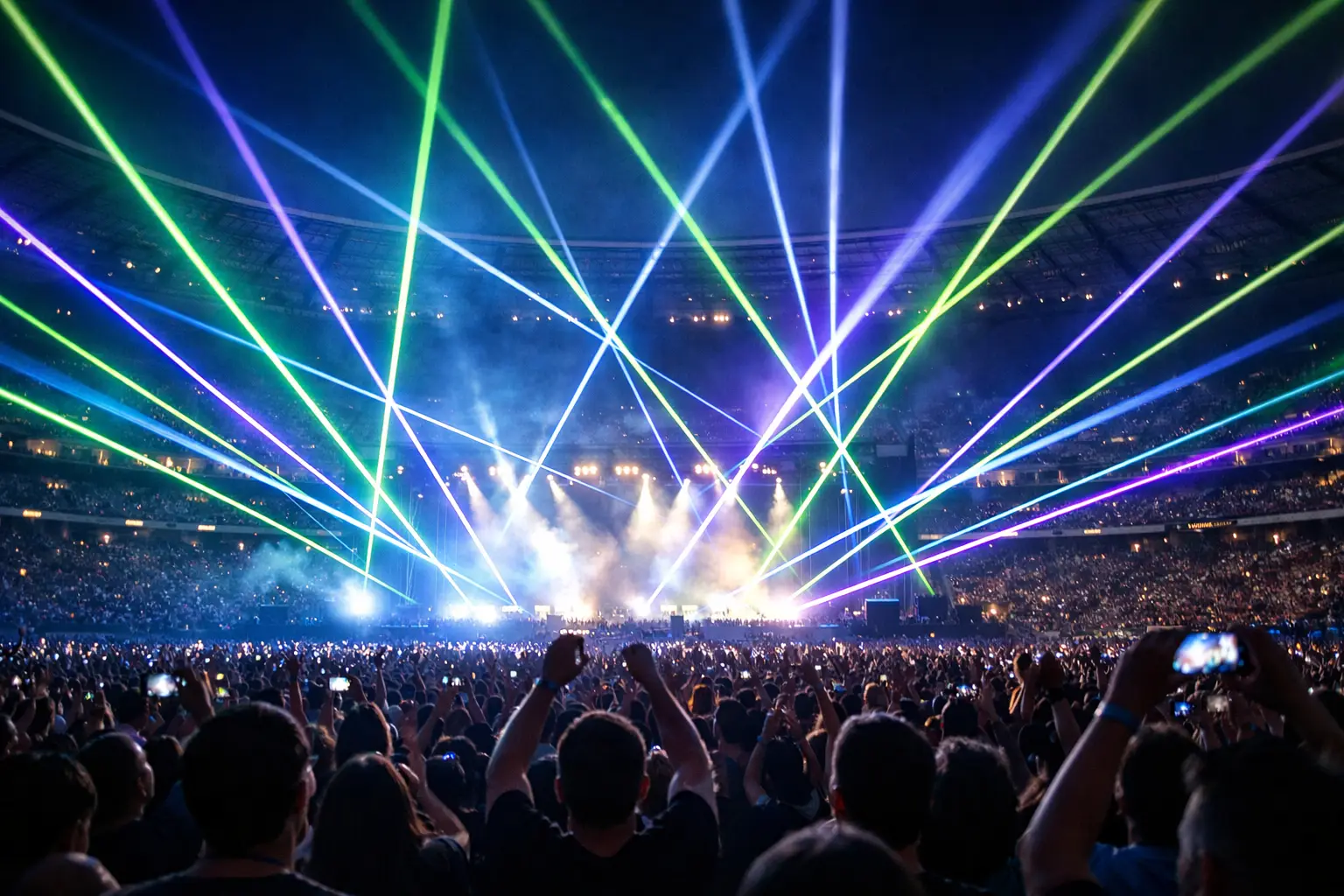
A stadium goes quiet for only a few seconds before the biggest moments. The team is about to take the field. A headliner is seconds from appearing. A citywide celebration is building toward its final reveal. Stadium laser effects give those seconds shape, color, movement, and a surge of anticipation that reaches every seat in the house.
This is not a matter of placing a few fixtures at midfield and pressing play. A successful stadium laser production is a custom-built visual event, designed around sightlines, music, timing, venue geometry, audience density, weather conditions, and a serious safety plan. When every element lands together, the result is pure visual magic on a massive scale.
Why Stadium Laser Effects Hit Harder
Stadium audiences are difficult to impress because they are spread across a huge footprint. Video walls, floodlights, pyrotechnics, performers, and signage all compete for attention. Lasers cut through that visual field with sharply defined beams, intense RGB color, and movement that can make the entire venue feel connected.
The magic is in the scale. A programmed fan of light can sweep across the architecture, while aerial beam looks rise above the stage or field in time with a musical drop. Animated logos, team marks, sponsor messages, and abstract graphics can become towering visual elements rather than static images on a screen. The crowd does not simply watch the production. It feels inside it.
That impact makes laser a powerful fit for player introductions, halftime entertainment, championship celebrations, concert openings, festival headliners, municipal fireworks finales, and brand launches. It can establish an identity in moments, whether the creative direction calls for a high-energy sports reveal, an elegant orchestral build, or a full-throttle electronic performance.
Stadium Laser Effects Begin With the Big Picture
The most memorable shows are designed as part of the event, not added at the last minute. Before a projector is selected or an animation is programmed, the production team needs to understand what the audience should feel and exactly when they should feel it.
For a sporting event, that may mean a 90-second player entrance that rises from suspense to a wall of color as the starting lineup is announced. For a concert, it may be a laser sequence mapped to a headliner’s first three songs, with looks that reinforce the artist’s visual language. For a civic event, it could mean a custom skyline, anniversary graphic, or countdown sequence that carries tens of thousands of people into one shared moment.
Build Around Audience Sightlines
A stadium is not one viewing position. The floor, lower bowl, upper deck, suites, broadcast platforms, and VIP areas all see the production differently. Projector locations, beam angles, screen or stage positions, and scenic structures must be assessed well before show day.
The strongest design often uses multiple perspectives on purpose. Broad aerial fans and atmospheric beam looks give the upper seating areas a dramatic view, while crisp laser graphics and stage-focused effects reward fans close to the action. A production that looks phenomenal from television camera positions but disappears for the upper bowl is not finished yet.
Match Projector Power to the Venue
There is no universal wattage for a stadium show. The correct system depends on throw distance, ambient light, competing production elements, haze availability, creative goals, and whether the event happens indoors, after dark outdoors, or in transitional daylight.
Professional RGB laser projectors in the 40-watt to 200-watt-plus range can deliver enormous visual presence, but more power alone is not the creative answer. A carefully engineered 40-watt system can be ideal for certain indoor arenas or tightly controlled installations. A major outdoor stadium production may call for far more output, multiple positions, and specially planned beam paths to achieve the intended effect. The right approach is based on the venue and show design, not a number chosen for bragging rights.
Visibility Depends on More Than Brightness
Laser beams become especially dramatic when they have atmosphere to travel through. In indoor venues, professionally managed haze can transform sharp points of light into giant geometric structures above the crowd. Outdoors, humidity, temperature, wind, dust, and natural atmospheric conditions all affect how beams read from the stands.
This is where production experience matters. Heavy wind can break up haze and change the look of aerial effects. A bright summer sky may limit what is visible until later in the program. Stadium floodlights, LED walls, and follow spots can either fight the laser design or become part of a coordinated visual composition.
A strong laser team plans for these realities early. It may adjust the show timeline, use higher-output systems, shift projector positions, create more graphic-based moments, or design alternate looks for changing conditions. Spectacle requires flexibility as well as power.
High-Impact Effects Require Professional Safety
At stadium scale, laser safety is not an afterthought. It is part of the production design from the first site review through the final cue. High-powered laser systems require experienced, licensed and insured operators who understand how to establish safe beam paths, protected areas, termination points, physical security, emergency procedures, and venue-specific controls.
Audience scanning, when used, is a highly specialized application with strict requirements. It must be properly calculated, programmed, measured, and managed by qualified professionals using appropriate equipment and procedures. Many stadium looks deliver extraordinary impact without directing beams into audience areas at all, using overhead aerial effects, field-facing designs, stage-focused graphics, and carefully terminated projections.
Outdoor events add another layer of responsibility. Depending on the location and production plan, airspace considerations, local requirements, venue rules, and coordination with other event elements may apply. Lasers also need to work in harmony with fireworks, drones, video, broadcast cameras, and emergency operations. The visual result should feel wild and unrestricted. The process behind it should be precise, controlled, and compliant.
Connecticut Laser Productions brings more than 20 years of laser-production experience to shows ranging from private celebrations to stadium-scale audiences of 80,000 and beyond. That combination of creative programming, high-wattage inventory, and safety-focused operation is what turns a bold idea into a polished live spectacle.
The Stadium Moments Lasers Make Bigger
Lasers are especially effective when the event needs a clear transition from ordinary programming to a must-see moment. A pregame entrance can begin with narrow beams tracing the venue before bursting into team-color fans. A halftime reveal can pair synchronized laser graphics with music, dancers, video, and flame effects. At a concert, a single tightly timed laser hit can turn the opening chord into a full-stadium eruption.
They also create valuable opportunities for branding without making the experience feel like an advertisement. A sponsor logo can appear as part of a larger animated sequence. A product silhouette can materialize above a stage. A city seal or event mark can become the centerpiece of a countdown, finale, or commemorative presentation.
The key is restraint in the right places. If every song, timeout, and announcement receives the same maximum-intensity treatment, nothing feels special. The best laser programming uses contrast: quiet darkness before a reveal, elegant color movement before a massive beam burst, and precise accents that leave room for the event’s biggest emotional peaks.
Choose a Partner That Can Scale With the Vision
When evaluating stadium laser effects, ask how the provider approaches the full production rather than simply what equipment they own. A capable partner should be able to discuss creative direction, site surveys, projector power, control systems, programming, crew experience, safety documentation, weather contingencies, and coordination with the venue’s production team.
It also helps to work with a company that can scale. A regional sports activation, arena concert, touring stop, fairground finale, or permanent venue installation may all require different approaches, but they share the need for reliable gear and disciplined execution. Custom animation, timecoded music synchronization, redundant planning, and experienced onsite technicians are what protect the audience experience when the pressure is highest.
The goal is not to add lasers just because they look impressive. It is to create the moment people record, replay, and talk about on the ride home. Start with the reaction you want from the crowd, then build the laser show with enough creative ambition and technical precision to make that reaction inevitable.
No responses yet