
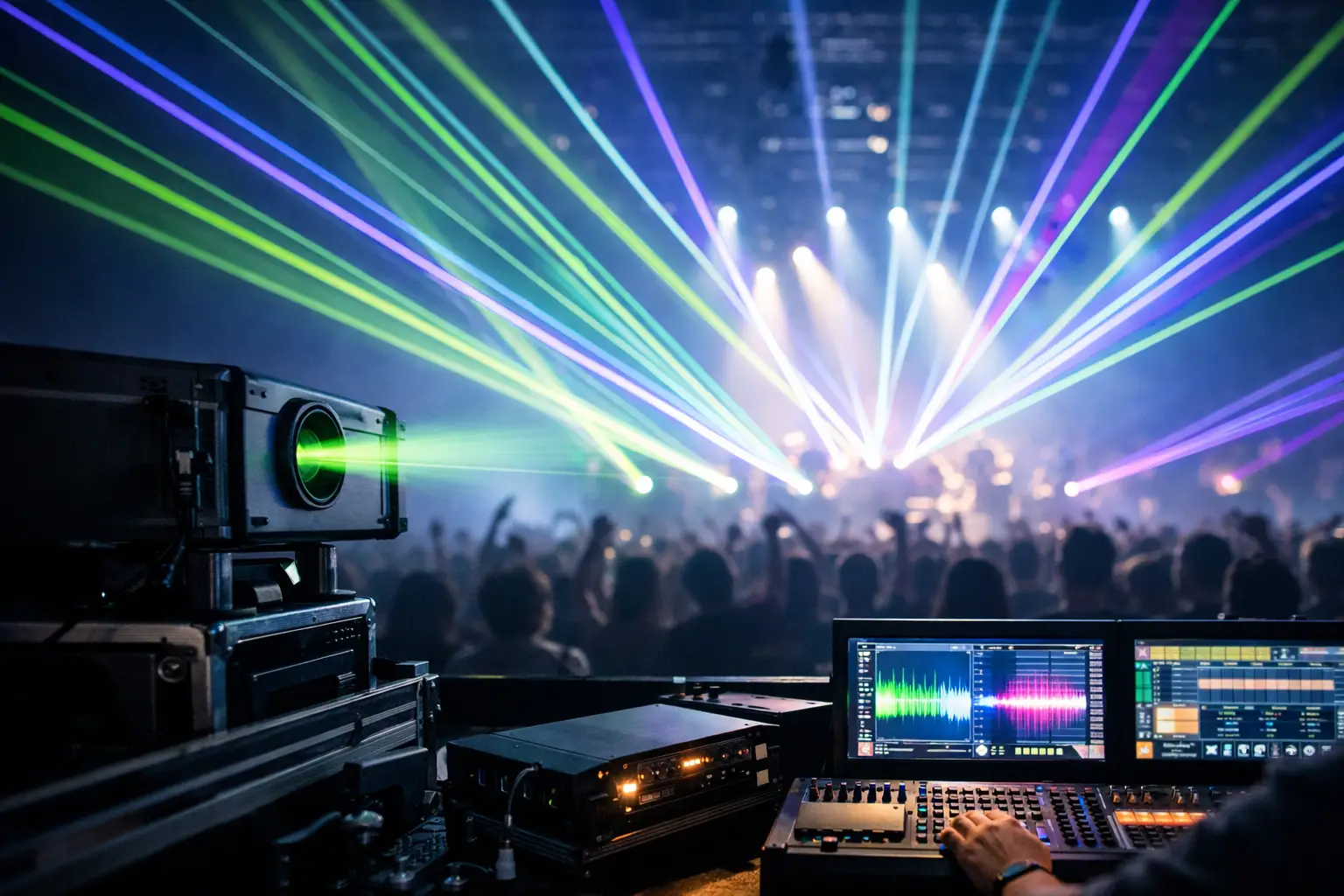
A great concert laser production does not sit politely behind the performers. It takes the energy already moving through the room and gives it shape: razor-sharp aerial beams over the crowd, color exploding with the chorus, animated graphics that hit exactly when the audience is ready to erupt. When the lights, music, staging, and lasers move as one, the result is not just a concert. It is a full-sensory visual spectacle people talk about long after the final encore.
For promoters, touring teams, venue operators, and festival producers, lasers can deliver the big-screen sense of scale that separates a good show from a must-see event. But spectacular results do not come from placing a projector near the stage and pressing play. They come from creative direction, serious projector power, exact programming, and professional safety planning working together.
What Makes Concert Laser Production Different
Concert lasers have a job that conventional lighting cannot fully replicate. Moving lights paint the stage, while lasers cut through space. Their beams can frame an artist, sweep across a packed arena, build a canopy over a dance floor, or create geometric architecture in the air. With haze or atmospheric effects supporting the design, every beam becomes visible from multiple audience angles.
That visual precision gives a production team enormous creative range. A laser cue can quietly trace the opening notes of a song, then burst into a high-speed fan, tunnel, or wave as the beat drops. It can place branded artwork above a DJ booth, create a vivid RGB color world for a headline act, or turn an outdoor festival field into a horizon of moving light.
The difference is timing. A generic laser effect may look impressive for a moment. Custom-programmed cues, however, react to the arrangement, tempo, transitions, and emotional lift of a live set. That is where the WOW factor becomes part of the performance rather than an interruption to it.
Start With the Room, Not the Projector
The right laser design begins with the venue and the audience experience. A nightclub, theater, amphitheater, arena, stadium, and outdoor fairground each create very different production conditions. Ceiling height, throw distance, stage position, ambient light, viewing angles, haze capability, video screens, roof structures, and audience capacity all affect what a laser system can accomplish.
A smaller indoor room may achieve astonishing intensity with a tightly focused system and carefully designed beam effects. A stadium concert or major municipal celebration requires much more reach, wider coverage, and projector output capable of remaining vivid against distance and competing production lighting. Professional systems can range from 40 watts to 200 watts or more, but wattage alone is not the entire answer. Beam quality, color balance, scanner speed, projection position, and programming matter just as much.
Outdoor shows add another layer of decision-making. Lasers can create breathtaking sky effects and massive audience-facing visuals, but ambient light, weather, sightlines, airspace considerations, and the lack of controlled haze can change the creative approach. An experienced team builds a design around those realities rather than promising an indoor look in conditions that require a different solution.
Power Should Match the Production Goal
More power creates opportunity, but it should serve the show. A high-output RGB projector can deliver brilliant color, long throws, and a larger visual footprint for touring stages, sporting events, or festival fields. In a more intimate setting, excessive output without disciplined design can overpower the room instead of elevating it.
The best question is not, “What is the biggest laser available?” It is, “What experience should the audience have?” A concert built around electronic music may call for dense aerial beams, kinetic tunnels, and relentless movement. A rock performance may benefit from strong architectural looks that punctuate key riffs. A corporate concert or product reveal may need clean logo projection and polished branded animation alongside the music-driven effects.
Programming Is Where the Show Becomes Personal
Laser hardware creates the canvas. Programming creates the moment.
For a live concert, that can mean designing cue stacks around a timecoded set, programming signature visuals for specific songs, or operating cues live when performers want flexibility. Both approaches have value. Timecode offers repeatable precision for tightly choreographed touring productions, while live operation gives the laser technician room to respond to extended solos, altered setlists, crowd interaction, and spontaneous energy on stage.
A strong show also needs visual pacing. If every cue is at maximum intensity, the audience stops noticing the impact. The most memorable designs use contrast: narrow beams before a wide fan, slow color movement before a rapid chase, darkness before a massive reveal. Those shifts make the biggest moments feel earned.
Custom animations bring another dimension to concert laser production. Artist names, tour marks, sponsor graphics, mascots, product imagery, and abstract motion graphics can all be integrated into the visual language of the event. The goal is not to fill every available second with imagery. It is to make the imagery feel native to the artist, brand, and audience.
Safety Is Part of the Production Value
A powerful laser show should feel wild, not careless. High-impact concert effects require a safety-first approach that protects performers, crew, and guests without flattening the creative vision.
Professional laser operation involves much more than equipment placement. The production team must evaluate beam paths, audience areas, stage locations, reflective surfaces, projector mounting, access control, emergency procedures, and venue-specific restrictions. Outdoor work may require additional coordination based on location and operating conditions. Every show should be designed and executed by qualified operators using compliant equipment and established safety practices.
This is one reason experienced production matters. The audience sees pure visual magic. Behind that moment are deliberate calculations, secure rigging, tested cues, proper zoning, and technicians who understand how to deliver intensity responsibly. Licensed and insured operators give event organizers confidence that the production is being handled with the same care as the rest of the live event.
How Lasers Work With the Rest of the Stage
Lasers are at their strongest when they are integrated, not isolated. They can complement moving lights, LED walls, pyrotechnics, scenic elements, video content, and atmospheric effects to build a complete visual environment.
Coordination is especially important when multiple departments share the stage. Video teams need to know when laser graphics may be visible on camera. Lighting designers need to balance fixtures and color palettes so the laser output remains distinct. Rigging, audio, and stage management teams need clear plans for equipment locations, cable runs, access, and show calls. For touring productions, consistency from venue to venue is essential, even when room dimensions change.
The practical benefit of a production partner with deep laser experience is that the system is designed to fit the show rather than forced into it at the last minute. Connecticut Laser Productions brings that mindset to events ranging from intimate celebrations to audiences of 80,000 and beyond, pairing custom creative programming with scalable professional RGB systems.
Choosing the Right Production Partner
When evaluating a laser provider for a concert, look beyond a highlight reel. Ask how they assess venues, how they scale projector power, whether programming is custom-built, who operates the systems, and how safety planning is managed. A provider should be able to explain the creative concept in plain language while also speaking confidently about technical execution.
It also helps to be clear about the event’s priority. Is the laser package meant to support an artist’s set, create a headline opening moment, transform a nightclub, carry a sponsor message, or give a local festival the scale of a major tour? The answer affects equipment selection, programming time, crew requirements, and budget.
A thoughtful production plan accounts for trade-offs early. More projector positions can create richer coverage but require additional rigging and coordination. Elaborate graphics need programming time and favorable projection surfaces. Outdoor scale may call for higher output, while indoor venues may benefit more from controlled haze and strategic beam placement. Honest planning produces a stronger show than overpromising ever will.
The next time you build a concert, think beyond what the audience will hear. Give them color that races with the rhythm, beams that reshape the room, and a final visual moment worth holding up a phone for. That is how a performance becomes an event people remember.
No responses yet