


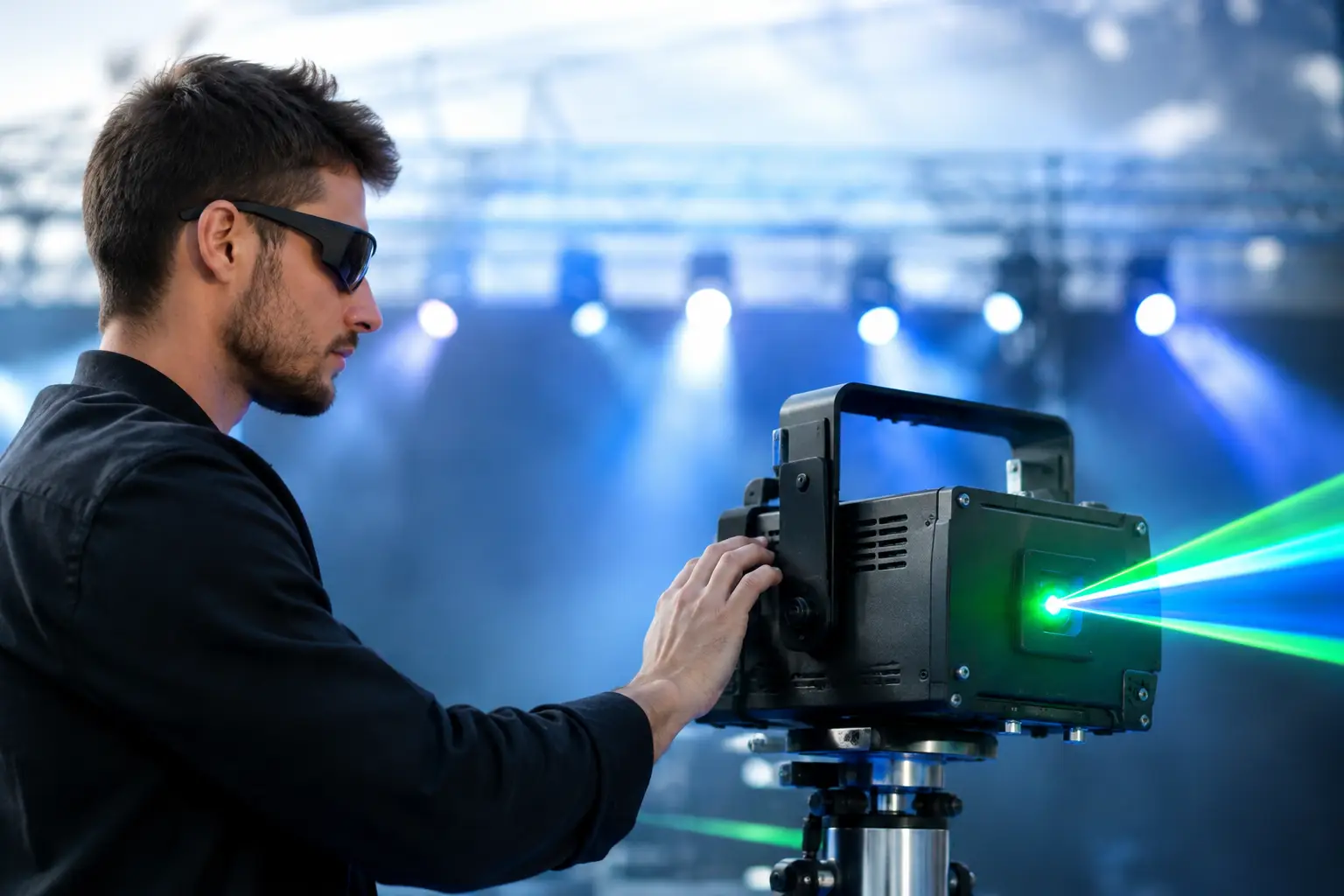
A laser beam can turn a concert drop, grand opening, or fireworks finale into a breathtaking visual spectacle. It can also create a serious safety and compliance problem when the person behind the console lacks the right training. That is why laser operator certification matters to anyone booking, producing, or operating a professional laser show.
For event planners and venue teams, the phrase is often used as shorthand for a qualified operator. The reality is more nuanced. In the United States, there is no single universal credential that automatically authorizes someone to run every laser show in every location. A legitimate professional needs practical training, documented safety knowledge, experience with the specific system, and the ability to operate under the applicable federal, state, local, venue, and event requirements.
What laser operator certification really means
Laser operator certification generally refers to formal instruction that demonstrates an operator understands laser safety, equipment operation, show control, and audience protection. Strong programs teach more than how to press play on a projector. They address beam paths, scan-fail protection, hazard zones, alignment, emergency procedures, atmospheric conditions, and the difference between a spectacular effect and an unsafe exposure.
For high-powered entertainment lasers, training should also cover the paperwork and operating conditions that surround a public show. In many US applications, laser light show systems and operations fall under federal requirements administered by the Food and Drug Administration’s Center for Devices and Radiological Health. Depending on the show design, location, and equipment, there may also be state laser registration rules, local fire marshal review, venue policies, insurance requirements, and site-specific restrictions.
Certification is valuable because it creates a baseline. It is not, by itself, a substitute for an approved production plan or real-world judgment. An operator may hold a course completion certificate, yet still be the wrong choice for a stadium show, a waterfront festival, or a packed nightclub if they have not managed those environments before.
Why a trained operator changes the entire production
The best laser shows feel effortless from the audience floor. Beams sweep through haze, color fills the architecture, animations hit on the beat, and the room erupts at exactly the right moment. That visual magic comes from preparation that most guests never see.
A trained operator begins with the site, not the effect. Ceiling height, sightlines, stage position, seating layout, reflective surfaces, aircraft considerations, access control, power distribution, weather, and haze all influence how a laser system can be deployed. A 40-watt projector in an intimate ballroom and a 200-watt system built for an outdoor audience of tens of thousands demand very different planning.
Certification-focused training gives an operator the vocabulary and process to identify risk. Experience gives them the instincts to solve problems before doors open. Together, they protect the audience, the client, the venue, and the creative impact of the show.
Audience scanning is not a casual effect
One of the most misunderstood parts of laser production is audience scanning, where beams are intentionally projected into or over an audience area. It can look incredible when properly designed and permitted. It can also be one of the most technically sensitive choices in a show.
This effect requires a detailed safety analysis, appropriate equipment, controlled exposure levels, proper scanning geometry, and a knowledgeable operator who understands the approved operating parameters. It is never something to add on a whim because a client saw it online. If audience scanning is not suitable for a venue or event plan, a skilled designer can still create immense impact with overhead aerial beams, stage framing, building projections, and synchronized graphics.
What event planners should ask before booking
You do not need to become a laser safety officer to hire a professional production company. You do need to know how to separate a credible provider from a vendor whose plan begins and ends with bringing a projector to the room.
Ask how the company handles operator training and whether the assigned technician has experience with your event type. A tour stop, city celebration, wedding, sports halftime production, and brand launch each come with different crowd behavior, timelines, site conditions, and creative expectations.
Ask whether the equipment is designed and documented for professional laser-show use. Request confirmation of insurance and ask how permitting, variances, notifications, or venue approvals will be handled where applicable. The right partner will discuss these items clearly, without burying you in jargon or making vague promises that everything is “covered.”
It is also smart to ask who controls the laser system during the event. Preprogrammed content is useful, but live events change fast. A professional operator can respond when haze shifts, a camera position moves, a scenic element changes, or the show schedule needs to be adjusted. That human oversight is part of what makes a laser production polished rather than risky.
Training matters for projector buyers, too
Buying a professional RGB laser projector does not automatically make someone ready to operate it in public. Powerful equipment offers extraordinary color, range, and creative potential, but greater output also increases the need for disciplined setup and informed control.
For touring professionals, production houses, schools, installation teams, and aspiring laser companies, laser operator certification can be a smart investment before the first public deployment. It helps build safe habits early: using key control and interlocks properly, checking scan safety systems, establishing exclusion zones, securing the projector, managing emergency stop capability, and documenting each setup.
The right level of training depends on how the system will be used. A permanent installation in a controlled theater has different demands than a mobile festival rig. An indoor graphics show may have different concerns than outdoor sky effects. Buyers should look for training that matches their intended equipment class and application, then continue building experience under qualified supervision.
Red flags that deserve a closer look
A low price is not automatically a red flag. A provider with no questions about your venue usually is. Professional laser work is site-specific, so a serious operator will want dimensions, schedules, audience layout, indoor or outdoor details, existing production elements, and the creative goal.
Be cautious if someone treats high wattage as the only measure of quality. More power can create a bigger visual reach, especially outdoors or in large arenas, but it does not replace good programming, safe beam design, quality optics, reliable control systems, or an experienced technician. The most memorable show is not simply the brightest one. It is the one that uses every beam with purpose.
Other warning signs include a refusal to discuss insurance, no clear safety process, equipment with questionable documentation, or claims that regulations never apply. Compliance is not a buzzkill. It is what allows a bold, high-energy production to happen responsibly.
Certification is the starting point, not the finish line
A certificate tells you an operator has completed a defined course of study. It does not reveal whether they can program a music-synchronized finale, coordinate with lighting and pyro teams, adapt a show for a historic venue, or keep a production moving during a weather delay. Those abilities are earned through shows, rehearsals, site visits, and countless technical decisions made under pressure.
That is why the strongest production teams pair formal laser safety education with proven show experience. They know when to push for maximum visual intensity and when a particular creative idea needs to be redesigned for the space. They understand that a laser show is not a rental item. It is a live, precision-engineered performance.
For clients, the takeaway is simple: ask about laser operator certification, but do not stop there. Choose a team that can explain its safety process, demonstrate its creative range, and scale its system to your audience without cutting corners. Connecticut Laser Productions approaches every show with that balance of pure visual magic and disciplined professional operation. When the countdown reaches zero and the first beam cuts through the air, that preparation is what lets everyone focus on the WOW factor.
One response
I enjoyed your take on the subject. The article has enough depth to be interesting while remaining comfortable to read in one sitting.