
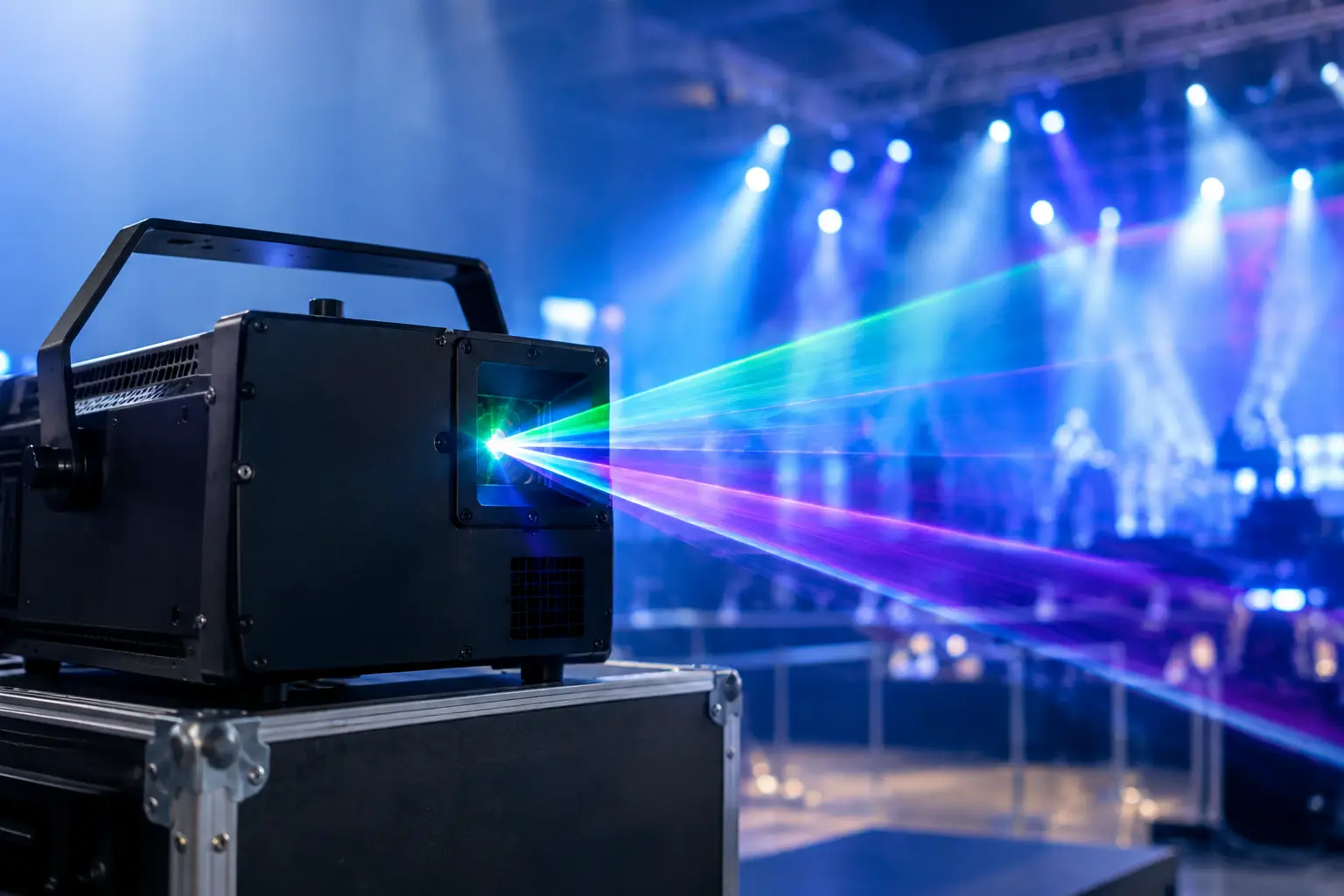
A laser can turn a ballroom ceiling into a moving galaxy or send razor-sharp color across a stadium crowd. But before the first beam cuts through haze, clients often ask one essential question: what laser class is safe for a live event?
The honest answer is that there is no single laser class that is automatically safe for every application. Safety depends on where the beam travels, how the system is enclosed or controlled, whether it can reach people, and who is operating it. A small presentation pointer, a classroom device, and a professional concert laser projector are built for entirely different jobs. Their safety requirements are different too.
For event producers, venue operators, and private hosts, the goal is not to choose the lowest-powered laser possible. The goal is to create a breathtaking visual spectacle while ensuring the audience is protected by proper design, equipment, procedures, and professional operation.
What Laser Class Is Safe for People?
Laser classes describe the potential hazard of accessible laser radiation under defined conditions. They do not tell the whole story of whether a laser show is safe. In fact, many spectacular professional productions use Class 4 laser projectors, while the audience remains protected because the beams are engineered, positioned, and controlled correctly.
Class 1 products are generally considered safe during normal use. The beam is enclosed, inaccessible, or reduced to a safe level before it reaches the user. A laser printer is a familiar example. Class 1 is the right answer when the public may directly interact with a product without needing specialized laser-safety knowledge.
Class 2 lasers are visible-light devices with low output. The natural blink response offers some protection from a brief accidental exposure, but nobody should intentionally stare into the beam. These are common in basic pointers and alignment tools, not large-format entertainment effects.
Class 3R lasers have higher accessible output and may present an eye hazard if viewed directly, particularly with optical instruments. They are not appropriate for casual use around guests simply because they seem compact or affordable.
Class 3B lasers can cause eye injury through direct exposure. Class 4 lasers carry the highest hazard category and can create eye and skin hazards, ignite materials under certain conditions, and produce hazardous reflections. Most high-impact RGB entertainment laser projectors are Class 4 systems. That includes the powerful 40-watt to 200-watt-plus platforms used to fill major outdoor spaces, concert stages, festivals, and sports venues with extraordinary color and movement.
That does not mean a Class 4 show is inherently unsafe. It means it must be designed and operated as a professional laser production, not treated like a plug-and-play party light.
Laser Class Is Only Part of Event Safety
A projector’s classification tells you what the equipment is capable of producing. Safe show design determines what the audience can actually access.
For a typical indoor laser show, beams may be projected above head height, across a controlled stage environment, onto scenic surfaces, or into clearly defined aerial zones. The visual result can still be pure visual magic: fan effects, tunnels, kinetic aerial patterns, logo reveals, and music-synchronized animations that transform the room. The difference is that beam paths are planned to keep hazardous exposure away from guests, staff, and performers.
Outdoor events add another layer of planning. A laser effect that works beautifully in an open field may need changes near roads, airports, elevated viewing areas, reflective architecture, or camera platforms. A professional team evaluates sightlines, beam termination, projector placement, weather exposure, audience boundaries, and the operational environment before showtime.
This is why wattage alone is not a safety rating. A 40-watt laser and a 200-watt laser should not be compared as if one is simply five times more dangerous in every scenario. Beam diameter, divergence, scan speed, scan pattern, distance, exposure duration, and accessible areas all affect the actual risk. Higher power gives a production more reach and impact, especially outdoors or in large venues, but it also demands deeper technical control.
Why Audience Scanning Requires Serious Expertise
Audience scanning is one of the most misunderstood parts of entertainment laser safety. It refers to intentionally directing scanned laser effects into audience space at levels designed to remain within applicable exposure limits. It can create an immersive, high-energy moment when engineered correctly. It is never a feature to improvise.
In the United States, professional laser displays are subject to federal requirements and may also involve state and local rules, venue policies, fire codes, and event-specific approvals. A compliant audience-scanning design requires more than setting a projector to a lower brightness level. It requires calculated and measured exposure levels, appropriate scanning equipment, safety interlocks, scan-fail protection, emergency stops, controlled zones, and trained personnel who can make real-time decisions.
The same applies to performers. A stage layout can change quickly when an artist walks downstage, a photographer steps into a beam zone, or a scenic piece is moved. Experienced operators plan for these variables instead of assuming the original plot will remain untouched all night.
For this reason, a venue or event organizer should be cautious when a vendor promises crowd effects without discussing safety zones, equipment certification, operator credentials, or show conditions. The strongest laser shows combine bold creative design with disciplined technical execution.
The Safe Choice Depends on Your Use Case
If you are buying a laser product for public interaction, education, office use, or an unattended installation, Class 1 is usually the safest starting point because the system is designed to prevent hazardous accessible exposure. If the device will be used by trained staff in a controlled environment, other classifications may be appropriate, but procedures and access controls become essential.
If you are planning an event, do not choose a production partner solely by asking for a “safe laser class.” Ask how the show protects people. A capable provider should be able to explain where projectors will be placed, how beams will be contained or terminated, whether audience scanning is proposed, who will operate the system, and what safety documentation or approvals apply.
For a wedding, bar or bat mitzvah, nightclub activation, or corporate launch, that may mean a compact but precisely programmed system creating dramatic aerial effects over the dance floor. For a municipal fair, stadium concert, or festival, it may mean multiple high-powered projectors, long-throw beam effects, custom animations, and a larger controlled perimeter. The scale changes, but the safety mindset should not.
What to Look for in a Professional Laser Partner
A professional laser company should treat safety as part of the creative plan, not as an afterthought added after the visuals are sold. Look for experienced technicians, insured operations, properly maintained systems, documented safety practices, and a willingness to inspect the site before recommending effects.
Ask whether the team custom programs the show for your venue and event flow. Generic content can look impressive, but custom programming lets operators account for ceilings, stage positions, décor, projection surfaces, entrances, and audience movement. It also lets the visual experience build with the music and the moment instead of feeling like a random light effect.
Connecticut Laser Productions approaches every production with that balance in mind: intense color, precision-engineered effects, and professional operation designed around the realities of the event. The objective is always the same – deliver the WOW factor without compromising the people who came to experience it.
The safest laser show is not necessarily the smallest or least powerful one. It is the one designed for the room, operated by qualified professionals, and built so every unforgettable beam has a controlled place to go.
No responses yet