
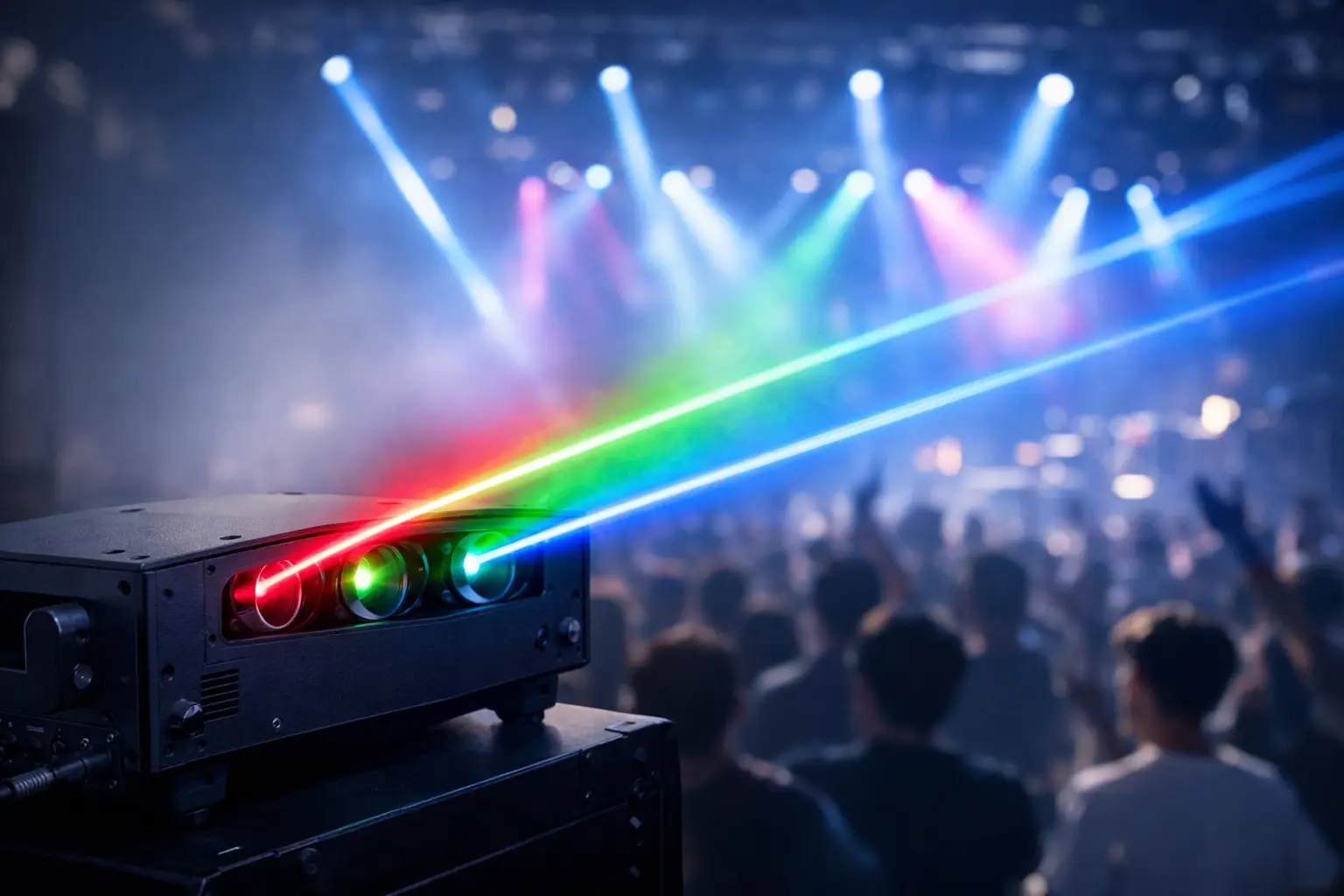
A great laser moment changes the scale of an event. One second, guests are watching a stage, a building facade, or an empty night sky. The next, RGB laser projectors are carving through the atmosphere with saturated color, kinetic beams, aerial effects, logos, and animations that pull every eye in the room toward the same spectacle.
For concert producers, event planners, venue teams, and buyers building a permanent installation, an RGB projector is not simply another lighting fixture. It is a precision visual instrument. The right system can turn a corporate launch into a brand reveal with real impact, give a wedding entrance a cinematic edge, or send a festival crowd into a full-sensory rush before the headliner takes the stage.
What Makes RGB Laser Projectors Different?
RGB stands for red, green, and blue – the three laser sources blended inside the projector to create a full palette of color. By controlling the intensity of each source, a professional projector can produce vivid reds, electric blues, rich greens, bright yellows, magentas, cyans, and clean white-light effects.
That color control is only part of the story. Unlike conventional fixtures that spread light broadly, lasers create exceptionally tight, focused beams. With haze or fog in the air, those beams become visible pathways of light that can sweep over a dance floor, fan above a stage, frame a performer, or stretch across an outdoor event site. The result has a sharpness and intensity that traditional wash lighting cannot replicate.
Professional RGB laser systems also support graphics and animation. With the proper scanning hardware and custom programming, a laser can draw logos, names, messages, geometric patterns, themed visuals, and music-synchronized sequences. That makes the technology equally powerful for entertainment and brand communication.
Power Changes the Possibilities
Wattage matters, but it is not a shortcut to a better show. A projector must be matched to the viewing distance, ambient light, venue size, atmospheric conditions, desired effects, and safety plan.
A smaller indoor celebration may benefit from a carefully positioned lower-power professional system that creates clean beam choreography without overwhelming the room. A nightclub, theater, or concert venue may call for more output to compete with stage lighting and reach farther into the audience space. For outdoor festivals, municipal celebrations, stadium environments, and large-scale skyline effects, high-powered RGB laser projectors in the 40-watt to 200-watt range and beyond can create visuals visible across enormous distances.
More power gives a production team greater reach and punch, especially outdoors or against bright scenic elements. It also demands more discipline. Beam paths, projection zones, termination points, aircraft considerations, weather exposure, and audience separation all become part of the technical design. The strongest show is never just the brightest system. It is the one engineered for the location and operated with precision.
Beam Quality Is More Than a Spec Sheet Detail
When evaluating a laser projector, buyers often focus first on wattage. Output is essential, but beam quality can dramatically affect what the audience sees. A tight beam with low divergence stays narrow over distance, producing sharper aerial effects and cleaner graphics. A wider beam can lose impact as it travels, particularly on long outdoor throws.
Color balance matters too. A system may list red, green, and blue sources, but its white balance and mixed-color performance determine whether the final image feels crisp and vibrant. Professional-grade RGB systems are designed to deliver rich color mixing rather than a weak or uneven blend.
For graphics, scanner performance is another major consideration. Fast, accurate scanners allow for smoother logos, text, and animations. If your goal is to create mind-blowing animations for a product launch or display branded content in a permanent venue, scanner quality deserves as much attention as raw optical power.
From Music-Synced Beams to Branded Visuals
The creative range of laser production is enormous because the medium responds so well to timing. A music-synchronized show can build tension with narrow beams, burst into color on a chorus, then shift into a massive fan effect precisely on the beat drop. The energy feels physical. Audiences do not just see the cue – they react to it.
For corporate events, lasers can transform a reveal into a signature moment. A company logo emerging from darkness, animated line work racing across a ballroom, or a precisely timed laser sequence leading into a keynote can give a brand message visual authority. It is especially effective when the show design reflects the event’s creative direction rather than relying on generic effects.
Private celebrations deserve that same intentionality. At weddings, bar and bat mitzvahs, anniversaries, and milestone parties, lasers can elevate an entrance, highlight a first dance, create an unforgettable countdown, or fill a room with color and movement when the dance floor comes alive. Scale is flexible. The goal is not to make every event look like a stadium concert. The goal is to create the right WOW moment for the people in the room.
Indoor and Outdoor Systems Have Different Demands
Indoor laser environments offer control. A production team can manage room layout, atmospheric haze, sightlines, ceiling height, and lighting levels. This makes indoor venues ideal for immersive beam shows, tightly choreographed graphics, and audience-focused visual sequences designed around a stage or dance floor.
Outdoor work introduces more variables. Ambient light, wind, rain, viewing distance, nearby structures, and airspace can all affect the design. A projector intended for outdoor deployment needs suitable environmental protection, stable mounting, dependable cooling, and a power solution designed for the site. It also needs enough output and beam quality to remain visible in the real conditions, not just in a dark warehouse test.
For major public events, experienced operators assess the site before the first beam is projected. They determine where effects can terminate safely, where crowds will move, how far the projectors must throw, and what permissions or coordination may be required. That planning is what allows a city celebration, fairground, sporting event, or outdoor concert to feel spectacular without becoming improvised.
Safety Is Part of the Show Design
High-powered laser systems are serious professional equipment. Many show-class projectors are Class 4 devices, which means they require informed handling, controlled operation, and a safety-first production plan. A powerful projector should never be treated like a plug-and-play party effect.
Safe laser operation involves more than keeping equipment on a truss. It includes secure mounting, beam containment, appropriate projection angles, access control, emergency-stop capability, system inspection, and trained operators who understand how the show behaves in the actual venue. Audience scanning and overhead effects require specialized evaluation and must be designed only when conditions, equipment, approvals, and professional expertise support their use.
Connecticut Laser Productions brings licensed, insured operation and two decades of laser-production experience to shows ranging from intimate celebrations to audiences of 80,000 and beyond. That operational knowledge matters because a laser show must work beautifully under pressure: on schedule, in sync with the program, and within a carefully managed safety plan.
How to Choose a Projector for Your Application
Start with the result you need to create. A touring artist may prioritize road-ready construction, consistent output, fast scanners, and straightforward integration with show-control workflows. A venue installation may prioritize reliability, remote control capability, discreet placement, and a system sized for repeatable nightly use. An educational, institutional, or military buyer may have different needs around operating procedures, training, environmental conditions, and technical documentation.
Then consider the space honestly. How large is the projection area? Will there be competing stage lights? Is the system indoors, outdoors, or both? Do you need aerial beams, graphics, long-distance effects, or all three? What does the atmosphere look like when haze is limited or when outdoor conditions are less than ideal?
Finally, decide whether you are purchasing equipment or commissioning a full production. Buying a professional Luminance RGB projector makes sense for qualified users who need their own system for touring, installation, or recurring events. Hiring a laser production team is the stronger choice when you need creative programming, experienced operators, complete safety planning, and a show built around a one-time event.
The projector is the engine. The real magic comes from pairing the right engine with a strong creative concept, precise programming, and a team that knows exactly how to make a crowd look up and stay there.
No responses yet