
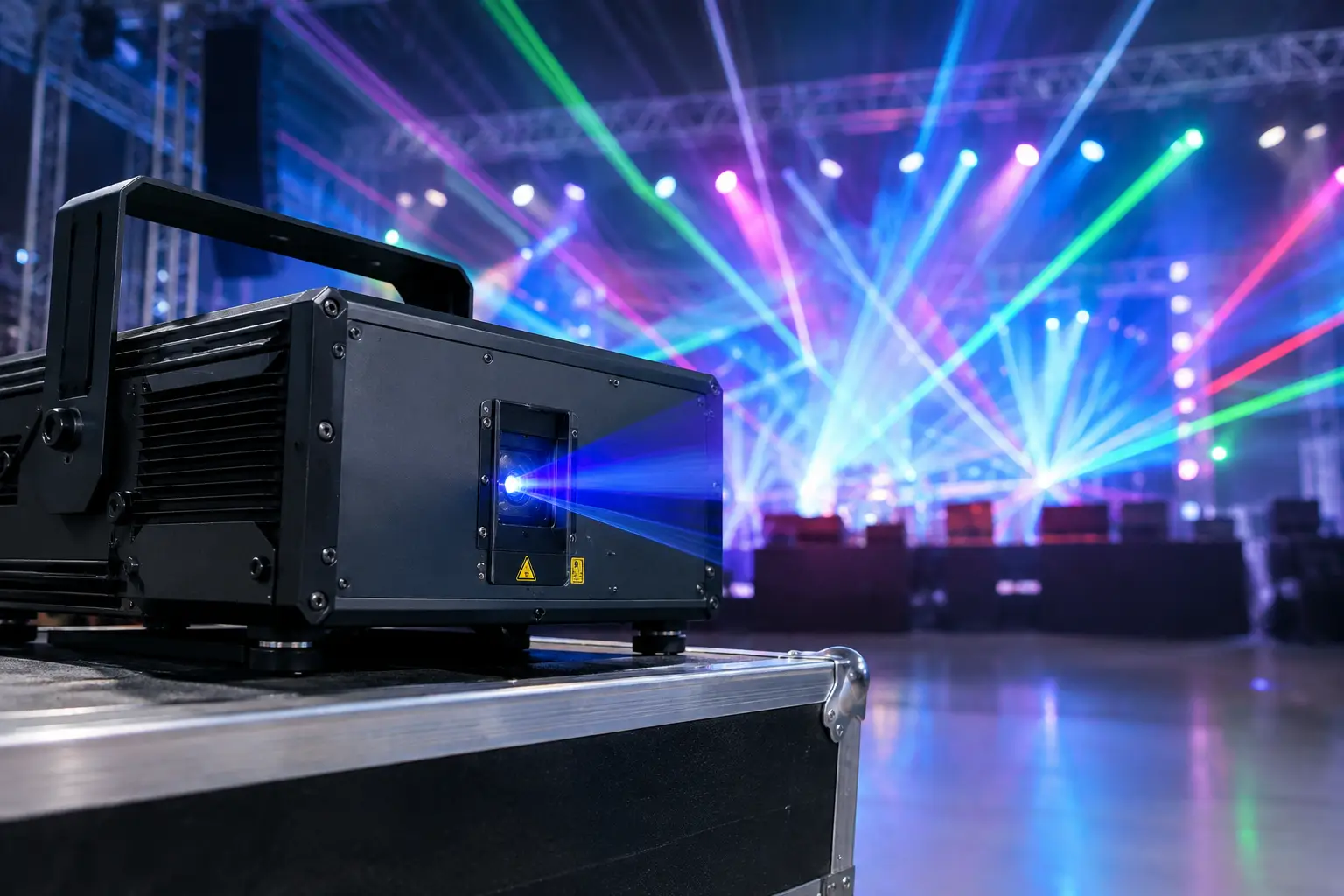
A professional laser equipment guide should begin with the moment your audience looks up, not a spec sheet. A laser system that fills a packed arena with razor-sharp color may be excessive for an intimate ballroom, while a projector that looks brilliant at a nightclub can disappear across a fairground field. The right choice creates pure visual magic: intense aerial beams, mind-blowing animations, and a synchronized visual pulse that makes the event feel larger than life.
For producers, venue teams, touring professionals, and buyers building permanent installations, the question is not simply how many watts to purchase. It is how the laser will perform in the real environment, with the intended sightlines, ambient light, programming demands, operating schedule, and safety requirements. That is where a professional system separates itself from a novelty effect.
Start With the Show, Then Select the System
A laser projector is part of a production ecosystem. It needs the right placement, haze or atmospheric support where appropriate, content, control hardware, power distribution, rigging strategy, and trained operation. Buying the highest-output unit without defining those conditions can lead to a costly system that never looks as powerful as it should.
Start by identifying what the show needs to accomplish. Are you creating a dramatic concert opener with towering aerial beams? Do you need crisp logo projection for a product launch? Is the goal an outdoor municipal celebration visible to thousands of people, or an immersive dance floor for a wedding or bar mitzvah? Each use case changes the equipment conversation.
Indoor productions often benefit from controlled lighting and haze, which lets beams read vividly at lower power levels. Outdoor events face a different challenge: distance, competing ambient light, weather planning, and large audience footprints. A system intended for stadium-scale spectacle must have the output, beam quality, and projection geometry to hold its presence over a much greater range.
Professional Laser Equipment Guide: Wattage Is Only One Variable
Wattage matters because it influences how much visible impact a projector can deliver, especially outdoors or across long throws. But wattage alone does not tell the full story. A well-engineered RGB projector with clean beam specifications, stable color balance, and precise scanning can outperform a higher-wattage system that produces a wide, uneven, or poorly aligned beam.
For many indoor parties, theaters, lounges, and smaller event rooms, a professionally deployed 40-watt-class system can produce a breathtaking visual spectacle when the room is properly designed. Larger concerts, festivals, sports presentations, and outdoor celebrations may call for 80 watts, 100 watts, 200 watts, or more, depending on throw distance and ambient conditions. There is no universal wattage threshold because room volume, projection distance, and desired effect all matter.
Beam divergence deserves close attention. In practical terms, lower divergence helps a beam stay tighter over distance, preserving intensity and definition. This becomes especially valuable for long-throw outdoor applications, arena rigging positions, and graphic projection where clean lines are part of the effect. Beam diameter at the aperture also contributes to the visual character of the system.
Color performance is equally important. A true professional RGB projector should deliver saturated red, green, and blue while producing smooth blends for vivid secondary colors. Poor color balance can make white look tinted, weaken certain graphics, or reduce the impact of a programmed sequence. When your show depends on color-changing cues synchronized to music or brand moments, consistency is not a minor detail.
Scanning Speed Determines What You Can Create
Aerial beam effects can look spectacular with relatively simple programming, but animated graphics demand more from the scanning system. Scanner speed and scan angle affect whether logos, text, geometric patterns, and custom artwork appear crisp, stable, and fluid.
For a branded launch, a laser logo is not just a logo. It is a high-energy reveal that must read cleanly from the intended audience position. For theatrical productions, the system may need to draw scenic elements and follow tightly timed cues. For touring acts, rapid, music-synchronized abstract content can become part of the performer’s visual identity. In these applications, projector power must be paired with scanners capable of handling the content you expect to run.
Ask how the system performs with your actual creative needs, not only with a static factory test pattern. A projector can be bright and still be the wrong fit if its scanning performance limits the animations, text, or intricate custom content your production requires.
Control and Content Turn Hardware Into a Show
The projector is the engine. The show is created through programming and control. Professional laser systems typically integrate with industry-standard control environments, allowing operators to time cues with music, lighting, video, and live event moments.
That integration matters when the room goes dark before a keynote entrance, when a headliner hits the stage, or when fireworks, lighting, and lasers need to land on the same beat. A laser cue that is late or disconnected from the rest of the production loses the impact that audiences remember.
For permanent installations, confirm how the system will be controlled day to day. A nightclub may need reliable repeatable cueing that staff can operate within a defined show file. A venue may need flexible integration with an existing lighting console. A touring package needs fast setup, predictable addressing, dependable connections, and equipment that can handle repeated transport.
Custom programming also changes the value equation. Prebuilt effects can provide energy, but custom content creates ownership. A city anniversary, university event, sponsor activation, or major brand reveal becomes more memorable when laser visuals are designed around the message rather than pulled from a generic effect library.
Safety Is Part of the Production Design
High-powered laser equipment is not a plug-and-play party accessory. It is specialized show technology that must be planned and operated responsibly. The same intensity that creates an unforgettable beam canopy also requires disciplined safety procedures, qualified personnel, correct placement, and compliance with applicable regulations.
A professional evaluation considers audience scanning restrictions, beam termination, projection zones, access control, mounting, electrical requirements, emergency shutdown capability, and local venue or jurisdictional requirements. Outdoor shows add further considerations, including aircraft awareness and site-specific operating conditions.
This is why a lower initial equipment price can be misleading. Professional operation includes the expertise to turn a powerful system into a controlled visual experience. Licensed, insured operators and safety-compliant planning protect the audience, the client, the venue, and the creative vision itself.
Purchase, Rental, or Turnkey Production?
The best path depends on how often you need lasers and how much in-house capability you have. A touring act, production company, venue, educational institution, or installation buyer may benefit from owning a professional RGB projector. Ownership gives you availability, creative control, and a system built around recurring needs.
For a one-time gala, wedding, municipal event, or product launch, turnkey production is often the smarter move. You gain properly matched equipment, custom programming, skilled operators, and a show plan without taking responsibility for storage, maintenance, logistics, or compliance. It also allows the system to scale precisely to the event rather than forcing the event to fit the equipment you own.
Connecticut Laser Productions works across both sides of that decision, from high-impact custom shows to professional Luminance RGB projector systems for buyers who need dependable hardware of their own. The practical advantage is perspective: equipment selection should be informed by real show conditions, not only by catalog specifications.
Questions to Ask Before You Commit
Before renting or buying, clarify the audience size, venue dimensions, throw distance, indoor or outdoor setting, ambient light levels, desired content, control integration, and whether atmospheric effects are allowed. Also ask who will install, program, operate, inspect, and maintain the system.
If a supplier cannot discuss beam quality, scanner performance, safety planning, and real-world deployment alongside wattage, keep looking. Professional laser equipment is a high-precision investment, and the strongest results come from matching the system to the experience you want people to feel.
The right laser setup does more than add color to an event. It gives the room a pulse, gives the crowd a reason to look up, and turns a scheduled gathering into the moment everyone talks about on the way home.
No responses yet