
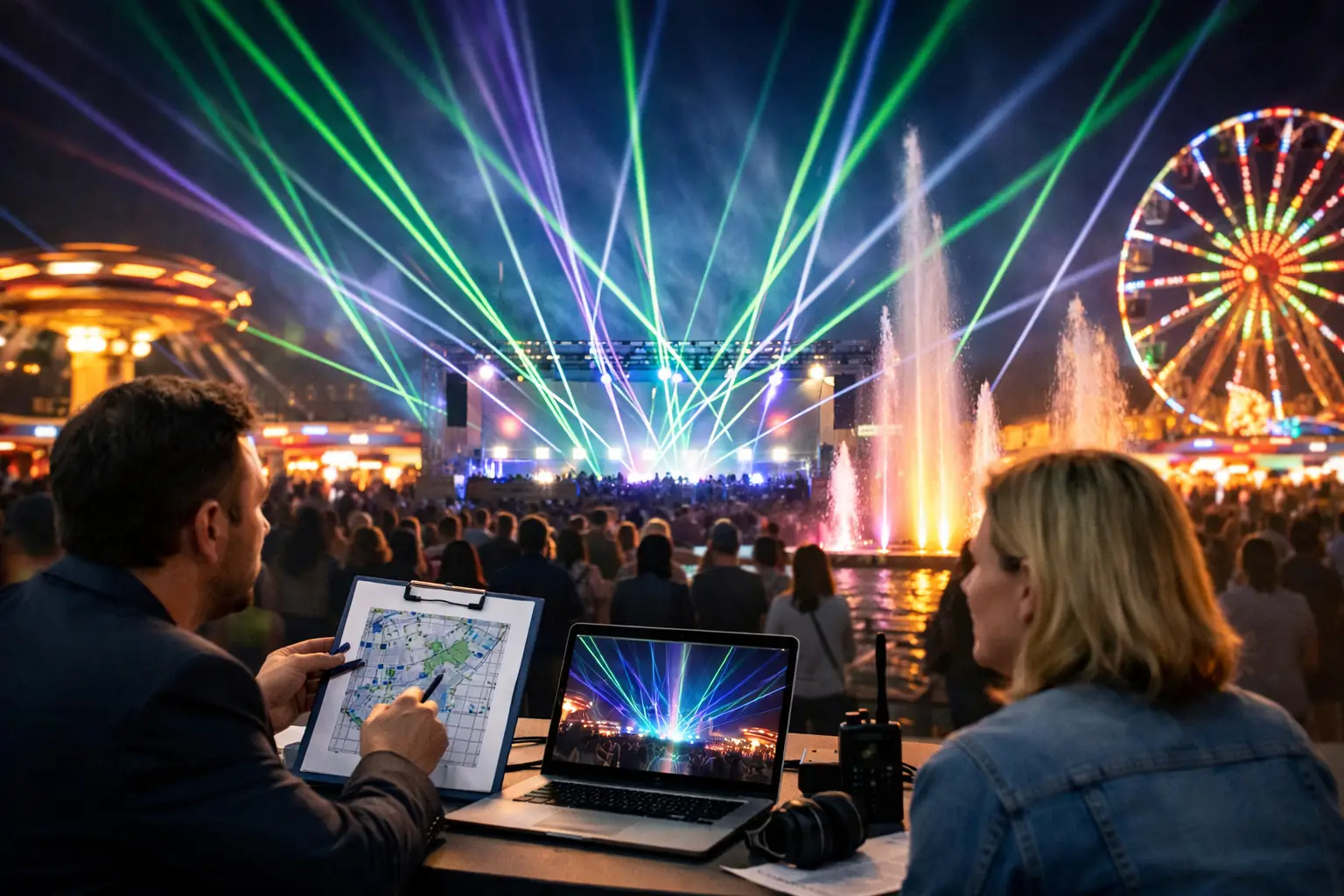
A great municipal fair laser show does more than fill the sky with bright beams. It gives families a reason to gather at the grandstand, turns a familiar fairground into a high-energy nighttime destination, and sends people home talking about the moment the entire crowd looked up at once.
For town fairs, city celebrations, agricultural expos, and waterfront festivals, a laser production can deliver the headline-scale impact people expect from fireworks while opening up creative possibilities that fireworks cannot match. Animated graphics, synchronized music, sponsor recognition, themed visuals, and dramatic color can all become part of one breathtaking visual spectacle. The result is not simply light in the sky. It is a custom show built around the identity of the event.
What Makes a Municipal Fair Laser Show Work
Municipal events bring together a wide audience. There are young children on the midway, longtime fair volunteers, local businesses, elected officials, concert fans, and visitors who may have never attended before. The show has to feel big enough to impress a crowd while remaining accessible, safe, and reliable in a live public setting.
That is why planning starts with the experience, not the projector. Is the laser show the finale after a national act? Is it designed to replace or enhance a fireworks program? Will it kick off opening night, celebrate a town anniversary, or draw visitors back to the fairgrounds after dinner? Those choices shape the music, runtime, viewing areas, effects, and system scale.
A 10-minute finale can be more effective than a longer show if every second is programmed with purpose. Big aerial beams establish scale. Rapid color changes create energy. Sweeping patterns draw attention across the field. Custom animations can reveal the fair logo, commemorate a milestone year, recognize local sponsors, or bring a community theme to life with pure visual magic.
The difference between an average display and a true crowd-stopper is timing. The strongest productions build anticipation before the first beam appears, hit major musical moments with precision, and end with a finale powerful enough to keep phones in the air and applause rolling.
Start With the Fairgrounds, Not a Standard Package
Every municipal fairground has its own challenges. A grandstand may offer a natural audience bowl, while an open midway can create multiple sightlines and competing ambient light. A waterfront location may have beautiful reflective surfaces but extra weather exposure. A historic town green may require careful placement that protects views, pedestrian flow, and nearby structures.
A professional site review identifies where the audience will stand, where the laser systems can be mounted, and how beams will travel through the space. It also considers trees, power availability, stage roofs, rides, vendor tents, roadways, and the locations of public safety personnel. These details are not production trivia. They determine how immersive and visible the show will be.
For a broad outdoor fairground, higher-powered RGB laser projectors can create bold aerial effects that stay visible across long distances. Connecticut Laser Productions deploys systems from 40 watts through 200 watts and beyond, allowing a production to be matched to the size and geometry of the venue rather than forcing a one-size-fits-all setup.
More power is not automatically better. A compact community fair with close viewing areas may need a carefully controlled system that delivers rich color and crisp animations without overwhelming the space. A large county fair or stadium-scale event may need multiple projectors, elevated positions, and broad beam coverage to create the visual impact the crowd expects. The right approach depends on the site, audience size, ambient lighting, and creative objective.
Choose a Viewpoint That Brings the Crowd Together
The best fair laser shows create a shared viewing moment. That usually means selecting a primary audience zone, such as the grandstand field, concert lawn, or a clear area facing the main stage. Guests can still see elements of the show from elsewhere on the grounds, but the main visual composition should reward people who gather in the intended viewing area.
This is especially valuable for organizers trying to manage traffic during a busy night. A scheduled finale can move people toward a central space, increase food and beverage activity beforehand, and create a natural rhythm for the evening. It can also give families a clear, memorable endpoint before they head home.
Build the Show Around Your Fair’s Story
A municipal fair does not need a generic light show. The strongest productions use laser technology to make the event feel unmistakably local.
A town celebrating its 250th anniversary can feature historic imagery, dates, and a final reveal of the town seal. A county fair can weave in agricultural themes, Ferris wheel-inspired movement, raceway energy, or a music sequence that reflects the local crowd. A festival with presenting sponsors can incorporate logos in a way that feels like part of the entertainment instead of a static ad on a screen.
Custom programming is where lasers become a true production medium. Professional RGB systems can render intense red, green, blue, and blended colors, creating everything from sharp geometric patterns to animated figures and branded artwork. When those visuals are synchronized to music, the effect is immediate: every beat has a visible counterpart in the air.
Music selection should fit the event and licensing plan. For some municipal fairs, an energetic all-ages soundtrack is the right call. For others, the laser sequence may be designed to complement a live band, tribute act, patriotic program, or cultural celebration. The pacing matters as much as the song choices. A show should rise, surprise, breathe, and then hit hard when the finale arrives.
Safety Is Part of the Spectacle
At a public event, safety is not a behind-the-scenes afterthought. It is fundamental to a professional laser show.
High-powered laser equipment demands experienced operation, compliant system design, controlled beam paths, and a clear understanding of the venue. Professional technicians assess audience locations, aircraft considerations, equipment positions, weather conditions, and the specific rules that apply to the event site. The production team should coordinate with fair management, local officials, venue personnel, and public safety teams well before show day.
This level of planning protects guests, staff, and the event itself. It also prevents the common failure points that can weaken a major finale: last-minute equipment placement changes, inadequate power, blocked sightlines, unclear access routes, or show control that has not been tested in the actual environment.
Licensed and insured operators bring more than paperwork. They bring the operational discipline needed to run an intense live spectacle with confidence. That includes secure mounting, cabling, backup planning, weather awareness, cueing, and active show supervision from first power-up through the final blackout.
Outdoor Conditions Need Real Planning
Outdoor events always involve variables. Rain, wind, humidity, haze, temperature shifts, and changing crowd patterns can affect production decisions. A capable laser team plans for these conditions rather than treating them as surprises.
Atmospheric haze can make beams look more dimensional and dramatic, but it needs to be used thoughtfully based on the venue and weather. Wind can influence haze distribution. Rain may require protective measures or a revised schedule. Ambient light from midway rides, vendor tents, and nearby streetlights may alter projector placement or the start time needed for maximum impact.
This is why an early site conversation is valuable. It gives the production team time to create a show plan that works in the real fair environment, not just on a drawing board.
Make the Laser Show a Featured Part of the Schedule
A laser show earns more attention when it is treated as a featured event instead of a last-minute add-on. Promote the start time on the fair schedule, announce it from the stage, include it in social messaging, and give guests a reason to stay for the finale. If it follows a concert, build a clean transition so the audience understands that the night is not over when the band leaves the stage.
For repeat annual fairs, the laser show can become a signature attraction. People begin to plan their visit around it. Sponsors see a premium visibility opportunity. Organizers gain a flexible visual platform that can evolve each year without repeating the same experience.
It can also work beautifully alongside fireworks, rather than replacing them. A laser pre-show can raise anticipation before the first shell launches, while a post-fireworks laser finale can keep the audience engaged after many guests assume the program is over. The right choice comes down to budget, venue rules, event goals, and the type of memory organizers want to create.
Plan Early Enough to Make It Feel Effortless
The most impressive show nights feel effortless to the audience because the hard work happened early. Once the date, site, main viewing area, and creative direction are clear, a production partner can begin designing a system that fits the fair rather than improvising around it.
Bring your fair’s biggest idea to the planning conversation: the anniversary, the music, the sponsor moment, the hometown pride, or the finale you want people to film from the midway. With the right design, technical team, and high-impact laser system, that idea can become the moment everyone waits for after dark.
No responses yet