
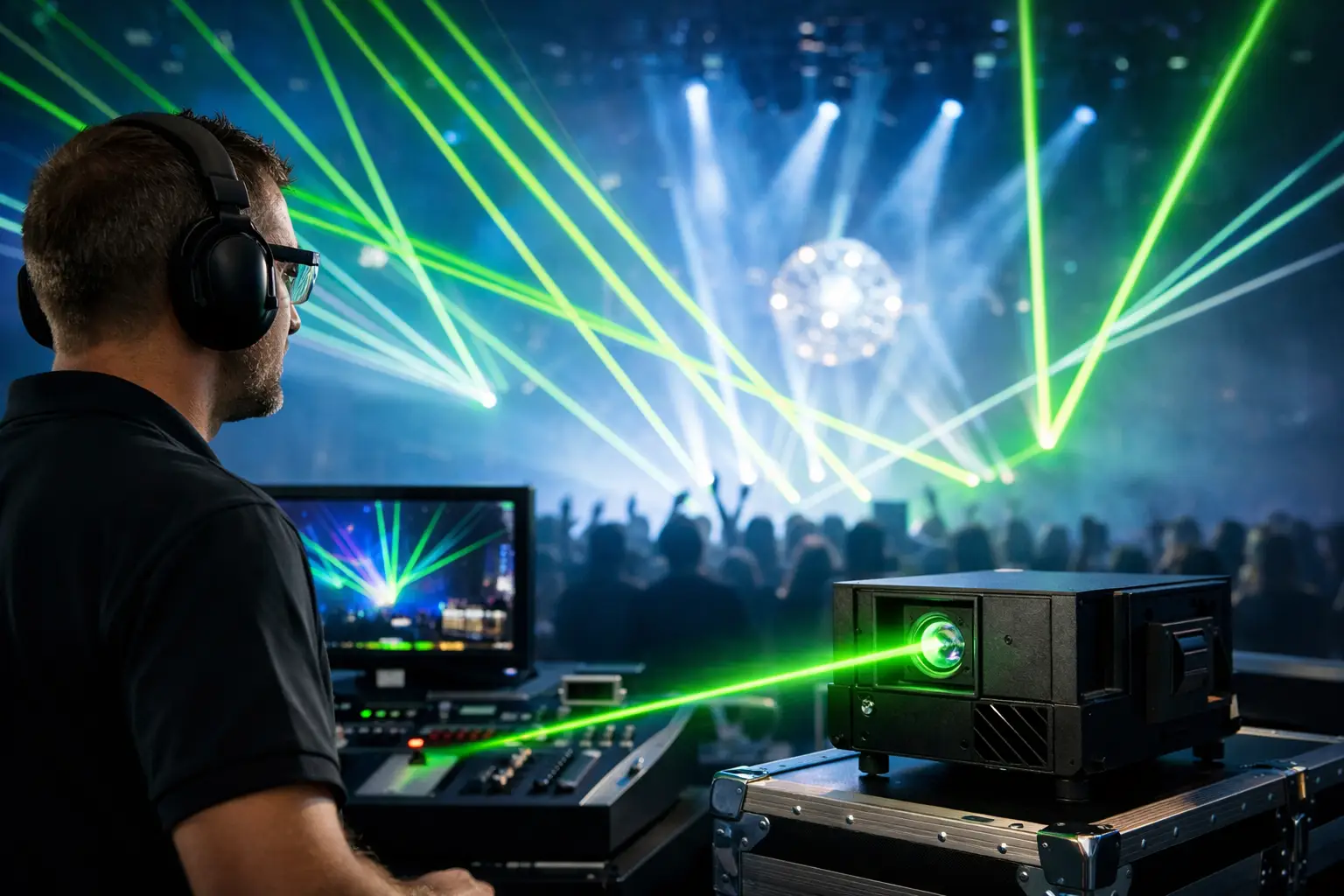
A laser show should feel enormous, electric, and completely effortless from the audience floor. That feeling is only possible when laser show safety is built into the production from the first creative sketch, not added as an afterthought once the beams are already programmed. The best shows create pure visual magic while protecting every guest, performer, crew member, and aircraft overhead.
For a wedding of 150, a packed nightclub, a city celebration, or a stadium audience of 80,000, the objective is the same: deliver maximum impact without putting a laser where it does not belong. That takes more than a powerful projector. It takes experienced operators, precise system design, compliant hardware, venue coordination, and real-time control.
Laser Show Safety Starts Before Load-In
A spectacular show begins with a clear understanding of the room, site, audience, and event schedule. Before a projector is mounted or a cue is programmed, a professional production team evaluates where people will stand, where performers will move, how high the trim can safely be set, and what reflective surfaces may change the risk profile.
That site survey matters because every venue behaves differently. A black-box theater may offer controlled lighting and predictable audience boundaries. A ballroom may have mirrors, glass, low ceilings, and moving decor. An outdoor festival may introduce wind, uneven terrain, nearby roads, drone activity, or airspace considerations. The same 40-watt, 100-watt, or 200-watt RGB laser system can create radically different design opportunities depending on those conditions.
The creative plan should follow the safety plan, not fight it. If the desired effect calls for huge fan patterns over a dance floor, the operator determines the proper projection zones, beam termination, mounting points, and scanning settings before the show is built. That allows the production to stay visually aggressive and immersive while maintaining controlled exposure levels.
Power Is Only One Part of the Equation
High-output laser projectors are extraordinary tools. Their saturated color, long throw, and razor-sharp aerial effects can fill an arena, transform a building facade, or turn a concert drop into a crowd-stopping moment. But wattage alone does not determine whether an effect is safe.
Beam diameter, divergence, scan speed, pattern shape, dwell time, projection distance, beam height, and audience position all affect the result. A static beam and a rapidly scanned graphic do not behave the same way. A tight, concentrated effect can carry energy over long distances, while a broad animated pattern distributes it differently. This is why professional laser design is a discipline, not a plug-and-play feature.
A qualified operator calculates and configures the show around the actual equipment and environment. They do not simply select a dramatic-looking preset and point it toward a crowd. They use tested projectors, appropriate optics, controlled scanning, physical masking where required, and show cues designed for the approved projection area.
For buyers considering a professional laser projector for touring, installation, education, or production work, this distinction is critical. A powerful RGB projector is capable of breathtaking results, but it must be matched with trained operation, proper control systems, safety hardware, and a clear understanding of applicable requirements. More power expands creative range. It also raises the standard for responsible use.
Audience Scanning Requires Specialized Expertise
Few effects generate a bigger reaction than beams that appear to surround the audience. Done correctly, audience scanning can make a room feel alive with color and motion. Done casually, it can create unacceptable risk.
Audience scanning is not a default setting and should never be treated as a party trick. It requires a specific safety analysis that considers projector output, scan pattern, distance, exposure duration, the position of every potential audience area, and the safety standards that apply to the event. It may be appropriate for one design and not for another.
There are also practical trade-offs. Keeping all beams above the audience can simplify the operating environment while still delivering enormous scale, especially with haze, fog, scenic surfaces, and synchronized music. For some events, that overhead approach is the smartest path to a jaw-dropping show. For productions that call for a more enveloping look, specialized design and qualified supervision become even more essential.
The right question is not, Can we put lasers over the crowd? The right question is, What effect creates the biggest possible moment within a professionally engineered safety plan?
The Venue Is Part of the Safety System
Laser safety does not live inside the projector alone. The venue team, event planner, production manager, lighting department, and security personnel all influence how smoothly the show operates.
Projectors need secure mounting, stable power, protected cable paths, and controlled access. A unit mounted on a truss, tower, balcony, or rooftop must remain mechanically secure throughout the event. No guest, vendor, or performer should be able to bump a stand, cross into a controlled backstage area, or interfere with the beam path.
Reflective objects deserve special attention. Mirrors, chrome decor, polished metal, glass walls, water features, and even certain scenic materials can redirect light in unexpected ways. A professional survey identifies those surfaces early so the show can be adjusted before doors open. Sometimes the answer is masking or a slight repositioning. Sometimes it is a different cue design. The audience never needs to see that decision-making process. They simply see a show that looks intentional, clean, and massive.
Atmospherics also matter. Haze and fog make laser beams visible in the air, which is central to the full-sensory laser experience. Yet density, airflow, fire-alarm coordination, ventilation, and sightline needs must all be managed. Too little atmosphere can flatten the visual impact. Too much can obscure exits, performers, or video content. The strongest productions tune these elements together during rehearsal and throughout the event.
Outdoor Laser Shows Add Airspace Planning
Outdoor laser productions can create some of the most memorable visual moments in live entertainment. Beams sweeping across a fairground, festival field, waterfront, or stadium sky can turn a major public gathering into an unforgettable spectacle. Outdoor environments also require additional planning.
When laser energy could enter navigable airspace, the production must address aviation safety and applicable federal requirements well before event day. Depending on the design, location, and projector output, that can involve regulatory documentation, coordination, operating restrictions, or designated shutdown procedures. These are not details to solve from the production trailer an hour before gates open.
Weather is another real factor. Rain, wind, temperature, and airborne dust can affect equipment placement and show visibility. A professional outdoor plan includes weather protection, secure structures, alternate cues, and a clear decision path if conditions change. Great production is not pretending weather does not exist. It is having a show that can adapt without sacrificing safety or momentum.
Why Trained Operators Make the Difference
The person at the laser console is as important as the projector itself. Professional operators understand creative programming, optical behavior, safety boundaries, equipment inspection, and event communication. They know when to hold a cue, reposition an effect, reduce output, or stop a show because a condition has changed.
This experience is especially valuable in fast-moving events. A performer may leave the planned stage area. A lift may rise into a projection zone. A venue may open a previously closed balcony. A haze machine may push atmosphere in an unexpected direction. These moments require an operator who is watching the environment, not just pressing play.
Connecticut Laser Productions approaches every show as both a visual performance and a controlled technical operation. Licensed and insured professionals, compliant systems, custom programming, and two decades of production experience allow the team to scale from intimate celebrations to major public events without losing the precision that keeps the experience on track.
Questions to Ask Before You Book
Event planners and venue teams do not need to become laser engineers, but they should expect clear answers from any laser provider. Ask who will operate the system on site, whether the design includes a venue survey, how the company addresses applicable safety requirements, and what happens if weather or event conditions change.
Also ask about the exact effect you want. A supplier should be able to explain whether it is appropriate for your location, audience layout, and schedule rather than promising every visual idea without qualification. The most credible answer is sometimes a better alternative: an elevated fan, a building projection, a stage-focused sequence, or a timed finale that delivers even more impact with a cleaner operating plan.
When the lights drop and the first color slices through the haze, guests should be thinking about the music, the energy, and the moment they will talk about tomorrow. Leave the calculations, controls, and safeguards to the professionals who know how to make that WOW factor shine at full power.
No responses yet