


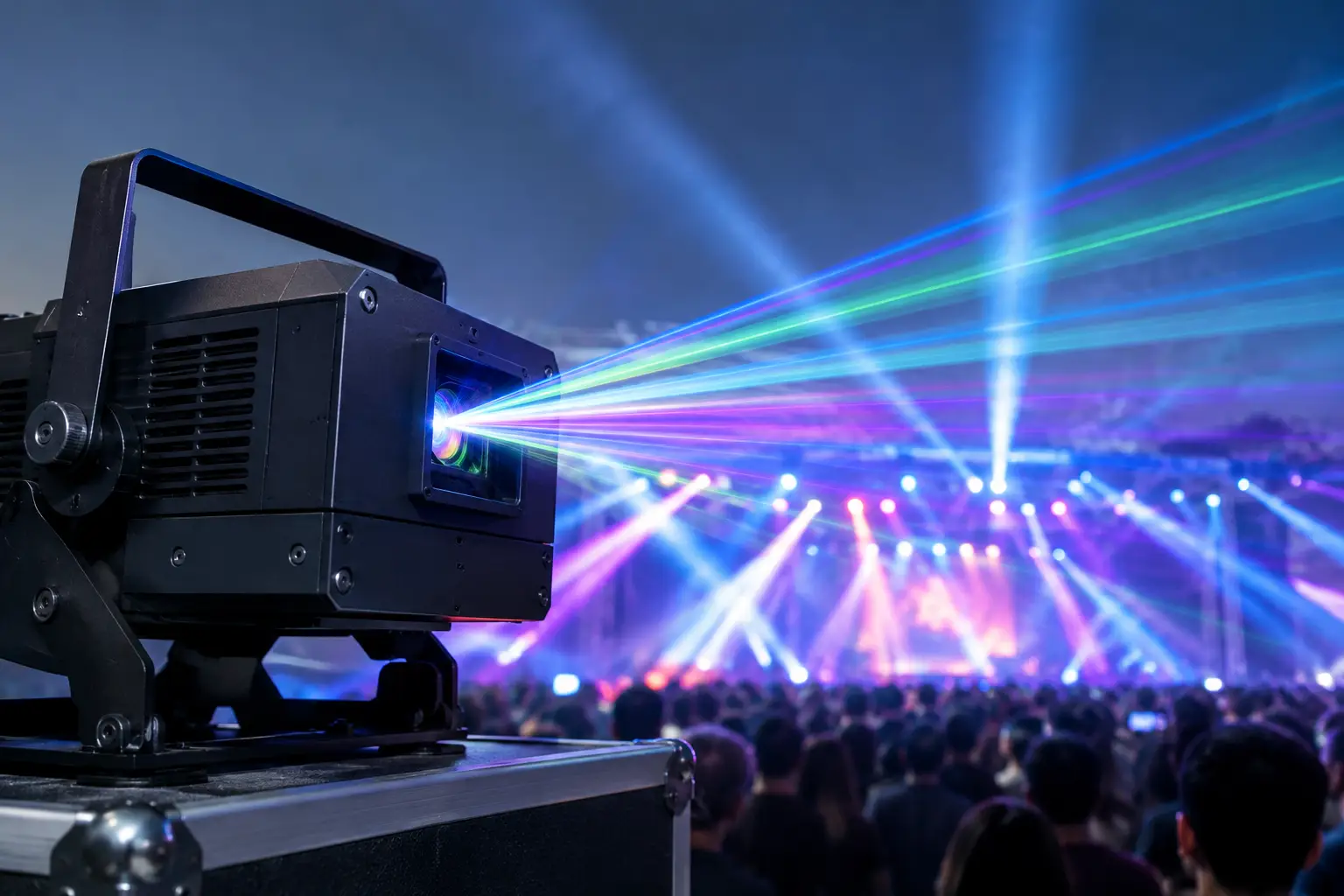
A laser beam can cross a ballroom, fill a concert arena, or paint a city skyline with pure visual magic. But the audience only sees the finished spectacle. Behind every breathtaking cue, animated logo, and music-synced aerial effect is laser hardware engineered to deliver color, speed, reach, and control without compromise.
For event planners, touring professionals, venue operators, and buyers building permanent systems, the right equipment is not simply about buying the highest wattage available. It is about choosing a complete laser platform that fits the room, the viewing distance, the creative objective, and the safety requirements of the production. When those pieces align, laser becomes more than lighting. It becomes the moment people remember.
What Professional Laser Hardware Actually Does
Professional laser hardware is the working engine behind a live laser show. A projector generates red, green, and blue laser light, combines those sources into a full RGB color palette, and sends the beam through precision scanning systems that create shapes, text, graphics, and sweeping aerial effects.
That explanation sounds straightforward. The real performance comes down to how well each component works under show conditions. A projector must reproduce vivid color at distance, hold its alignment through transport and operation, respond accurately to programming, and manage heat during demanding runs. It also needs to integrate with control systems, safety devices, and the physical realities of the venue.
A lower-powered unit may create an impressive effect in a dark club with haze and a tightly controlled audience area. That same projector can disappear in a large outdoor festival field, a brightly lit arena, or a stadium packed with tens of thousands of people. Scale changes everything.
Wattage Sets the Starting Point, Not the Whole Story
Wattage matters because it determines how much visible output a projector can deliver. More output generally means a beam can remain bright over longer throw distances, compete with ambient light, and create stronger aerial effects in bigger environments.
For a private celebration or indoor theatrical setting, the ideal system depends on ceiling height, room size, lighting levels, haze availability, and where guests will be positioned. For a municipal event, major concert, sporting presentation, or outdoor spectacular, systems in the 40-watt to 200-watt range and beyond may be required to create the commanding visual presence the event demands.
Still, wattage is not a shortcut to a great show. A powerful projector with poor color balance, weak scanning, improper placement, or no atmospheric support will not create the impact of a well-designed system. The goal is not to chase a number. The goal is to make every beam read with intensity where the audience is actually looking.
Color Balance Creates the Emotional Impact
RGB laser systems mix red, green, and blue sources to produce a wide range of colors. That is what makes laser shows feel alive: saturated blue tunnels, electric green fan effects, rich magenta graphics, and full-color animations that hit on the beat.
Not all RGB systems render color the same way. Source quality, modulation performance, optical alignment, and projector calibration affect whether colors appear clean and vibrant or uneven and washed out. For branded events and product launches, accurate color reproduction can be especially valuable when corporate marks, product shapes, or signature colors are part of the visual story.
The difference is visible. A balanced projector can move from a sharp white logo to a deep blue aerial sequence and then burst into multicolor graphics without losing the punch that makes laser so unforgettable.
Laser Hardware for Different Event Scales
The best laser system is designed around the event, not pulled from a one-size-fits-all inventory list. A wedding, nightclub, touring concert, and waterfront Fourth of July production may all use RGB laser projectors, but the production choices should be completely different.
For an intimate indoor event, controlled beam effects, elegant graphics, and a few well-timed moments may be more effective than filling every inch of the room. The hardware needs to be compact, quiet enough for the environment, and positioned to create excitement without overwhelming the space.
For concerts and festivals, speed and visual density often take priority. Fast scanners, high-output projectors, multiple beam positions, and tightly synchronized programming can turn a stage into a high-energy visual machine. Laser works particularly well when it is programmed as part of the entire production, responding to musical drops, transitions, artist entrances, and crowd-building moments.
Outdoor events introduce another layer of planning. Throw distance, ambient light, weather exposure, projector mounting, power distribution, and sightlines all affect the design. A large-scale show may need elevated positions, long-range optics, weather-conscious deployment, and enough output to remain visible against urban lighting or twilight conditions.
For permanent installations, reliability and access matter just as much as show impact. A nightclub, entertainment venue, attraction, educational facility, or branded environment needs hardware that can be properly mounted, serviced, integrated into a control workflow, and operated by trained personnel. The best installation is one that creates a powerful experience night after night without becoming a maintenance problem.
The Components That Separate a Show System From a Gadget
A laser projector is only part of the picture. Professional results depend on an entire system built for precision.
High-quality scanners determine how quickly and accurately the beam can draw graphics and animations. Slow or poorly tuned scanners can make text flicker, distort shapes, or limit the complexity of the content. For aerial beam shows, scanning performance affects the fluidity of fans, cones, tunnels, and kinetic patterns that make a room feel as if it is moving.
Optics influence beam quality over distance. Beam divergence, alignment, and lens selection determine whether a laser line stays tight and intense or spreads too quickly as it travels. This matters enormously in arenas, outdoor events, and installations where the audience may be hundreds of feet from the projector.
Control hardware and software provide the creative command center. They allow programmers to synchronize cues with music, trigger custom content, map effects to stage positions, and build shows with precise timing. The visual spectacle may feel spontaneous to the crowd, but it is usually the result of detailed programming and careful rehearsal.
Atmospheric effects also deserve consideration. Haze gives laser beams a surface in the air, transforming an invisible path into a three-dimensional architectural element. Without it, graphics may still look sharp on a screen or building, but aerial beams will have far less presence. The right amount depends on the venue, ventilation, event rules, and desired look.
Safety Hardware Is Part of the Creative Plan
High-powered laser systems are not consumer toys. They require professional design, proper placement, compliant operation, and a clear understanding of audience scanning limitations, aircraft considerations, venue conditions, and applicable regulations.
Safety features can include key switches, emission indicators, remote interlocks, emergency-stop systems, scan-fail protection, secure mounting hardware, and controlled beam zones. Those are not extras added after the creative conversation. They are fundamental parts of a professional laser production.
A capable laser team evaluates sightlines before show day, identifies safe projector positions, considers reflective surfaces, and plans effects around the audience rather than forcing a preset look into an unsuitable room. Licensed and insured operators bring technical discipline to the spectacle, allowing the production to feel fearless because the planning behind it is precise.
This is especially important for public events, concerts, sporting presentations, and outdoor shows. The bigger the audience and the more ambitious the effect, the more valuable experienced supervision becomes. Safety compliance protects the guests, the client, the venue, and the future of the event itself.
Buying Equipment or Booking a Full Production
There are two smart ways to bring professional laser impact to an event or venue. One is to purchase the right projector system for an in-house team, touring package, or permanent installation. The other is to book a turnkey production that includes equipment, custom programming, deployment, operation, and teardown.
Equipment ownership makes sense for organizations with trained operators, frequent use cases, and a clear maintenance plan. Buyers should look beyond initial output specifications and ask about color performance, scanner quality, control compatibility, cooling, serviceability, housing design, and safety integration. A projector that looks impressive on a spec sheet should also be dependable after repeated transport, long show days, and real-world setup conditions.
Turnkey production makes sense when the priority is the finished experience. Connecticut Laser Productions combines professional Luminance RGB laser systems with custom show design and experienced operation, scaling from private celebrations to stadium-scale events. That approach gives clients one accountable production partner from the first creative idea through the final blackout.
The strongest laser experiences begin with a simple question: what should the audience feel when the room goes dark? Start there, then let the hardware, programming, and production design build the color, energy, and unforgettable WOW factor around that moment.
No responses yet