
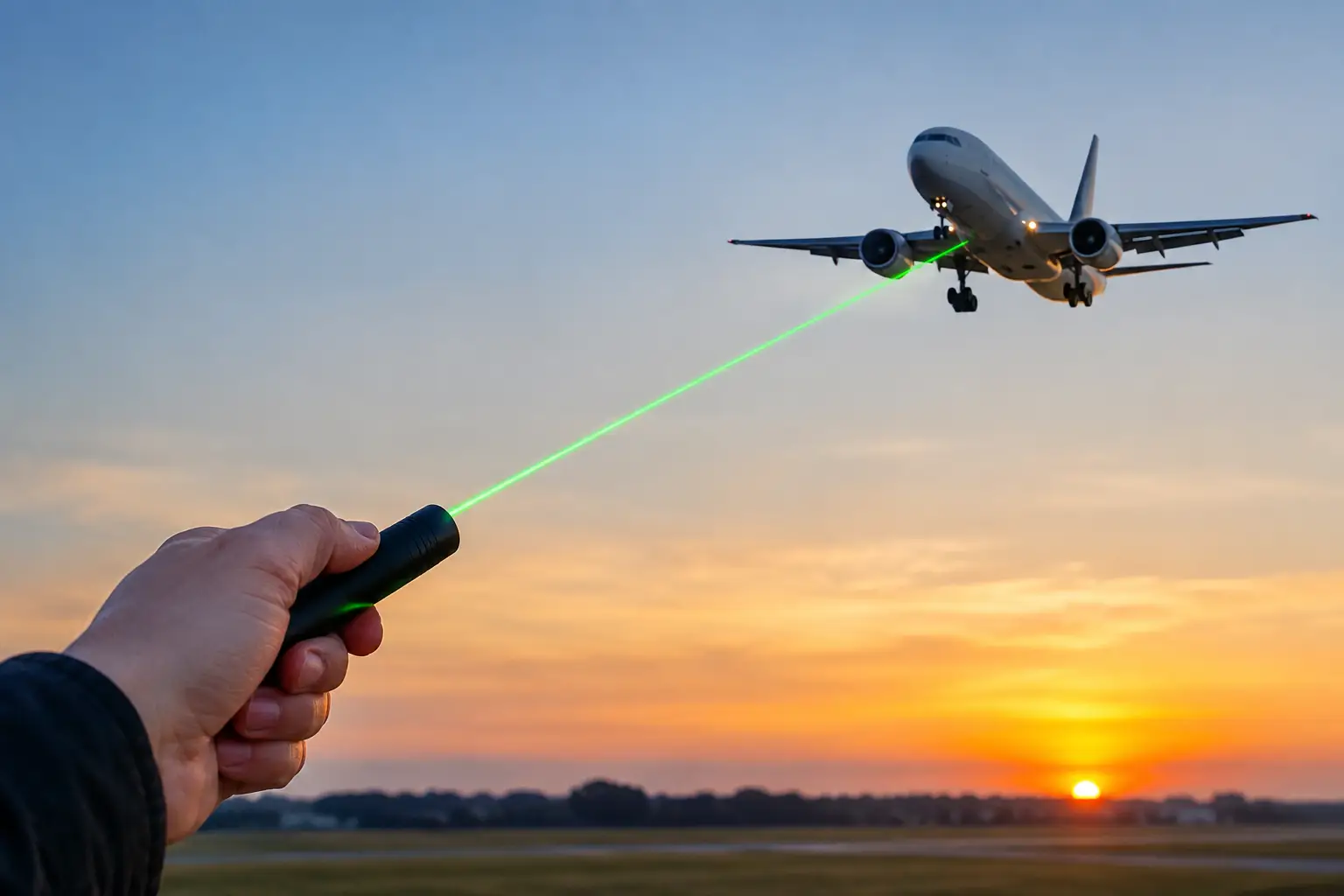
A stadium-ready laser beam can turn haze, music, and motion into pure visual magic. But when that beam reaches open sky, the question changes fast: are lasers safe near aircraft? They can be, but only when the show is designed, reviewed, and operated around airspace safety from the first creative conversation.
A laser projector is not just another lighting fixture. High-powered RGB systems can produce exceptionally bright, tightly focused beams that remain visible over great distances. That is exactly what makes a laser show so breathtaking. It is also why outdoor laser production near aircraft demands professional planning, engineered controls, and operators who understand where spectacle ends and aviation safety begins.
Are Lasers Safe Near Aircraft? Only With Real Controls
Lasers are not inherently unsafe near aircraft. An uncontrolled beam, a poorly positioned projector, or a last-minute outdoor setup without airspace review can create a serious risk. The difference is planning.
Pilots depend on clear vision during every phase of flight, especially takeoff, landing, emergency response, and low-altitude operations. A laser aimed into navigable airspace can cause distraction, glare, temporary visual interference, or flash effects. Even if a beam does not cause an eye injury, a momentary disruption inside a cockpit is unacceptable.
That is why professional laser safety is not based on a crew member simply looking up and deciding the sky appears clear. It starts with the venue location, surrounding airports and heliports, event date and time, beam directions, projector power, beam divergence, scan patterns, audience areas, and the physical limits of the show site.
For an event producer, the practical answer is straightforward: never treat an outdoor laser effect as a plug-and-play add-on. A serious show provider evaluates whether an airspace-safe design is possible before promising skyward beams, wide exterior looks, or large-scale outdoor effects.
Why Aircraft Can See a Laser From Far Away
A laser beam can look like a crisp line of color above a concert, fairground, or wedding venue. From an aircraft, that same beam may be visible from much farther away than people on the ground expect. Atmospheric haze, humidity, dust, and smoke can make the beam appear even more dramatic for an audience, while also increasing its visibility at distance.
Power matters, but it is not the only factor. Beam diameter, divergence, scanning speed, projector elevation, aiming angles, terrain, building obstructions, and the number of projectors all affect the risk profile. A 40-watt system and a 200-watt system are not interchangeable production tools, yet neither should be evaluated by wattage alone.
The key question is not, “Can we make the beams bigger?” It is, “Where can every beam travel under every expected operating condition?” That includes normal show cues, test patterns, unexpected weather changes, and the possibility of aircraft entering the area.
Helicopters deserve particular attention. Medical, law-enforcement, news, utility, and private helicopters can operate at lower altitudes and follow routes that differ from commercial airline traffic. A venue that seems distant from a major airport may still be near active helicopter operations or other aviation activity.
Professional Airspace Planning Happens Before Show Day
The most successful laser productions make safety part of the creative design, not a restriction added after the show has been programmed. If a client wants an enormous outdoor moment, an experienced production team can often create the impact through properly contained aerial looks, architectural projection, surface effects, choreographed scanning, or audience-safe indoor environments.
Before an outdoor production moves forward, the laser provider should evaluate the site and determine what coordination, notifications, approvals, or operational restrictions may apply. In the United States, the FAA has processes for reviewing outdoor laser operations that could affect navigable airspace. Requirements can vary significantly based on the location, equipment, intended beam use, and proximity to aviation activity.
That review takes time. It should never be left until the week of the event, much less the afternoon of load-in. A municipal celebration, waterfront festival, stadium concert, or outdoor brand launch may involve multiple stakeholders, including venue management, local public safety teams, airport personnel, event security, and production leadership.
A credible laser company does not promise a specific sky effect before the site has been evaluated. The best answer may be a fully approved design. It may also be a modified design that keeps the energy below defined boundaries. In some locations, the right answer is to keep the laser show indoors or eliminate exterior aerial effects entirely.
That is not a compromise in production value. It is precision engineering applied to the show.
What Safe Laser Operation Looks Like at an Event
The audience sees sweeping color, mind-blowing animations, and music-synchronized movement. Behind that experience should be a disciplined operating plan.
A professional setup begins with correctly selected equipment, secure mounting, and carefully defined projection zones. Projectors are positioned so intended beams remain within approved areas and are not allowed to drift toward uncontrolled airspace. Physical beam blocks, termination surfaces, software zones, scan-fail safeguards, keyed access, emergency stops, and real-time operator oversight all play distinct roles.
For audience scanning, the standard is even higher. Effects that pass over guests require specialized calculations, tested equipment, conservative exposure limits, and operators who understand laser safety standards. A packed dance floor, an intimate wedding reception, and a festival crowd of 80,000 each present different geometry, sightlines, and risk factors. There is no universal setting that makes every setup safe.
During an outdoor event, trained operators also need clear authority to pause or alter cues when conditions change. If aircraft activity, weather, crowd movement, equipment behavior, or a site change creates uncertainty, the show effect stops. That decision protects guests, crews, the event organizer, and everyone in the airspace above.
The Biggest Mistakes to Avoid
The most avoidable problem is assuming that a laser pointer, DJ laser, rental fixture, or purchased projector can be used outdoors like a searchlight. It cannot. Aiming any laser at an aircraft is dangerous and illegal. Intentionally illuminating aircraft can lead to severe consequences, and “we did not know it was visible that far away” is not a safety plan.
Another mistake is confusing a projector’s product label with a complete event safety strategy. Professional laser equipment can be an extraordinary creative tool, but it still requires correct installation, programming, maintenance, and operation. Buying more wattage does not buy more expertise.
Event teams should also avoid waiting until the visual design is locked before involving a laser professional. If outdoor lasers are central to the event concept, bring the production partner in during venue selection and early site planning. That creates more options, cleaner approvals, and a more polished final show.
Finally, do not rely on unqualified personnel to make airspace decisions during the event. A person with a radio, a clear view of the sky, or familiarity with concert lighting is not automatically qualified to operate high-powered lasers near aviation activity.
How to Build a Big Visual Moment Without Creating Airspace Risk
A smart production partner does not respond to safety limits with a flat “no.” They redesign the moment around what the venue can support. A nighttime exterior can still feel massive with building projection, laser effects contained by structures or scenic elements, bold architectural color, synchronized lighting, video, pyrotechnic alternatives where permitted, and a finale that uses music and timing to create genuine audience awe.
Indoors, the creative palette often expands. Ballrooms, arenas, theaters, nightclubs, and temporary event structures can provide controlled surfaces and predictable sightlines for immersive beam choreography. The result can feel more intense than an open-sky effect because the visual energy is concentrated around the audience.
For large public events, scale also comes from design discipline. A well-programmed 40-watt system in the right environment can outperform a much larger projector used without purpose. At the other end of the spectrum, 100-watt, 200-watt, and higher-output systems can create jaw-dropping stadium and festival visuals when deployed by experienced crews within a compliant plan.
Connecticut Laser Productions approaches every show with that balance in mind: maximum visual impact, precise engineering, and professional operation built for the real conditions of the event.
Questions to Ask Before Booking Outdoor Lasers
Ask your provider whether they will evaluate the venue for nearby airports, heliports, and likely low-altitude aviation activity. Ask how they handle required FAA coordination and whether the desired look may need to change after site review. Ask who will operate the system, what safety systems are included, and who has authority to stop the effect if conditions demand it.
You should also ask whether the vendor is properly insured and experienced with your event scale. A backyard celebration, city fireworks night, touring concert, and corporate launch all deserve a custom plan. The goal is not merely to check a box. It is to create a show that looks intentional, powerful, and fully under control.
The right laser design does more than fill the sky with color. It gives your audience the rush of a once-in-a-lifetime visual spectacle while keeping every beam exactly where it belongs.
No responses yet