


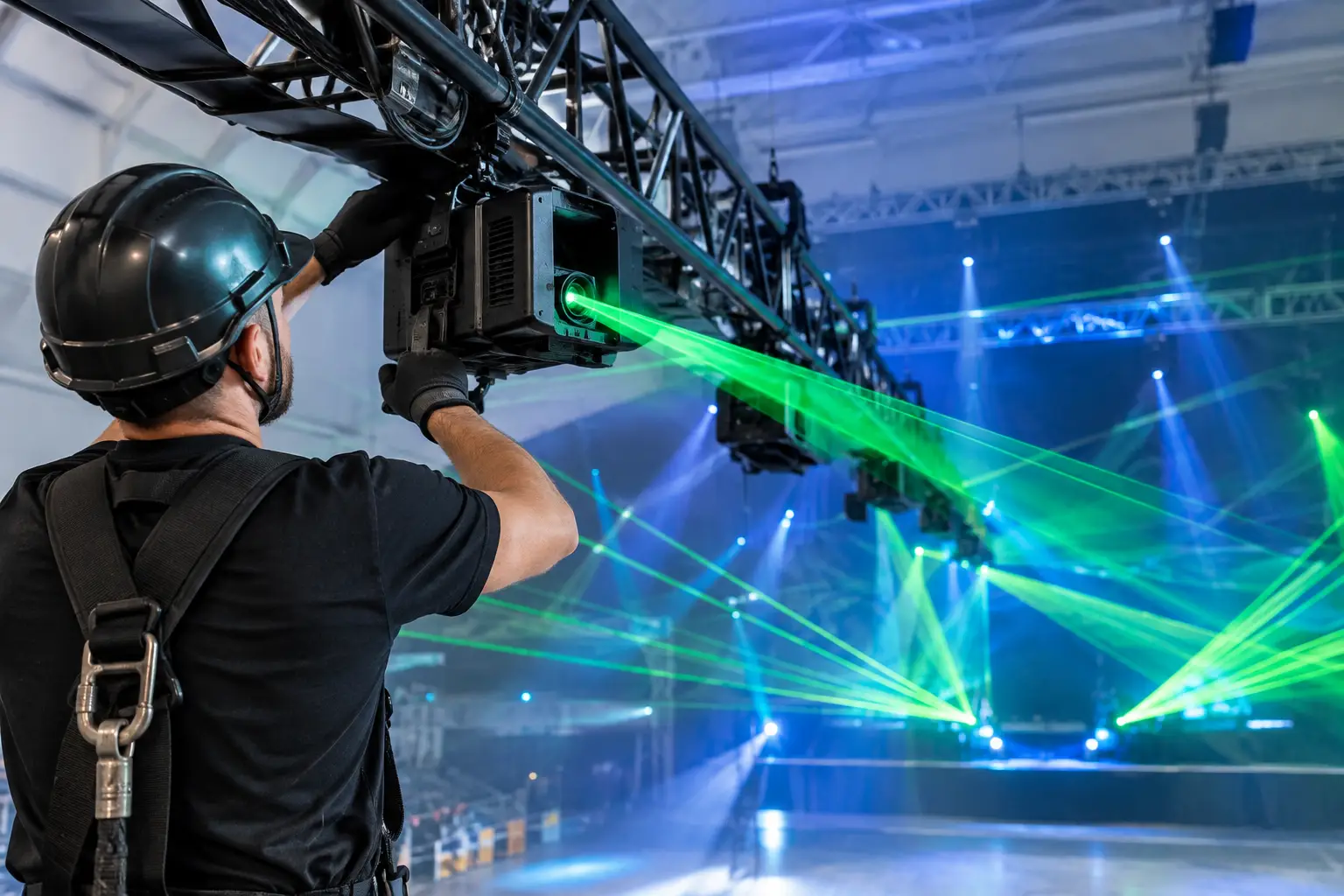
A laser show can turn a dark room, arena floor, or outdoor stage into pure visual magic. But the moment a projector leaves the ground and goes into the air, the production becomes a rigging, safety, sightline, and engineering conversation. This venue laser rigging guide helps planners, venue teams, and production managers ask the right questions before the first brilliant RGB beam fires.
The goal is not simply to hang laser equipment high enough to look impressive. The goal is to create a breathtaking visual spectacle that reaches the audience, supports the show design, protects performers and guests, and remains stable from doors through load-out. A well-rigged laser system feels effortless to the crowd. Behind that moment is precise planning.
Start With the Show, Not the Hang Point
A truss location is not automatically a laser location. Before selecting projector positions, define what the audience needs to see. Are you creating aerial beam effects above a concert crowd? Projecting animated logos onto a building facade? Building a high-energy nightclub canopy? Filling a stadium with wide fan effects during a walk-on moment?
Each objective changes the rigging plan. Aerial beams often benefit from elevated positions that can sweep across haze above the audience without creating unwanted obstructions. Graphic projection needs a clean, stable line to a screen, wall, stage deck, or scenic surface. A product launch may call for discreet projector placement that preserves a polished corporate environment while delivering a huge reveal.
Start with the room dimensions, stage location, audience footprint, ceiling height, trim height, obstructions, and camera positions. Then consider the creative direction: beam looks, graphics, color cues, music synchronization, and whether the lasers need to play with moving lights, video, pyrotechnics, or scenic elements. Rigging supports the creative, not the other way around.
Evaluate the Venue Before Designing the Laser Rig
A site visit can prevent expensive compromises later. Photos and CAD drawings are useful, but they do not always reveal low trusses, hidden HVAC ducts, uneven catwalk access, reflective surfaces, or a balcony that creates a difficult sightline.
Identify structural and production points
The venue must confirm which points are approved for suspended loads and what those points can carry. Laser projectors, mounting hardware, safety bonds, cabling, network accessories, and any supporting truss all contribute to the load calculation. Never assume an existing lighting pipe, decorative beam, or house truss is suitable just because it is overhead.
A professional rigger should evaluate point loads, span loads, attachment methods, and the condition of the structure. If a projector needs to be located where no approved point exists, ground support, a purpose-built tower, or another engineered solution may be safer and more effective.
Check access and aiming practicality
A perfect position on paper is useless if technicians cannot safely reach it for installation, alignment, inspection, and removal. Ask how the crew will access the point: lift, ladder, catwalk, roof access, or flown truss pre-rig. Also account for the time needed to aim and test the system after it is installed.
Laser projectors require deliberate orientation. A few degrees of adjustment can change where a beam terminates, whether an effect clears scenic pieces, and how well graphics read across the room. Build access into the schedule rather than treating alignment as an afterthought.
Build Safety Into Every Layer of the Design
High-powered entertainment lasers are not casual plug-and-play fixtures. A 40-watt, 100-watt, or 200-watt RGB system can create extraordinary impact, but that power demands qualified operation, controlled beam paths, and compliant procedures.
The production plan should identify laser hazard zones, audience areas, performer locations, operator position, projector locations, and the intended termination of every effect. It should also address reflective surfaces such as mirrors, polished metal, glass, water, chrome décor, and LED walls. A reflected beam can introduce risk or disrupt a carefully programmed look.
A properly designed show accounts for scanner-failure protection, emergency-stop systems, physical security, safety interlocks, secure safety bonds, and cable management. It also considers what happens when a performer steps onto a riser, a scenic wall moves, or a venue changes seating layouts after the initial design approval.
The exact requirements depend on the jurisdiction, venue, laser classification, show design, and applicable federal, state, and local rules. Work with licensed, insured laser professionals and qualified riggers who understand the relevant safety standards and permitting process. Safety is not a visual compromise. It is what gives a production the confidence to go bigger.
Choose Height and Angle for Impact, Not Just Clearance
Higher is not always better. A projector placed too high can flatten beams against the ceiling, reduce the sense of immersion, or make graphics difficult to see. Too low, and it may compete with performers, create troublesome sightlines, or limit the available safety envelope.
For concert and festival environments, a common design strategy is to position projectors at elevated side-stage, upstage, or front-of-house locations. This can create broad aerial architecture across the room while preserving a clean visual frame around the artist. In theaters, balcony rails and box booms may offer valuable angles, provided they are structurally suitable and the beam paths are professionally reviewed.
Outdoor shows add another layer. Wind, weather protection, tower stability, long throw distances, and ambient light all influence placement. A projector that creates incredible beams in a dark club may need substantially more output, a different lensing choice, or a new location to command attention at a municipal fair or stadium event.
Plan for Power, Data, and Redundancy
Rigging is only one part of the infrastructure. Every flown laser position needs reliable power, protected signal distribution, and a clean cable route that does not create a safety issue or visual distraction.
Confirm the projector’s electrical requirements early, especially when multiple high-output units share a truss or remote distribution point. Separate circuits, appropriate power distribution, and verified grounding help prevent nuisance shutdowns during a critical cue. Avoid running laser control alongside sources of interference without a deliberate signal plan.
For networked control, identify cable paths, switch locations, wireless limitations, and backup options before the room fills with scenic, audio, and lighting infrastructure. In larger productions, redundant control paths and spare equipment can be the difference between a minor service adjustment and a lost show moment.
Coordinate With Every Department
Laser rigging affects more than the laser department. Lighting needs to know where projectors will live so fixtures do not block apertures or overpower key effects. Video needs to understand potential reflections and camera exposure concerns. Audio, scenic, automation, venue operations, and security all need clarity on access zones and show-time restrictions.
The best production meetings cover practical questions early: Will haze be allowed, and where will it be placed? Can a lift remain available after doors? Are there blackout windows for alignment? What scenic pieces move during the show? Who has authority to stop the system if conditions change?
For branded events, this coordination also protects the client experience. A logo animation that lands perfectly during a keynote reveal can feel mind-blowing. The same animation, blocked by a banner or washed out by an unplanned video cue, loses its impact. Precision is part of the spectacle.
Use a Pre-Show Inspection Process
Before doors open, the laser team and rigging team should inspect the installation together. Confirm that clamps, bolts, pins, safety bonds, truss, cable strain relief, projector orientation, and physical access controls are all as designed. Verify that the emergency-stop system works and that the programmed show matches the approved beam paths.
During the final focus session, inspect the room as an audience member would. Look from the floor, balcony, side seating, VIP areas, performer positions, and camera platforms. A beam that appears clear from front-of-house may interact differently from a side section or elevated suite.
Document any changes made on site. Venues evolve, and a strong record makes the next event faster, safer, and more consistent.
Scale the System to the Room and the Moment
A small private celebration may need one carefully positioned projector to create an intimate canopy of color. A touring concert, outdoor festival, or city celebration may call for multiple high-wattage systems, distributed positions, long-throw optics, and a dedicated crew. More wattage is not automatically the answer. Output, beam divergence, atmospheric conditions, throw distance, and creative intent must work together.
Connecticut Laser Productions approaches rigging as part of the full show design, pairing custom programming with professional systems that can scale from intimate events to massive public spectacles. The right placement turns powerful equipment into a visual experience with purpose.
When you walk a venue, do not just look up for places to hang equipment. Look outward from the audience, across the stage, through the camera lens, and into the moment you want people to remember. That is where a great laser rig begins.
No responses yet