


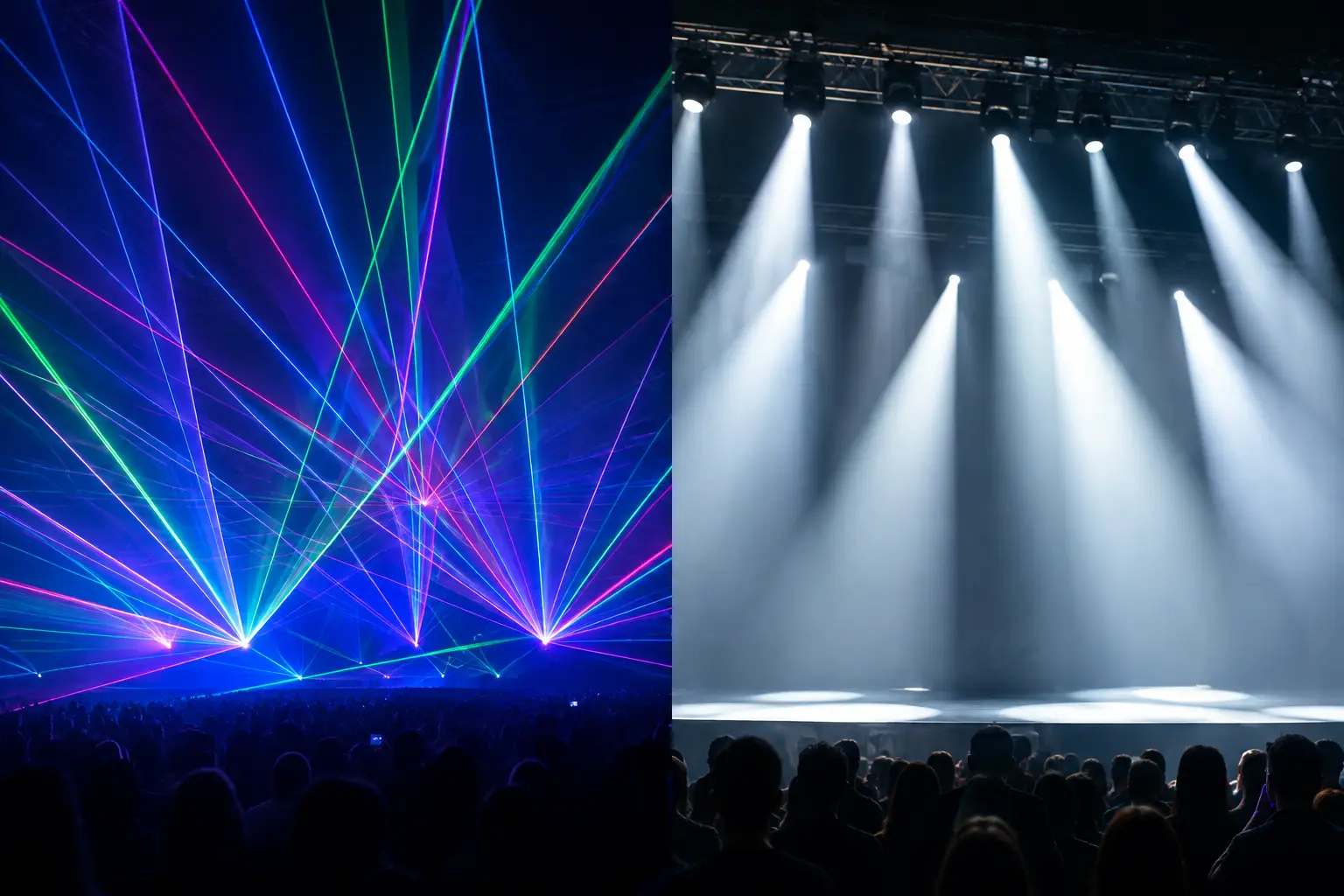
A spotlight can put a singer, speaker, bride, or product at the center of the room. A laser can turn the entire room into the moment. That difference is at the heart of lasers versus spotlights for live events: one directs attention to a subject, while the other can redraw the visual boundaries of a venue with color, movement, and pure visual magic.
Neither tool wins every production. A keynote speaker needs to be seen clearly. A touring artist needs a visual language that can hit from the first downbeat to the final encore. A town fair may need a spectacle that reads across an open field, while a wedding might call for a romantic, controlled effect that transforms a dance floor without overwhelming the celebration. The strongest productions do not treat lighting as a generic add-on. They choose the medium that supports the experience people are there to remember.
Lasers Versus Spotlights: The Core Difference
Spotlights are built to reveal. They illuminate performers, architecture, scenic elements, and focal points. Their beam is visible in haze or atmospheric effects, but their primary job is to put usable light on a physical subject. That makes them essential for speeches, theatrical scenes, broadcast environments, fashion presentations, and any event where faces, wardrobe, or products must remain clearly visible.
Lasers are built to create. With precisely controlled RGB beams, a laser system can carve through the air, fan above a crowd, sweep across a building façade, create tunnels over a dance floor, and project animated graphics or custom branded imagery. Instead of simply making an object visible, lasers make the space itself feel alive.
That distinction matters when event planners ask for more “wow.” Adding more conventional fixtures can brighten a room, but it may not change the audience’s emotional response. A professionally programmed laser show creates depth, speed, scale, and surprise. It can make a ballroom feel like a concert arena or turn a stadium entrance into a breathtaking opening statement.
When Spotlights Are the Better Choice
A spotlight is the right answer when clarity is the production priority. At an awards dinner, for example, guests need to see honorees cross the stage and react in real time. At a corporate presentation, the presenter and product need clean, flattering illumination. During a wedding ceremony, focused lighting helps preserve the intimacy of the vows while ensuring photographers and videographers can capture the moment.
Spotlights also provide the control needed for theatrical storytelling. A narrow follow spot can isolate a performer in darkness, guide the audience from one part of the stage to another, or create a dramatic reveal without filling the entire room with effects. In these applications, spectacle comes from restraint as much as intensity.
For outdoor events, spotlights can also illuminate flags, buildings, signage, and performers at distances where audience visibility is the main requirement. Their power is practical and immediate: they show people what matters.
Still, spotlights can have limits when the objective is to create an immersive, share-worthy visual event. Even powerful moving lights tend to read as fixtures aimed into a space. Lasers create visible geometry in the air and can fill an audience’s field of view in a completely different way.
When Lasers Create the Bigger Moment
Lasers excel when an event needs to feel larger than its footprint. A custom laser production can build anticipation before a product launch, punctuate a DJ drop at a nightclub, create a cinematic entrance for a bar or bat mitzvah, or turn a municipal fireworks finale into a full-sensory spectacle.
Their advantage comes from beam quality and precision. Professional RGB laser projectors generate intensely saturated color and extremely defined aerial effects. Green, blue, red, cyan, magenta, and white can cut through haze with a crispness that conventional lighting cannot duplicate. With music-synchronized programming, those beams do not merely flash. They accelerate, pulse, fan, rotate, and morph with the soundtrack.
For large outdoor spaces, higher-powered laser systems can project over considerable distances and create effects that remain visible to a broad audience. A 40-watt system may be ideal for an indoor event or a modest outdoor production, while 100-watt, 200-watt, and higher systems are engineered for major festivals, stadium environments, city celebrations, and audiences stretching into the tens of thousands. The correct wattage depends on throw distance, ambient light, atmospheric conditions, projection surface, and the creative scope of the show.
Lasers also offer a rare branding opportunity. Custom logos, text, animations, and graphic sequences can turn a launch, grand opening, sports presentation, or branded event into a visual signature. A spotlight can reveal a company mark on a backdrop. A laser can animate that mark across a façade, screen, or atmospheric canvas with movement that commands attention.
The Real Answer Is Often Both
The most memorable live productions often use lasers and spotlights together because they serve different jobs. Spotlights keep performers and speakers visible. Lasers surround the action with scale, color, and kinetic energy. One creates focus; the other creates environment.
Imagine a concert opening. The stage begins in darkness except for a tight spotlight on the artist. As the first beat lands, RGB laser beams explode outward in synchronized patterns, framing the performer and reaching over the crowd. The spotlight ensures the audience sees the artist. The laser show ensures they feel the arrival.
The same principle applies to corporate events. Clean stage lighting makes executives credible and presentations readable. A laser sequence before the keynote or at the launch reveal can give the production an edge that standard ballroom lighting rarely achieves. For private celebrations, warm spotlighting can preserve the elegance of dinner and speeches, then hand the room over to lasers when the dance floor opens.
Venue Conditions Can Change the Decision
The room or site can matter as much as the creative brief. Lasers show best when there is some control over ambient light and when haze, fog, or other approved atmospheric enhancement can reveal the beam paths. In a sunlit outdoor setting, even a powerful laser will not produce the same aerial impact it delivers after dark. In a heavily lit convention hall, a laser effect may need a carefully timed reveal or a darker presentation window to hit at full strength.
Spotlights are generally more forgiving in bright conditions because their purpose is illumination. If an event takes place at noon, a spotlight or other conventional fixture may contribute more practical value than a beam-focused laser effect. Once daylight fades, the equation changes fast.
Ceiling height, sightlines, room dimensions, reflective surfaces, and audience placement also deserve attention. A skilled production team evaluates where the beams will travel, where effects can be projected, and how to create maximum impact without compromising the guest experience. An intimate ballroom and an open-air fairground demand very different system designs.
Safety Is Part of the Spectacle
High-powered lasers are not a plug-and-play party accessory. They require professional design, setup, alignment, programming, and operation. The more powerful the system, the more critical that expertise becomes.
A compliant laser production accounts for beam paths, scan zones, termination points, projection angles, venue surfaces, aircraft considerations for outdoor work, and all applicable safety requirements. Audience scanning, when used, is a specialized application that must be engineered and operated correctly. There is no substitute for licensed, insured professionals who understand both the creative potential and the responsibilities of high-output laser systems.
This is where a professional laser partner brings value beyond equipment. Connecticut Laser Productions combines custom show programming with experienced operators and scalable professional laser systems, helping clients create massive visual impact while keeping production planning grounded in safety and precision.
Budget: Compare Impact, Not Just Fixtures
A basic spotlight package may cost less than a custom laser production, particularly for a short event with simple visibility needs. But the comparison should not stop at fixture count or rental price. Ask what the audience will see, photograph, record, and talk about after the event.
If the goal is to illuminate a podium, spotlights are a smart and efficient choice. If the goal is to make a milestone celebration, launch, concert, or public event feel like a once-in-a-lifetime experience, a laser show may deliver far more emotional and promotional value. Custom programming, system power, crew requirements, travel, venue conditions, and show duration all shape the investment.
The best planning question is not, “Should we rent lasers or spotlights?” It is, “What do we need the audience to feel at this exact moment?” Start there, and the right visual design becomes much easier to see.
One response
I appreciate the way you developed this piece. The article feels complete, and the ending brings the main ideas together in a satisfying way.