
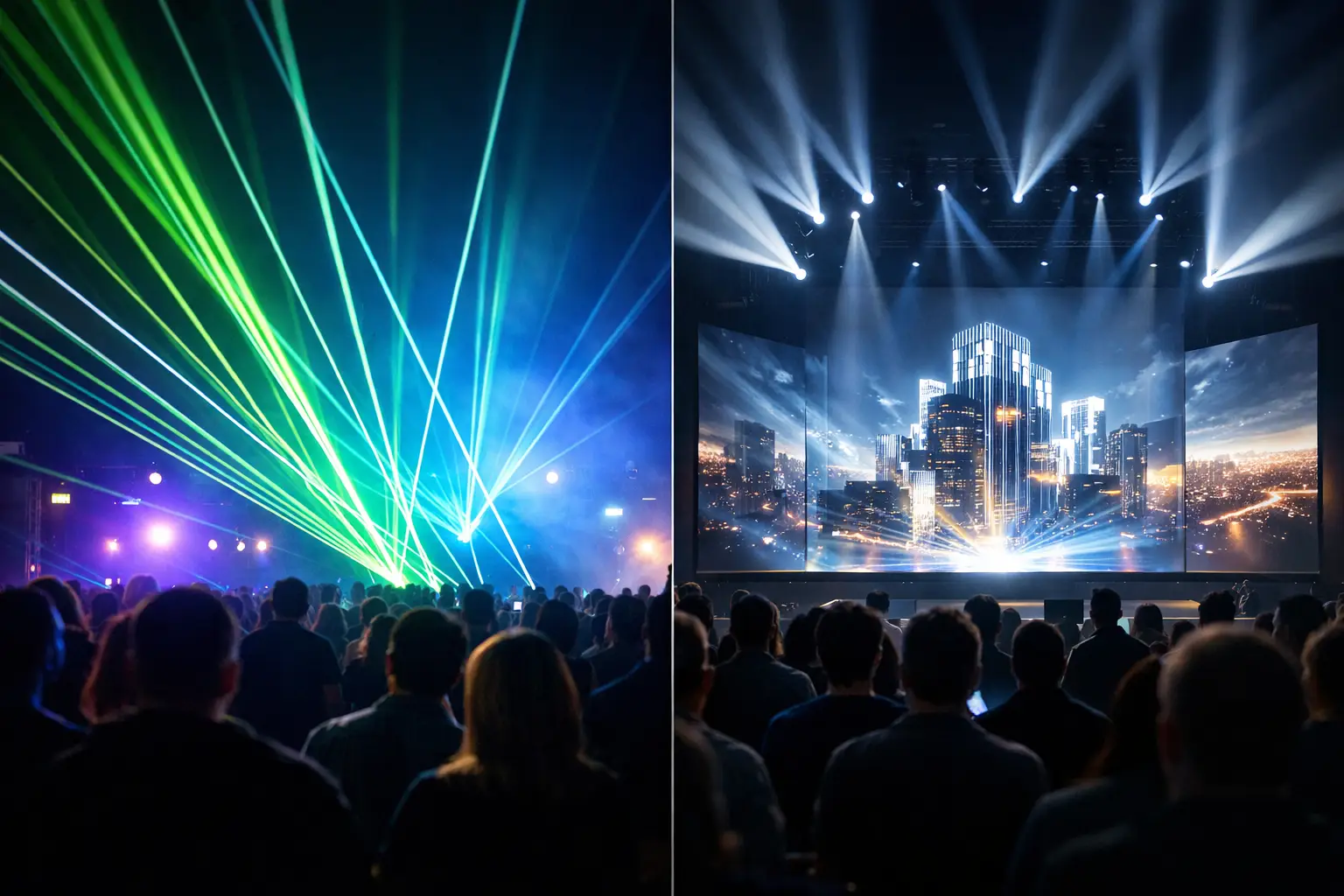
A packed dance floor goes dark. A laser slices through the room in electric green, fans over the crowd, and snaps into a music-synced animation above the stage. That instant, physical rush is why laser versus projection is not simply a question of which technology looks better. It is a decision about what you want your guests to feel, where the visual effect will live, and how big you need the moment to become.
Both tools can transform an event. Both can carry branding, motion, color, and drama. But they work in fundamentally different ways. A projector throws light onto a surface. A laser creates intensely concentrated beams, aerial effects, graphics, and animated content that can appear to float in space. Choosing well starts with understanding that distinction.
Laser Versus Projection: Two Different Visual Languages
Projection is surface-based. It needs something to hit: a screen, wall, building facade, stage scenic, floor, or other mapped surface. When the image is sharp, bright enough, and properly aligned, projection can turn a blank backdrop into a moving environment. It is an exceptional choice for video, detailed photography, cinematic storytelling, sponsor reels, keynote content, and architectural projection mapping.
Laser is atmosphere-based as much as it is surface-based. A professional RGB laser system can create razor-sharp aerial beams, tunnels, liquid-sky effects, cones, fans, and high-energy graphics that command the room. With properly controlled theatrical haze or fog, the light itself becomes visible. It does not just illuminate the show. It becomes the show.
That difference changes the audience experience. Projection asks people to look at an image. Lasers can place the audience inside one. For a nightclub reveal, concert drop, wedding entrance, halftime production, or festival finale, that immersive energy can produce the pure visual magic that people capture, share, and remember.
When Projection Has the Advantage
Projection earns its place when the message requires detail. A high-resolution video of a product, a speaker presentation, a film sequence, or a branded motion package is generally better served by projection on an appropriately sized surface. It can reproduce subtle gradients, facial footage, textures, and complex visuals that are outside the natural strength of laser graphics.
It is also the logical choice when the event design already includes a large scenic wall or LED-adjacent presentation area. Corporate general sessions, theater productions, museum experiences, and building mapping projects often need visual content that changes scene by scene. Projection can create environments, carry narrative, and support speakers without demanding that every moment feel like a concert climax.
Still, projection has real operating limits. Ambient light can wash it out fast, especially outdoors during daylight or in brightly lit ballrooms. Long throw distances, surface color, projector placement, obstructions, and screen quality all affect the final image. A projection that looks impressive in a controlled rehearsal can lose impact when sunlight, streetlights, or house lighting enter the equation.
For outdoor events after dark, projection can be spectacular on a building, water screen, or dedicated surface. But if there is no clean surface to use, its possibilities narrow. You cannot project a crisp video image into open air and expect it to hang over a crowd.
When Lasers Take Over the Room
Lasers excel when impact matters more than video realism. Their beam intensity, saturated RGB color, and precise movement make them a natural centerpiece for concerts, touring productions, festivals, sporting events, municipal celebrations, grand openings, and high-energy private parties.
A high-powered laser show can cover immense distances and maintain visual authority across a large outdoor field, arena, or stadium environment. At the same time, a thoughtfully scaled system can make an intimate ballroom feel enormous. The right wattage, projector count, beam layout, haze strategy, and custom programming determine whether the effect feels elegant and controlled or genuinely mind-blowing.
Laser graphics are also powerful for logos, names, messages, countdowns, and animated effects. A couple’s monogram above a wedding dance floor, a sponsor logo sweeping across a venue, or a custom sports-team animation before player introductions can create a branded moment with far more energy than a static sign. The content is not trying to replace a full-motion commercial. It is designed to hit with speed, color, movement, and scale.
This is where professional systems matter. A 40-watt system for a smaller event and a 100- or 200-watt-plus configuration for a major public production are not interchangeable. Power is only one part of the equation, but it affects throw distance, visibility, and the ability to compete with large spaces and ambient light. More wattage is not automatically better for every venue. The system must be engineered for the room, the audience layout, and the desired effect.
Brightness Is Not a Fair One-Number Comparison
Clients often ask whether a laser is brighter than a projector. The honest answer is that wattage and projector lumens do not measure the same thing, so a simple number-to-number comparison can mislead.
A projector spreads light across an entire image area. As the projected image gets larger, the available brightness is distributed over more surface. Laser beams concentrate energy into extremely narrow, vivid lines, which is why they can look so intense in a dark or hazy venue. A bright projected image may be ideal for a 16:9 presentation screen, while a laser beam may remain visible and dramatic across a much larger volume of space.
The environment decides a lot. In a sunlit outdoor setting, neither standard projection nor aerial laser effects will deliver their full nighttime personality. As daylight fades, lasers rapidly gain dramatic power. Projection becomes stronger when it has a bright, controlled surface and limited competing light. A site visit or production consultation prevents expensive assumptions.
Content, Branding, and Music Synchronization
If your event depends on detailed video storytelling, projection should be part of the creative conversation. If it depends on a huge reveal, a pulse-raising musical moment, or visual effects that make a crowd erupt, lasers deserve the lead role.
The most impressive productions often use both with clear intent. Projection establishes the world: a mapped facade, scenic canvas, cinematic introduction, or branded visual sequence. Lasers then break beyond the surface, shooting through the air in perfect time with music and transforming the entire venue into a living visual environment.
That combined approach works especially well for product launches, touring shows, large galas, sporting events, and city celebrations. The screen carries the story. The lasers deliver the exclamation point.
Custom programming is what keeps the show from feeling generic. Laser cues can be built around a walk-on, first dance, band drop, fireworks finale, speech conclusion, team entrance, or logo reveal. Every color change, beam movement, graphic, and blackout can support the rhythm of the event. This is not a light pointed at a wall. It is a designed production moment.
Safety Is Part of the Spectacle
High-impact lasers require professional planning and operation. Audience scanning, beam paths, projection zones, aircraft considerations, emergency stop systems, venue restrictions, and local requirements all matter. The most exciting laser show is one that has been designed to deliver maximum visual force while maintaining compliant, controlled operation.
That is particularly critical for public events, outdoor productions, and installations using high-powered systems. Licensed, insured operators understand how to position equipment, manage audience areas, program safe effects, and adapt to the realities of the venue. A laser projector is not a plug-and-play party light when the goal is professional-scale results.
Connecticut Laser Productions brings more than 20 years of show experience to that balance of spectacle and precision, from private celebrations to massive public audiences. The creative goal is always clear: build the biggest possible WOW factor without treating safety as an afterthought.
How to Make the Right Call
Start with the event’s hero moment. If guests need to read a presentation, watch a film, see close-up product visuals, or follow a visual narrative, projection may be the primary tool. If the goal is to make the room explode with color, movement, and music-driven energy, lasers are often the stronger answer.
Then consider the venue. Do you have a suitable projection surface? Can the room be darkened? Is haze permitted? Is the event indoors, outdoors after sunset, or running through daylight? How far is the audience from the performance area? These practical details shape the design as much as the creative brief does.
Finally, think about scale and shareability. A beautifully projected logo may communicate your brand. A custom laser logo flying over thousands of people can turn that brand into a moment. For the biggest events, the right answer is often not laser or projection. It is a production designed to let each medium do what it does best.
Give your audience more than something to watch. Give them a moment they can feel from the first blackout to the final burst of color.
No responses yet