
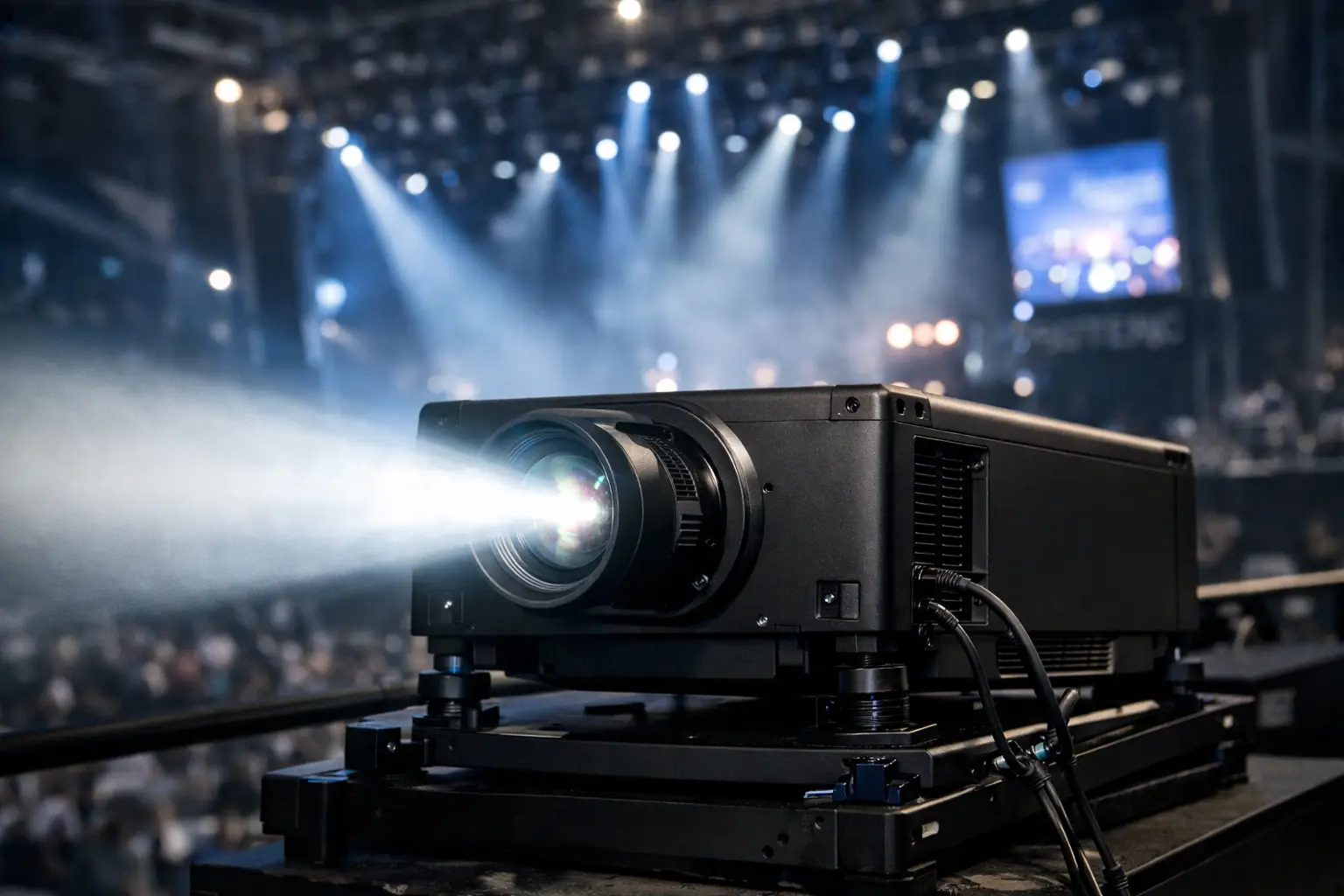
A projector can look impressive on a spec sheet and still fall flat when the room fills, the music hits, and every phone in the audience is pointed at the stage. This Luminance projector review looks at what professional buyers actually need to know: how these RGB laser systems perform as visual engines for concerts, venues, touring rigs, outdoor events, installations, and high-impact celebrations.
The short version: Luminance projectors are built for buyers who want more than a few beams over a dance floor. The platform is designed around serious RGB output, vivid aerial effects, graphics capability, and the control flexibility required for programmed entertainment. The right result, however, depends on matching the projector’s power, optics, control system, and safety plan to the size and purpose of the show.
Luminance Projector Review: The Big Picture
Luminance RGB laser projectors occupy the professional end of the laser-show conversation. They are intended to create saturated color, sharply defined beam effects, animated graphics, logos, tunnels, fans, and kinetic aerial looks that change the energy of a room or an open field.
That distinction matters. A professional laser projector is not a plug-and-play party light. It is a precision optical system that needs competent programming, correct placement, secure mounting, proper electrical planning, and trained operation. In the hands of an experienced show team, it can turn a stage, ballroom, stadium, or city celebration into a breathtaking visual spectacle. Treated casually, even a powerful projector will not deliver the polished impact buyers expect.
For production companies and venue operators, the appeal is scale. A well-specified Luminance unit can be part of a compact indoor rig or a much larger system with multiple projectors, haze, lighting, video, and timecoded music. That ability to grow is a major advantage for organizations serving different room sizes and event types.
Power Is Not Just a Wattage Number
Wattage gets attention because it should. It determines how much visual presence a laser can deliver against ambient light, over distance, and through atmospheric effects. But power alone does not tell the full story.
A lower-power projector can create beautiful indoor beams in a controlled nightclub, theater, wedding venue, or ballroom, especially with effective haze and a darkened environment. Bring the same unit into a bright convention hall, a large arena, or an outdoor festival, and the visual impact can disappear quickly. Bigger spaces, brighter surroundings, and longer throw distances call for substantially more output.
Luminance systems are available across a broad range of professional power levels, including high-wattage configurations suited to major productions. For context, a 40-watt-class system may be a strong starting point for many serious indoor applications, while stadium-scale events, large outdoor displays, and long-distance aerial effects can demand 100 watts, 200 watts, or more depending on conditions and creative expectations.
The best buying question is not, “What is the highest wattage available?” It is, “What must the audience see from where they are standing?” A stage-mounted laser for a 500-person concert has different requirements than a rooftop display for a municipal celebration or a beam array reaching across a sports venue.
Ambient Light Changes Everything
If your event includes daylight, city glow, LED walls, follow spots, or a heavily lit stage, plan power accordingly. Lasers can still deliver strong effects in challenging environments, but the design must account for contrast. Pure aerial beam looks need haze or atmospheric conditions to read clearly. Graphics need an appropriate projection surface, viewing angle, and projection distance.
This is where a real production test beats a catalog comparison. A qualified supplier can evaluate the venue, intended sightlines, show duration, weather exposure, and surrounding light before recommending a system.
Color, Beam Quality, and the WOW Factor
The reason RGB laser systems command attention is color. A well-tuned RGB projector can move from electric blue to saturated red, vivid green, deep violet, warm yellow, and dynamic multicolor transitions with a level of intensity conventional lighting cannot duplicate.
In a Luminance projector review, color performance should be judged by more than whether the unit produces red, green, and blue. Look at balance. White should read as clean and convincing rather than leaning heavily toward one color. Mixed hues should feel rich on camera and to the eye. At full output, beams should retain a crisp, consistent appearance rather than becoming soft or uneven across the projection field.
Beam quality also shapes the final image. Tight divergence helps beams hold their definition across longer throws. Good optics and alignment help graphics stay clean, particularly when projecting logos, text, or detailed animations. For touring and permanent installations, these details are not minor technical trivia. They determine whether your visual centerpiece feels premium every night or needs constant compromise.
There is a trade-off. The more demanding the graphic content, projection distance, and audience expectation, the more critical scanner performance, optical alignment, and programming become. A projector selected mainly for aerial beams may not be the ideal choice for intricate logo projection, and vice versa.
Control and Programming Make the Hardware Perform
A laser projector is only as compelling as the content running through it. Luminance systems are attractive to professional users because they can be integrated into real show-control environments, not just operated as a standalone effect.
For a concert, that may mean cueing laser looks to specific musical moments: a beam explosion at the chorus, synchronized geometric fans during a breakdown, or audience-facing graphics for a headline reveal. For a corporate launch, it may mean projecting a logo with precise timing before transitioning into animated brand colors. For a permanent venue installation, it may mean repeatable programmed looks that staff can call up consistently.
Before purchasing, confirm the control options that matter to your workflow. Consider whether you need professional laser-control software, network integration, ILDA connectivity, DMX compatibility, show files, timecode capability, emergency-stop integration, or remote monitoring. The answer depends on whether the projector will be operated by a laser professional, a lighting programmer, an in-house venue team, or an installation contractor.
A common mistake is buying more power than the show needs while underestimating control and content. Spectacular laser production is a marriage of engineering and choreography. The projector provides the horsepower. The programming gives it a voice.
Safety Is Part of the Production Value
No responsible Luminance projector review should treat safety as an afterthought. High-powered entertainment lasers require disciplined operation, not improvisation. Audience scanning, beam termination, aircraft considerations, controlled zones, mounting height, emergency stops, masks, exclusions, and venue layout all need to be addressed before showtime.
For public events, buyers should work with licensed, insured, experienced operators who understand applicable regulations and can build a compliant show plan. Outdoor events may require additional coordination because airspace and sightlines introduce a different set of considerations. Indoor installations need equally careful attention to beam paths, reflective surfaces, room geometry, access control, and emergency procedures.
This operational discipline does not reduce the spectacle. It protects it. When the safety plan is properly designed, the creative team can push toward larger, more immersive effects with confidence. Connecticut Laser Productions has spent two decades producing laser experiences at every scale, and that production perspective matters when selecting equipment as well as operating it.
Who Should Buy a Luminance Projector?
Luminance is a strong fit for laser-show companies, concert and touring professionals, venue operators, production houses, educational institutions, military organizations, themed attractions, and buyers planning permanent entertainment installations. It also suits serious private-event producers who want professional-grade visual impact rather than consumer-level effects.
For a nightclub or small venue, a carefully sized system can become a signature visual feature. For festivals and municipal events, multiple high-output projectors can create a massive aerial canvas visible across a wide audience area. For corporate marketing teams, graphics and logo effects can turn a product reveal into a moment people remember and share.
It may not be the right purchase for a buyer who only needs occasional decorative lighting and has no plan for qualified operation. In that case, a turnkey laser production can be the smarter move: the equipment, content, technicians, safety documentation, and show execution arrive as one coordinated experience.
The Right Projector Is the One That Fits the Show
A Luminance projector can deliver pure visual magic, but the best result comes from selecting the unit around the event rather than forcing the event around the unit. Start with the audience size, venue dimensions, ambient light, desired effects, content needs, operating environment, and safety requirements. Then choose the output and configuration that make those goals realistic.
For buyers ready to create a true headlining moment, the next step is not simply choosing a wattage. It is designing the visual experience your audience will still be talking about after the final beam fades.
No responses yet