
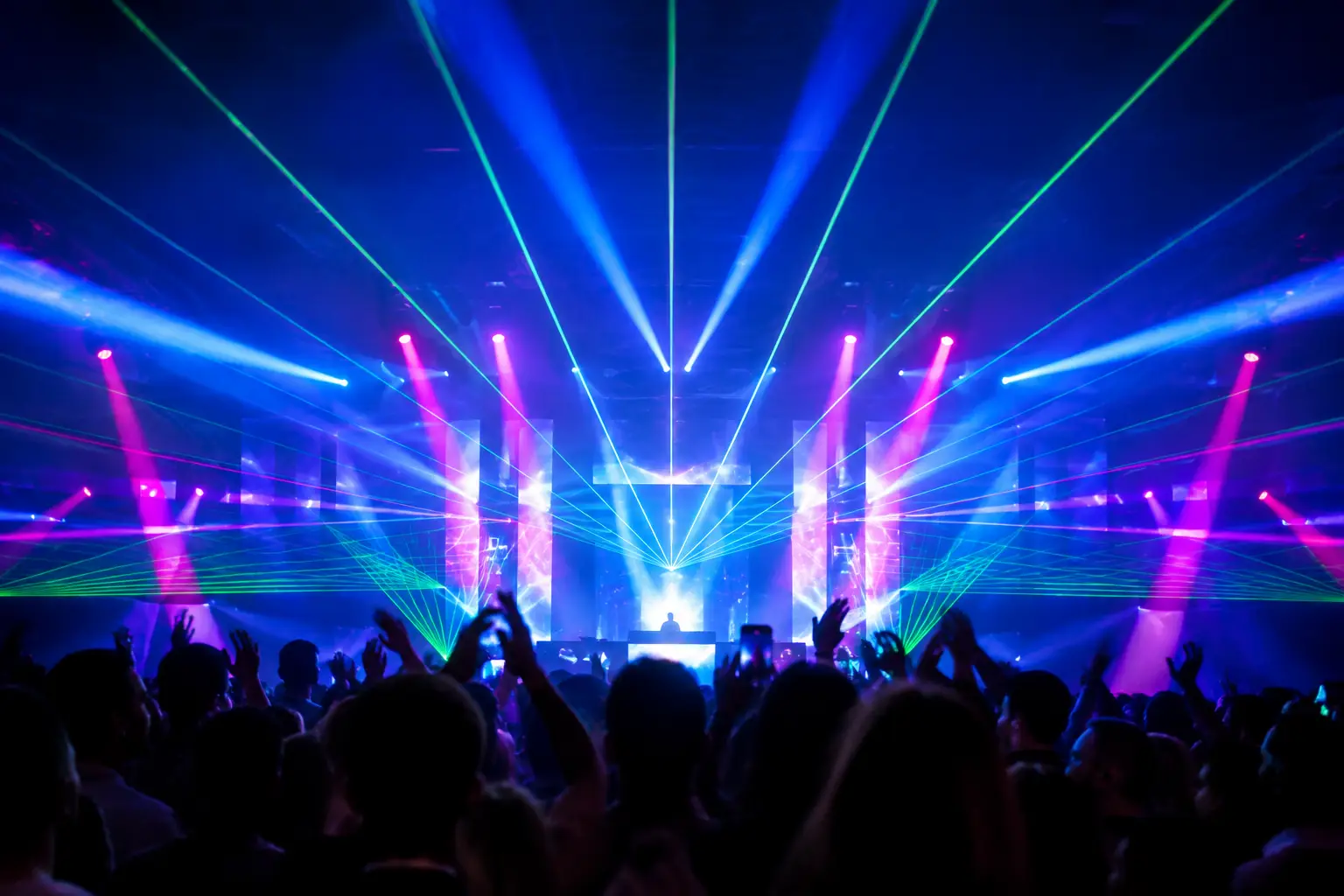
The difference between a laser show that looks impressive and one that stops a crowd cold is timing. Laser choreography turns beams, color changes, aerial effects, graphics, and movement into a performance with purpose. When the bass drops, the room should feel it. When a speaker reaches the big reveal, the visual hit should land on the exact second. That is where pure visual magic meets precision production.
For event planners, promoters, venues, and private hosts, choreography is what makes lasers more than a bright add-on. It gives the show a rhythm, a story, and a reason for guests to keep looking up.
What Laser Choreography Actually Does
At its best, laser choreography is programmed visual motion synchronized to the key moments of an event. It may follow a live performance, a pre-produced soundtrack, a countdown, a brand reveal, or a custom sequence built around an audience experience.
The raw equipment matters. High-powered RGB projectors deliver the saturated reds, greens, blues, and full-color blends that make beams visible across a ballroom, theater, outdoor fairground, arena, or stadium. But wattage alone does not create a show. A 40-watt system and a 200-watt outdoor-capable system each need the right creative direction, placement, programming, and safe operating plan.
Choreography tells every cue where to go and when to appear. A beam can sweep over a dance floor, frame a performer, burst into a fan at a chorus, transform into animated graphics, or build anticipation during a product launch. The audience sees a breathtaking visual spectacle. Behind it is a sequence of deliberate decisions measured in fractions of a second.
Why Timing Creates the WOW Factor
People remember moments, not fixture lists. A laser cue that arrives just before a fireworks finale, a team entrance, a wedding reception reveal, or a headliner’s first note can make an event feel larger than life. The same effect delivered late, early, or without a clear visual rhythm can lose its impact.
Music-synchronized programming is especially powerful because it gives the audience something familiar to follow. Percussion can trigger sharp beam hits. Sustained vocals can open into slow, floating aerial looks. A rising track can build from tight geometric patterns into a room-filling canopy of color. Even guests who know nothing about production recognize when the visuals feel connected to what they hear.
That connection also works without music. For a corporate keynote, laser choreography can punctuate a speaker’s entrance, count down to a new product reveal, or place a company message in a dramatic field of animated light. At a municipal celebration, it can pace a large audience through an opening ceremony and create clear visual peaks across a wide outdoor site.
The Show Starts With the Event, Not the Projector
Every effective laser production begins with the environment and the desired audience reaction. A nightclub wants energy that never lets the room go flat. A wedding may call for romance, a grand entrance, and an unforgettable dance floor. A festival needs scale, sightline coverage, and visual power that holds up against a large stage package. A sporting event needs fast, high-impact cues built for entrances and crowd momentum.
The question is not simply, “How many lasers do we need?” It is, “What should the audience feel at each key moment?” That answer shapes the production.
For an indoor event, the room’s ceiling height, haze conditions, stage location, reflective surfaces, guest flow, and available rigging points all influence the design. Outdoor laser choreography brings a different set of variables: projector throw distance, weather planning, ambient light, viewing zones, airspace considerations, and the scale of the audience. A show designed for a packed banquet room should not be treated like a show for tens of thousands gathered across an open field.
The most memorable productions match the system to the site. Oversizing can be wasteful or visually overwhelming in an intimate room. Undersizing can leave a major outdoor event looking flat. The right solution is the one that delivers maximum impact where guests are actually standing and looking.
Laser Choreography for Live Music and Touring
Concerts are where synchronized lasers can become part of the artist’s identity. A custom cue sequence can make a signature song feel like a full-sensory event, with beams moving through the audience, abstract animations behind the artist, and color palettes that reinforce the music’s mood.
There is a trade-off between pre-programmed precision and live flexibility. A touring act using timecode can achieve tightly locked sequences night after night. A DJ, jam band, or performer who changes sets may benefit from an experienced operator who can run custom looks live, responding to transitions and crowd energy in the moment. Many productions use a combination: prepared cue stacks for known songs, plus live control for everything that changes onstage.
The best choice depends on the artist, the venue, rehearsal time, and how much the set evolves. What should not change is the production standard. Lasers must support the performance, not distract from it or compete with the people onstage.
Big Reveals, Brand Moments, and Private Celebrations
Laser choreography is equally effective when the event has one major moment to own. Corporate marketing teams can use lasers to unveil a logo, highlight a vehicle, introduce a new product, or turn a plain stage into a mind-blowing branded environment. Animated laser graphics can put a message in motion, while aerial effects build the tension before the reveal.
For private events, the scale may be smaller, but the emotional payoff can be just as big. Imagine a couple entering their reception through a corridor of color, a bar mitzvah dance floor erupting with music-synced beams, or a milestone birthday transforming from dinner party to full-throttle celebration. The programming should fit the people in the room. A sophisticated gala needs a different visual language than a high-energy teen celebration.
This is where custom design earns its value. A generic laser loop may provide light. A show built around the occasion creates a memory guests will talk about long after the final song.
Safety Is Part of the Creative Process
A dramatic laser effect only works when it is planned and operated professionally. High-powered laser systems are specialized equipment, not a plug-and-play party decoration. Safe execution requires trained, licensed, and insured operators who understand projector placement, beam paths, audience scanning limitations, venue conditions, applicable regulations, and show-site coordination.
Safety planning should happen before programming is finalized, not after. The creative team needs to know where the projectors can be positioned, what areas must remain clear, how low beams can travel, and how the venue will be used throughout the event. Haze, lighting truss, scenic elements, video walls, pyrotechnics, and performers all affect the final plan.
That discipline does not reduce the spectacle. It makes the spectacle possible. Connecticut Laser Productions combines custom creative programming with professional, safety-compliant execution so clients can pursue the biggest possible visual statement without treating critical production details as an afterthought.
What to Share When Planning a Laser Show
A production partner can develop a much stronger concept when the event brief includes more than a date and venue. Share the audience size, room or site dimensions, event schedule, music or artist information, stage layout, desired visual references, and the moments that matter most. If there is a product reveal, grand entrance, countdown, award presentation, or finale, identify it early.
It also helps to be honest about the event’s priorities. Some clients want a continuous atmosphere of movement across several hours. Others want to concentrate the budget into a three-minute opening that leaves the audience stunned. Both approaches can work. The production should be designed around the moment you need people to remember.
A well-choreographed laser show does more than fill the air with color. It gives your event a pulse. Start with the feeling you want in the room, then let experienced show designers turn that feeling into a cue-by-cue visual experience your audience cannot ignore.
No responses yet