
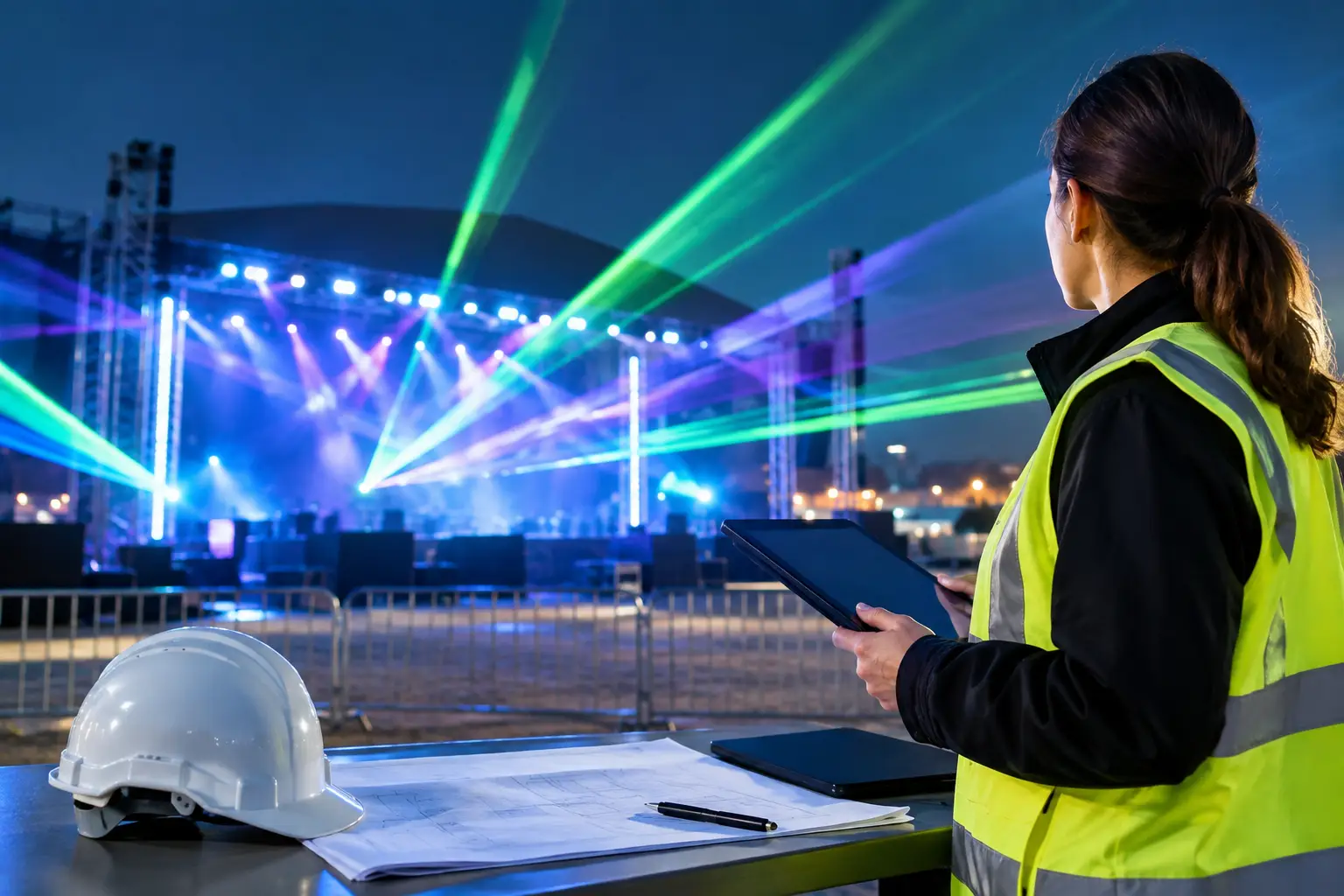
A 100-watt RGB laser can turn a concert finale, city celebration, or product launch into pure visual magic. It can also create a serious planning problem if it is treated like a plug-in lighting effect. Why laser events need permits comes down to one simple reality: high-powered beams travel far, interact with people and aircraft, and must be operated under rules designed to protect both.
The permit process is not there to drain the energy from a show. Done correctly, it is what allows a production team to create massive aerial beams, vivid graphics, music-synced effects, and breathtaking color with a clear safety plan behind every cue. For event planners, venues, and producers, getting the approvals right early is how the big moment stays a big moment – instead of becoming a last-minute cancellation.
Why Laser Events Need Permits and Approvals
“Permit” is often used as a catch-all term, but a professional laser event may involve several distinct approvals and requirements. Which ones apply depends on the projector power, show design, whether the event is indoors or outdoors, the venue, the audience position, and the event’s proximity to airports or public roads.
At the federal level, public laser light shows in the United States generally fall under Food and Drug Administration laser-performance requirements. A laser manufacturer’s product reporting and a show operator’s laser light show variance are not interchangeable. The projector may be built and documented for professional use, while the operator still needs authorization to use it in a public entertainment production.
That distinction matters. Buying or renting a powerful projector does not automatically grant permission to aim it over a crowd, across a skyline, or into open outdoor space. The show must be designed and operated within the conditions of the applicable authorization.
Local rules add another layer. A fire marshal, building official, special-events office, police detail coordinator, park authority, or venue may require a permit, operational plan, certificate of insurance, or on-site inspection. A municipal fireworks-and-music festival will have different questions than a nightclub installation. A wedding in a private ballroom may be more straightforward, but it still requires a responsible look at beam paths, exits, ceiling materials, audience areas, and the venue’s own policies.
The Real Issue Is Control of the Beam
Laser light is not ordinary stage wash. A high-powered laser remains tightly concentrated over distance, which is exactly why it can create those huge, electric fans of color that make audiences stop and stare. It is also why every beam path must be intentional.
A compliant production evaluates where the projector sits, where every programmed effect travels, how far the audience is from the aperture, and what physical barriers or scan limits are needed. It accounts for reflective surfaces, mirrors, glass, polished metal, water, camera lenses, and unexpected sightlines from balconies or side-stage access.
Audience scanning deserves particular care. Effects that appear to sweep through the crowd can be thrilling when they are professionally engineered and measured, but they are not a creative decision to make casually. Power levels, divergence, scanning speed, beam diameter, audience distance, and exposure calculations all affect whether an effect can be used safely. In many shows, the best answer is to keep the strongest beams above the audience and use carefully designed effects to preserve the same immersive impact.
The trade-off is not spectacle versus safety. It is uninformed spectacle versus precision-built spectacle. A skilled operator can make the ceiling feel alive, fill a stage with kinetic geometry, and give a crowd a full-sensory experience without gambling on untested beam placement.
Outdoor Shows Add Airspace and Public-Safety Questions
Outdoor lasers are where early planning becomes absolutely essential. A beam that looks contained from the production compound can project into a much larger environment than organizers expect. Nearby airports, heliports, hospitals, roads, waterfronts, neighboring properties, and elevated vantage points all need to be considered.
For outdoor laser displays, FAA notification or coordination may be necessary, especially when a show could affect navigable airspace. Requirements and review periods vary by location and show design, so this is not a task for the week of the event. Aviation coordination is about preventing distraction or interference with pilots, not reducing the visual impact of a festival headline or New Year’s countdown.
Local authorities may also want to know how the operation will be secured. Can the public approach the projector position? Is the equipment on a rooftop, truss tower, stage deck, or temporary scaffold? Who has access to the control area? What happens if weather changes, a lift moves, or an event footprint shifts after load-in?
A serious plan answers those questions before gates open. It identifies the laser safety officer or qualified operator, defines the termination zones, details emergency shutoff procedures, and makes clear who can call a pause if site conditions no longer match the approved design.
Venues Need Documentation Because They Carry Risk Too
A venue manager is not being difficult when they ask for paperwork. They are protecting guests, staff, artists, property, and their operating license. The same goes for a municipal event organizer approving a show in a downtown park or a stadium production manager coordinating a halftime spectacular.
Most professional venues will want proof that the laser provider is insured and qualified, along with equipment details and a clear production plan. They may ask for certificates of insurance, operator credentials, safety procedures, rigging details, electrical requirements, and confirmation that the laser system is appropriate for the room or site.
This is particularly relevant when the event includes multiple production departments. Lighting, video, pyrotechnics, haze, scenic elements, camera positions, drone operations, and performers can all alter the safe laser environment. A beam path approved during preproduction may need adjustment once a giant LED wall, mirror ball, moving scenic piece, or camera crane enters the picture.
The strongest productions treat the laser team as part of the full technical conversation from the beginning. That coordination protects the show design and avoids the expensive mistake of discovering at rehearsal that a signature effect cannot be used as planned.
What Can Go Wrong When Permits Are an Afterthought
The obvious risk is a show being stopped by an authority having jurisdiction. But the more common damage often happens earlier: a venue declines the effect, a city will not issue the event permit without laser documentation, or an outdoor concept has to be redesigned after an airspace concern emerges.
Last-minute changes cost money and dilute the creative vision. A production that was meant to crown a brand launch with towering sky beams may end up with a smaller, less dramatic indoor alternative because the team did not allow time for review. Worse, unqualified operation can expose organizers to liability if a guest, performer, pilot, or property is put at risk.
There is also a reputational cost. Event planners build their names on flawless execution. A show that starts late, loses a key effect, or draws attention from enforcement agencies is not the kind of WOW factor anyone wants attached to their event.
Start the Laser Conversation Before You Lock the Creative
The right time to discuss permits is at concept stage, not after the marketing artwork promises a laser spectacular. Share the date, venue, city, audience size, indoor or outdoor setting, show hours, desired effects, and whether the production is near an airport or dense public area. Those details allow a qualified provider to determine the likely approval path and build a design that can actually make it to show time.
For smaller private events, the process may be limited to venue approval, insurance, and a safe operating plan. For municipal festivals, touring concerts, stadium shows, and large outdoor productions, it can involve substantially more documentation and lead time. It depends on the jurisdiction and the creative ambition – and that is exactly why experience matters.
Connecticut Laser Productions approaches permitting and compliance as part of the production value, not an afterthought. The goal is never merely to put beams in the air. It is to deliver a controlled, custom-programmed visual spectacle that hits hard on cue and gives organizers confidence behind the scenes.
Before you announce the finale, bring your laser production partner into the room. A few early technical answers can protect the permits, the schedule, the budget, and the breathtaking moment your audience will remember long after the lights come up.
No responses yet