
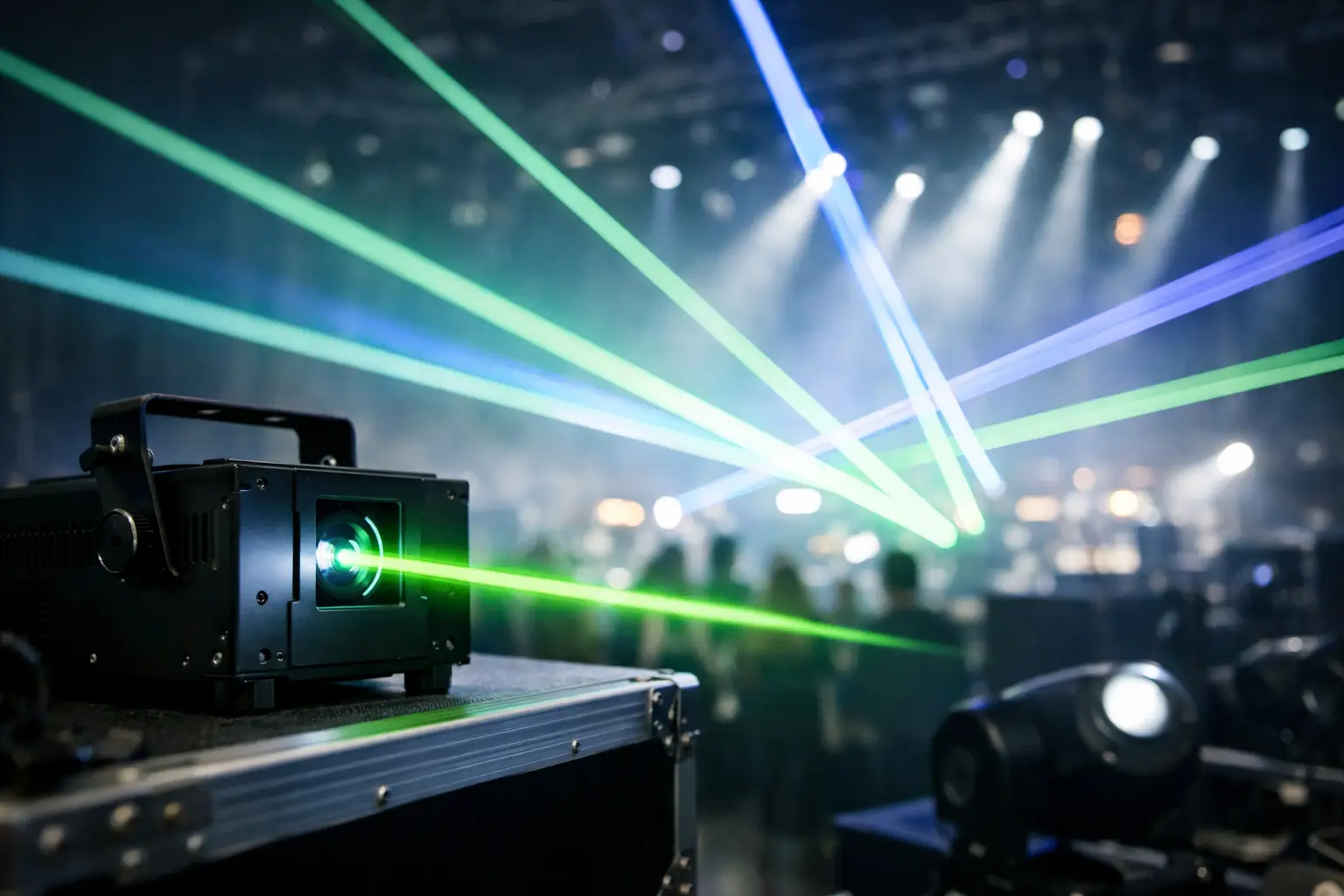
A 40-watt laser can transform a packed ballroom into a kinetic world of color. That same projector may disappear against the scale of an outdoor festival field. Knowing how to choose laser wattage is not about buying the biggest number available. It is about matching visible power to your venue, audience distance, ambient light, creative goals, and the safety plan behind the spectacle.
For an intimate celebration, the right system creates rich aerial beams, animated graphics, and music-synced energy without overwhelming the room. For a stadium entrance, city celebration, or touring concert, the system must cut through distance and competing production lighting to create a breathtaking visual statement. Wattage is a major part of that decision, but it is never the only part.
How to Choose Laser Wattage by Event Scale
Start with the visual moment you need people to remember. Is the laser show a high-energy accent between bands? Is it the centerpiece of a wedding reveal? Does it need to fill an arena, reach a grandstand, or create a skyward beacon visible across a fairground? The larger and brighter the environment, the more output you will generally need.
A professional RGB laser projector in the 40- to 60-watt range can deliver serious impact for many indoor applications. Think nightclubs, theaters, ballrooms, private events, mid-size concert rooms, and carefully controlled outdoor spaces after dark. With haze or fog to reveal aerial beams, this range can produce sharp tunnels, fans, waves, and vivid music-synchronized effects that feel enormous from the dance floor.
For large venues and outdoor events, 80 to 120 watts often becomes the more appropriate conversation. These systems are built for bigger throws, larger audience zones, brighter stage environments, and visual designs that need to remain visible from hundreds of feet away. They are a strong fit for amphitheaters, major corporate events, outdoor concerts, sporting events, municipal celebrations, and festival stages.
When the production must compete with massive lighting rigs, LED walls, long viewing distances, or a stadium-scale crowd, 150 watts to 200 watts or more may be warranted. This is the territory of major touring productions, large public gatherings, and landmark moments designed to deliver pure visual magic to tens of thousands of people.
More wattage creates more potential impact, but it also raises the bar for system design, setup, control, and compliant operation. A 200-watt projector is not automatically the right answer for a 150-person reception. The goal is a show that feels intentional, not simply intense.
Venue Size and Throw Distance Matter More Than You Think
Laser light spreads as it travels. A beam that looks brilliant at 40 feet will not appear identical at 400 feet, especially outdoors. That is why the throw distance from projector to performance area, audience, building facade, or projection surface should guide the wattage recommendation.
For indoor productions, ceiling height matters as much as room length. A low-ceiling venue can still support striking laser effects, but it may call for more controlled beam paths and a system selected for the room rather than its maximum output. A theater with a high trim height gives a production team more space to build dramatic overhead beam architecture.
Outdoor shows introduce additional variables. Open air absorbs the visual advantage created by haze, wind can quickly disperse atmospheric effects, and there is often no dark ceiling or wall to frame the beams. If guests are spread across a large field or seated in grandstands, higher power helps preserve the bold color and movement that makes a laser production feel alive.
Do not estimate distance based only on the venue brochure. A site review or accurate dimensions can prevent underpowered results and unnecessary expense. The best laser plan considers projector placement, sightlines, rigging positions, stage orientation, nearby buildings, and exactly where the audience will be standing or seated.
Ambient Light Can Change the Wattage Requirement
A laser system does not perform in a vacuum. It competes with every other source of light in the environment.
A dark nightclub with controlled lighting may need far less wattage than a ballroom filled with architectural uplighting, moving lights, and bright video displays. A sunset festival set is different from a midnight festival set. A stadium with LED boards, broadcast lighting, and powerful concert fixtures demands a laser system with enough output to hold its own.
This does not mean all other lighting must go dark. The most memorable productions balance elements. Lasers can slice through a blackout for a dramatic reveal, then interact with lighting, video, performers, and music for a full-sensory spectacle. But if the design calls for bright lasers to remain visible while everything else is at full intensity, the wattage requirement will rise.
Color also affects perceived brightness. Green typically appears brighter to the human eye than red or blue at comparable output levels. A quality RGB projector balances red, green, and blue sources to create strong whites and saturated colors, but the specifications behind that balance matter. Two projectors with the same advertised wattage may not deliver the same color quality, beam divergence, or real-world visual punch.
Wattage Is Only One Measure of Projector Performance
Choosing a laser based on wattage alone is like choosing a concert sound system based only on amplifier power. It tells part of the story, not the whole story.
Beam quality determines how tight and crisp the laser remains over distance. A tight beam creates more defined aerial effects and sharper visual lines. Scanner performance affects the speed and accuracy of graphics, logos, text, animations, and complex abstract effects. Color balance affects whether a corporate logo looks faithful, whether white appears clean, and whether the show maintains its visual depth across a full palette.
For event producers and installation buyers, reliability also matters. A projector that looks exceptional in a specification sheet is not enough if it cannot perform consistently through a long show schedule, travel demands, or changing venue conditions. Professional systems should be evaluated for build quality, thermal management, controls, serviceability, and compatibility with the show-control environment.
If you are purchasing equipment rather than booking a turnkey production, define the work the projector must do most often. A laser used for nightclub beam shows has different priorities than a unit intended for outdoor touring, permanent venue installation, branded architectural projection, or detailed graphics work.
Match the System to the Creative Goal
The strongest productions begin with a show concept, then select the hardware to bring it to life. A wedding may need elegant first-dance effects, a monogram reveal, and a joyful finale. A product launch may need precise logo animation, countdown sequences, and a dramatic reveal timed to a keynote. A concert may need enormous fan effects, audience sweeps designed within approved safety parameters, and frame-by-frame synchronization with the artist’s music.
Here are four questions that quickly clarify the right wattage range:
- How large is the audience area, and how far away is the furthest viewer?
- Is the event indoors, outdoors, or moving between both environments?
- How much stage, architectural, video, or daylight-related ambient light will compete with the laser?
- Are you prioritizing aerial beams, projected graphics, building-scale visuals, or a combination of effects?
A lower-watt system can be spectacular when the room is controlled and the design is precise. A higher-watt system earns its place when the show needs to travel farther, fill more space, and command attention in a visually demanding environment.
Safety and Professional Operation Are Part of the Decision
High-powered lasers are specialized entertainment systems, not plug-and-play party lights. The more powerful the projector, the more essential professional planning becomes. Proper operation requires thoughtful placement, controlled projection zones, secure mounting, appropriate safety hardware, venue coordination, and an operator who understands how to execute effects without compromising the audience or staff.
For public events, the production team should address applicable safety requirements, local conditions, and the event’s specific operational needs well before show day. Outdoor productions can require additional planning due to airspace considerations, weather, changing audience flow, and the lack of fixed boundaries.
This is where experienced laser professionals add real value. They do not simply arrive with a powerful projector. They design a system around the venue and creative brief, program effects for the moment, manage the equipment throughout the event, and keep the production focused on a polished, compliant result.
Connecticut Laser Productions works with professional RGB systems ranging from 40 watts to 200 watts and beyond, scaling each show around the space, the crowd, and the desired WOW factor. That range makes it possible to build from an immersive private-party experience to a massive outdoor visual event without forcing every concept into the same equipment package.
The right laser wattage is the one that makes your event look larger than life while still fitting the room, the schedule, the budget, and the safety plan. Share the venue dimensions, audience count, event timing, existing lighting plan, and the moment you want guests to feel in their bones. From there, the wattage becomes less of a guess and more of a creative decision that puts the show exactly where it belongs: at the center of attention.
No responses yet