
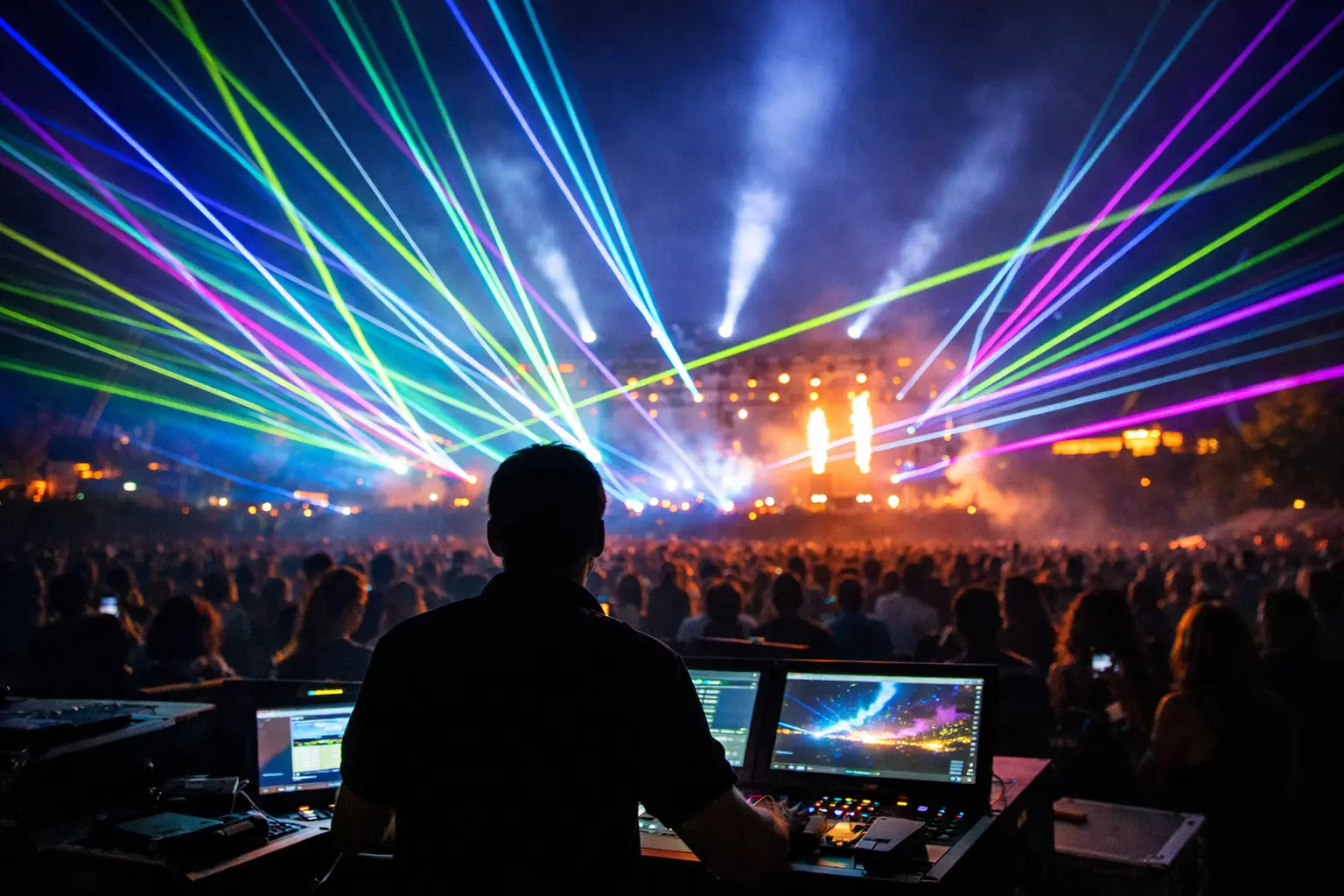
A laser show can turn a standard event reveal, concert drop, first dance, or grand finale into pure visual magic. But knowing how to plan laser shows means thinking beyond bright beams and colorful graphics. The strongest productions begin with a clear audience moment, then pair creative ambition with the right room, power, programming, atmosphere, and safety plan.
A few well-placed lasers can make an intimate celebration feel cinematic. A field of high-powered RGB systems can make a fairground, arena, or festival crowd look up at the same instant. The difference is not simply wattage. It is intentional production design.
Start With the Moment You Want to Create
Before choosing equipment, define what the audience should feel and when they should feel it. Is the laser show the headline attraction? Is it supporting a band, DJ, keynote, fireworks display, or product launch? Does the room need elegant movement overhead, or does the client want a high-energy blast of beams, aerial effects, logos, and mind-blowing animations?
A laser production works best when it has a job to do. For a corporate launch, that may be building anticipation before a logo reveal. For a wedding, it might be a romantic first-dance canopy that gives way to a full dance-floor celebration. For a stadium concert, it may mean synchronized beam chases and graphic content that amplify the music’s biggest hits.
Share the run of show early. A production team needs to know the exact cues that matter: doors open, walk-on, award presentation, countdown, first dance, headliner entrance, finale, and any planned fireworks or confetti. When those moments are mapped, the laser content can be programmed to hit with precision rather than appearing as a disconnected visual add-on.
How to Plan Laser Shows Around the Venue
The venue determines what is possible long before the first beam is switched on. A ballroom, nightclub, theater, tent, outdoor stage, rooftop, stadium, and municipal park all create different opportunities and constraints.
For indoor events, ceiling height, rigging points, room width, reflective surfaces, smoke detection, audience layout, and sightlines shape the design. Low ceilings can still look incredible, but they call for carefully controlled projector positions and beam paths. A larger room may benefit from multiple laser locations that create depth over the crowd instead of sending every effect from one corner.
Outdoor events add distance, weather, ambient light, wind, and airspace considerations. Powerful 40-watt to 200-watt-plus systems can create spectacular long-throw effects, but power alone cannot defeat a brightly lit sky or poor placement. The show must be designed for viewing distance, the stage orientation, and the point at which the audience enters and gathers.
Ask the venue these questions before locking the creative direction:
- Where can projectors be positioned securely, with clear sightlines and controlled access?
- What power is available at each proposed location, and is dedicated distribution required?
- Are haze, fog, pyrotechnics, fireworks, or other atmospheric effects permitted?
- What are the venue’s rules for rigging, fire safety, curfew, load-in, and outdoor weather contingencies?
A site visit is often the fastest way to prevent expensive surprises. It reveals obstructions, balcony overhangs, trees, video walls, truss limitations, and the real ambient-light conditions that a floor plan cannot show.
Build the Look Before You Choose the Wattage
Every event planner wants the WOW factor. The smarter question is what kind of WOW the event needs. Crisp aerial beams, sweeping fan effects, tunnel sequences, animated graphics, branded logos, and laser text each require different programming choices and projector positions.
Wattage should follow the visual objective, not lead it. A small private party may need a compact, professionally installed system that fills the dance floor without overwhelming the room. A large festival or outdoor celebration may require multiple high-output RGB laser projectors to read across hundreds of feet and compete with stage lighting.
Color also matters. Full-color RGB laser systems can produce vivid saturated effects and make branded content feel far more integrated than a single-color beam. Yet graphic complexity has trade-offs. Detailed logo animations need enough viewing distance and a suitable projection surface or atmospheric conditions. A simple, perfectly timed beam look can be more powerful than an overdesigned sequence that no one can read from the back of the venue.
Music synchronization is where a laser show becomes a performance. Provide final tracks, timecode information, artist cues, and brand assets as early as possible. Custom programming takes time, especially when the show includes animated content, multiple projectors, or cues that need to align with live performers, video, lighting, and fireworks.
Treat Atmosphere and Lighting as Part of the System
Lasers are visible in the air because beams reflect through haze or fog particles. Without atmosphere, an audience may see graphics on a surface but lose much of the dramatic aerial impact. With too much haze, the room can look cloudy and the effects can lose definition.
This is why laser planning belongs in the larger lighting and environmental design conversation. Haze output, HVAC airflow, open doors, outdoor wind, stage smoke, and even venue alarms can affect the result. In a concert environment, the lighting director and laser programmer should coordinate looks so fixtures do not wash out the most important beam moments.
For outdoor shows, atmospheric conditions are less predictable. Wind can quickly disperse haze, and a cold, damp evening behaves differently from a dry summer afternoon. Build a visual plan that still performs when conditions are less than perfect, using strong beam architecture, well-placed projectors, and effects that read without relying on one fragile element.
Put Safety and Compliance at the Center
A breathtaking show is never worth an unsafe shortcut. Professional laser systems are powerful precision instruments, and every production must be planned around audience safety, controlled beam paths, secure mounting, emergency procedures, and applicable federal, state, local, venue, and airspace requirements.
This is not the place for improvised equipment placement or an untrained operator. Audience scanning, if it is considered at all, requires specialized calculations, measurement, controls, and professional judgment. Many event designs deliver enormous impact by keeping effects above the audience or directing them into controlled zones.
Experienced, licensed, and insured operators evaluate the room, establish safe exclusion areas, inspect equipment, and monitor the show in real time. For outdoor skyward effects, approvals and restrictions may apply depending on the location, airport proximity, event footprint, and planned beam use. Start those conversations early rather than treating compliance as a last-week production task.
Plan the Production Timeline and Budget Honestly
The cost of a laser show depends on far more than projector rental. Custom programming, number and output of projectors, graphics, operators, travel, rigging, power distribution, control systems, rehearsal time, safety planning, permits, and event duration all affect the final scope.
A focused single-location show can create a dramatic impact with a tighter budget. A touring concert package, municipal celebration, or stadium-scale production may involve multiple systems, redundant control, crew calls, site surveys, and extensive preprogramming. Neither approach is automatically better. The best investment is the one that supports the audience size, creative objective, and event schedule without cutting the operational elements that make the show reliable.
Bring a laser partner in while the event is still being designed. Early collaboration can reduce last-minute changes, identify the right projector locations, and make sure the reveal, music, lighting, and staging all build toward one unforgettable peak.
When the lights drop and the first perfectly timed color cuts through the room, guests will not be thinking about power distribution or cue sheets. They will feel the energy of a show built for that exact moment. That is the standard Connecticut Laser Productions brings to every production: big visual ambition, engineered with the control and care a live event demands.
No responses yet