
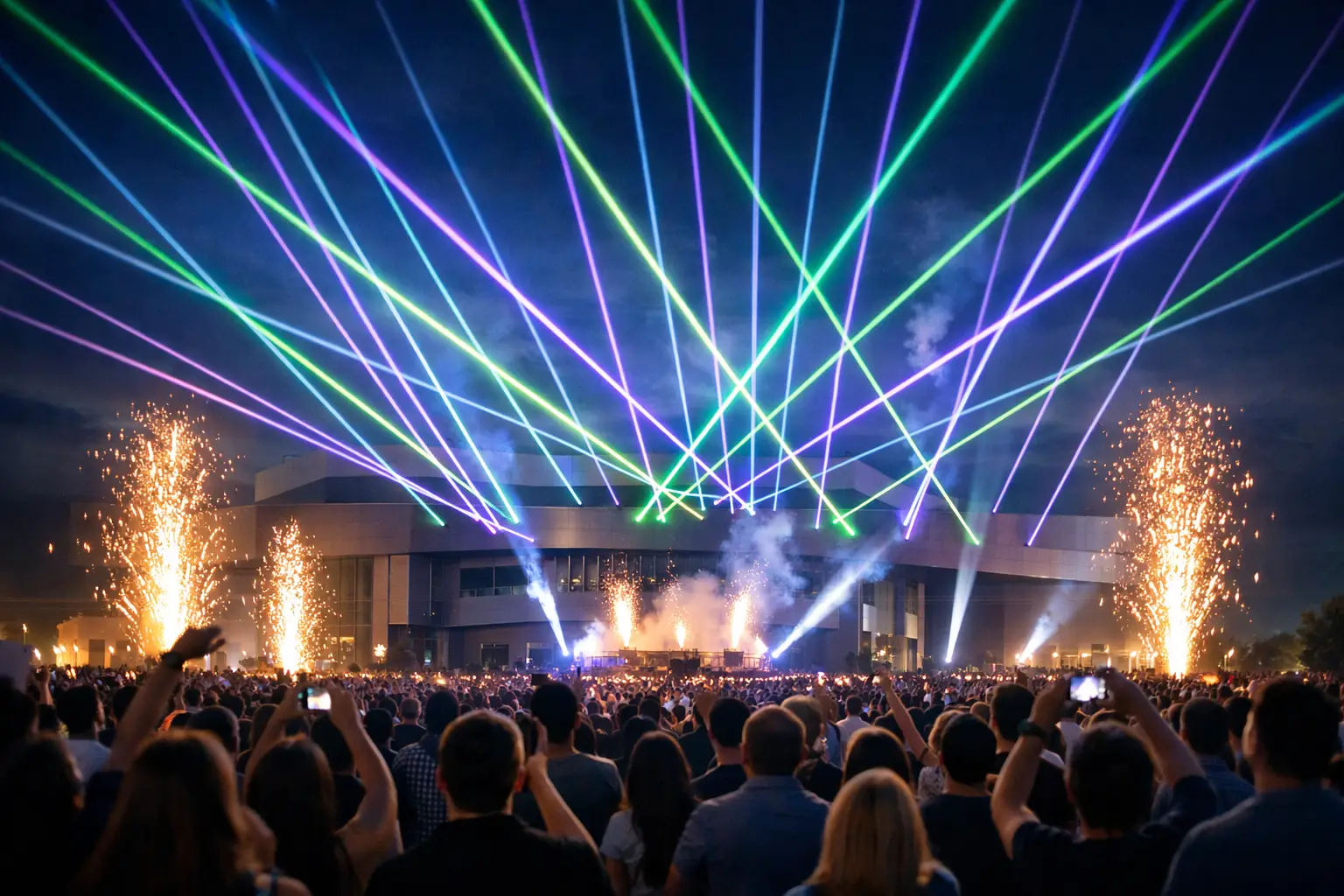
A ribbon cut is a photo moment. A laser show for grand opening is the moment people stop, look up, pull out their phones, and remember why they came. For a new store, venue, headquarters, attraction, or mixed-use development, that difference matters. The opening night is the first proof that the brand has arrived with energy, confidence, and something worth talking about.
A professional laser production turns the building, launch message, crowd, and soundtrack into one coordinated visual event. Brilliant RGB beams can frame an entrance, sweep across an outdoor plaza, fill an indoor ballroom with color, or reveal a logo in the air at exactly the right second. Done well, it is not just lighting. It is a powerful announcement.
Why a Laser Show for a Grand Opening Creates Attention
Grand openings have a short window to create momentum. Guests may be arriving from work, media teams may need a compelling visual, and the event program often has only a few minutes to make its biggest statement. Lasers concentrate that attention.
Unlike static décor, a laser show has movement, timing, scale, and a clear beginning and payoff. The lights can build with a music track as the audience gathers, shift into animated graphics during remarks, then explode into full-color aerial effects for the official opening. That rising energy gives guests a reason to stay through the reveal instead of treating the ceremony as a quick stop.
The visual value also travels beyond the venue. Crisp beam shots, crowd silhouettes, branded aerial graphics, and a dramatic countdown create social-ready footage that feels bigger than a conventional opening. For marketing teams, the result is content with an immediate sense of place and occasion.
A laser production is especially effective when the goal is to communicate one of three things: this location is a destination, this brand is entering the market with force, or this organization is investing in the community. The creative treatment changes, but the emotional message is the same: something significant is happening here.
Build the Show Around the Opening Moment
The strongest productions do not start with the projector. They start with the exact moment the client wants the crowd to feel. Is the opening centered on a ribbon cut, a CEO announcement, a product reveal, a first performance, or doors opening to the public? That answer shapes the show.
For a retail or restaurant launch, the laser sequence may act as a fast, high-energy exterior opener that pulls foot traffic toward the entrance. For a corporate headquarters, it may begin with refined architectural color and build toward a branded logo reveal after executive remarks. A concert venue, nightclub, or entertainment complex can lean harder into bass-driven beams, kinetic animation, and a more immersive party atmosphere.
Music synchronization is where the show becomes an experience rather than a collection of effects. A custom soundtrack or approved event track gives every beam sweep, logo transition, and burst of color a reason to happen. A short two- to five-minute finale can deliver enormous impact if it is timed precisely. Longer shows can work for public festivals or city-center openings, but only when there is enough audience programming to support them.
The reveal itself deserves careful choreography. A countdown can build anticipation, but it needs an answer. That might be a logo suspended in haze, lasers outlining a newly opened façade, a burst of color around a product, or beams racing overhead as the doors open. The goal is a clean visual peak that photographers, guests, and the event team can recognize instantly.
Branded imagery needs a purpose
Laser graphics can display names, logos, dates, messages, and animated effects. They are ideal for reinforcing a launch identity, but they should not become a slide deck in the sky. One memorable mark, a concise message, and a polished animation often make a stronger impression than trying to display every sponsor or talking point.
Readable graphics depend on the environment. Fog or haze makes aerial beams dramatically more visible, while a projection surface, building façade, or screen may be better for certain logos and detailed imagery. A site survey helps determine what will read clearly from the audience viewpoint.
Indoor and Outdoor Grand Openings Need Different Plans
An indoor laser show offers control. Ballroom ceilings, theaters, atriums, warehouses, and clubs can become immersive environments with carefully placed projectors, haze, music, and room-darkening. The production team can shape where guests stand, where cameras shoot, and how the visual sequence lands.
Outdoor events offer a larger canvas and bigger visual potential, particularly after dark. A laser system can reach across a plaza, fairground, parking area, or building exterior with spectacular scale. But outdoor work introduces variables that cannot be ignored: sunset time, ambient light, weather, neighboring properties, crowd flow, and local operating conditions all affect the final design.
Daylight is the most common planning reality check. Lasers are most powerful at dusk and after dark. If a grand opening must occur at noon, a laser feature can still be part of the event plan, but it should be reserved for an indoor reveal, a shaded environment, or an evening after-party. Promising nighttime intensity in full sun is not good production strategy.
Power is another early consideration. High-impact systems require reliable electrical distribution, appropriate cable paths, and a clear understanding of where control and audio positions will live. These details are invisible to guests when handled well, which is exactly the point.
Scale the System to the Space and the Audience
A small private opening and a public launch for thousands should not receive the same production package. The right system depends on venue dimensions, darkness, viewing distance, weather exposure, desired beam brightness, and whether the show includes graphics or broad aerial effects.
Professional RGB laser projectors can range from approximately 40 watts for intimate and medium-scale applications to 200 watts or more for major outdoor spectacles, stadium environments, and large public gatherings. More wattage is not automatically better. A powerful system in a compact room may be excessive, while an underpowered system at a large outdoor site can disappear against ambient light and distance.
A good production partner plans the full visual field, not just the equipment count. Projector locations must account for audience sightlines, stage activity, video cameras, speakers, signage, and the moment guests enter the space. The show should look intentional from the primary viewing area, not only from the control position.
For large civic, retail, or entertainment launches, consider the arrival experience too. A pre-show look can establish color and energy before the formal program starts. Then, when the opening sequence begins, the visual language can shift noticeably so the audience understands that the main event has arrived.
Safety Is Part of the Spectacle
High-powered lasers demand professional planning and operation. The brightest, most exciting show is only successful when it is designed around compliant audience safety practices, properly positioned equipment, and trained operators who understand the site.
This includes evaluating projector placement, beam paths, scan zones, reflective surfaces, ceiling height, overhead obstructions, and the movement of guests and staff. Outdoor productions may also require coordination related to airspace awareness and local approvals, depending on the location and show design. Venue rules, fire requirements, insurance documentation, and load-in procedures should be discussed long before event day.
This is where experienced laser producers earn their place. A licensed and insured team can turn a creative concept into a show that is visually fearless while remaining operationally disciplined. Connecticut Laser Productions brings two decades of production experience to that balance, with custom programming and scalable systems built for everything from private celebrations to massive public audiences.
Give the Production Team the Right Information Early
The fastest way to get a grand opening laser concept moving is to share the event fundamentals: the venue address, event date, expected attendance, indoor or outdoor setting, approximate show time, desired reveal moment, brand assets, and any music or messaging requirements. Photos, floor plans, site maps, and a simple event schedule are exceptionally useful.
It also helps to be honest about the priorities. If the main objective is press coverage, the show should favor a sharp reveal and camera-friendly staging. If the goal is keeping guests engaged through a VIP party, the production may focus more on atmosphere and repeated visual moments. If the opening is a community event, the design may need wider audience coverage and a program that works for guests arriving at different times.
Budget influences the scale, but it should not erase the concept. A focused, beautifully programmed show in the right location can outperform a larger setup with no clear story. The best question is not, “How many lasers can we get?” It is, “What should guests see, hear, and feel when this place officially opens?”
A grand opening gets one first night. Give it a visual signature strong enough that the crowd leaves with the launch still playing in their minds.
No responses yet