
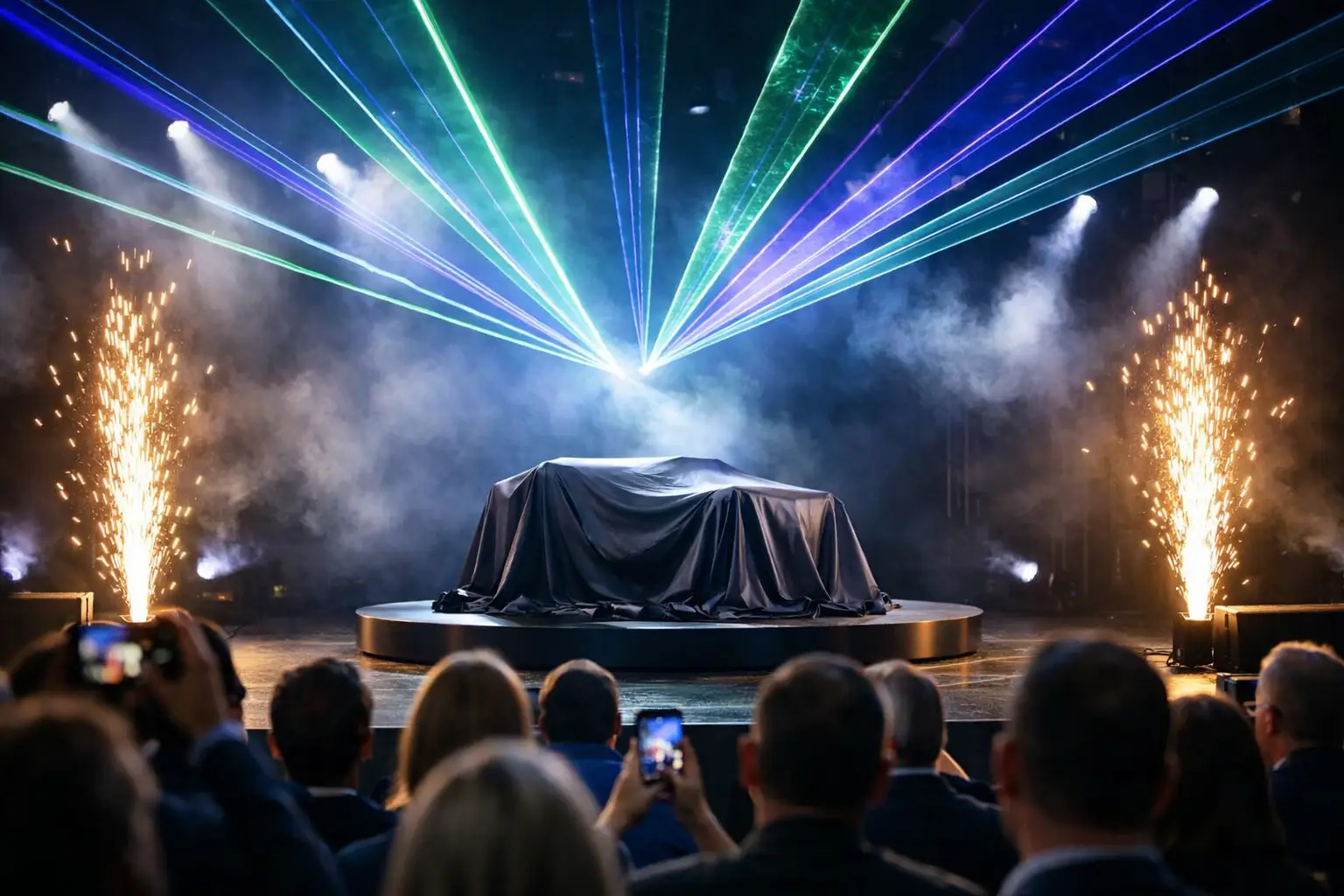
A great laser show for product launch does more than fill a room with color. It controls the instant your audience sees the product for the first time. The lights drop, the soundtrack builds, brilliant RGB beams cut through the air, and your brand story rises around the object everyone came to see. That is not a technical effect. It is the moment your launch becomes memorable.
For marketing teams, event planners, and venue producers, the real opportunity is to turn a product reveal into a full-sensory event. Laser production gives a launch scale, energy, and precision that a standard presentation screen simply cannot match. Done well, it makes the product feel larger than life while keeping the message clear.
Why a Laser Show for Product Launch Creates Attention
Product launches have a difficult job. Guests may be journalists, dealers, executives, influencers, customers, or employees, and each group arrives with a different level of interest. A laser reveal creates a shared moment before anyone has time to glance at a phone, start a side conversation, or drift toward the bar.
Lasers are uniquely effective because they create visible architecture in the room. Beams can frame a stage, sweep across a ballroom ceiling, form a tunnel of light over an entrance, or build anticipation around a covered product. Custom graphics, logos, animated effects, and synchronized music turn that visual energy into a clear brand statement.
The difference is intention. Random beams may look exciting, but a launch production must serve the reveal. The audience should understand what they are seeing, when to look, and why the moment matters. That requires custom programming, precise cueing, and a production team that knows how to make spectacle support the story.
Start With the Reveal, Not the Equipment
The best launch concepts begin with one question: what should the audience feel at the exact second the product appears?
A high-performance vehicle may call for speed, power, and sharp kinetic movement. A new consumer technology product may need crisp geometry, futuristic animation, and a clean build from darkness into intense color. A luxury product often benefits from restraint – elegant aerial beams, refined logo treatment, and a perfectly timed reveal rather than nonstop visual chaos.
This is why projector wattage alone is not the plan. A 40-watt system can create a striking indoor reveal in the right ballroom, while a 100-watt to 200-watt-plus system may be required to dominate an outdoor plaza, arena, festival field, or large convention space. Room size, ambient light, viewing distance, haze conditions, stage location, and audience count all affect the design.
The strongest approach is to build the show backward from the reveal cue. Decide how the product enters, whether it is lifted, driven, uncovered, or simply illuminated, then program the visual and musical journey that earns that moment.
Give the Audience a Story to Follow
A launch show does not need a long narrative, but it needs a progression. Start with intrigue. Introduce a visual motif connected to the product or brand. Build intensity through music, movement, and animation. Then deliver the reveal with enough contrast that the audience immediately feels the payoff.
For example, a brand introducing a new outdoor product could begin with laser animations that suggest motion, terrain, and changing weather. As the music rises, beams expand from the stage into the audience space. At the reveal, the logo resolves, the product is illuminated, and the laser system shifts from abstract energy to bold branded visuals.
The product remains the hero. Laser effects should never obscure the object or compete with the person delivering the launch message. The goal is pure visual magic with a clear focal point.
Match the Laser System to the Venue
Indoor and outdoor launches demand different production thinking. Indoors, haze can make laser beams appear almost solid, producing incredible aerial looks over a stage or audience. In a controlled environment, designers can use tighter beam patterns, projection surfaces, ceiling effects, and detailed graphic work with exceptional impact.
Outdoors, scale becomes the advantage. Powerful RGB laser projectors can throw dramatic beams across wide spaces, create massive skyward effects, and make a product reveal visible to a crowd that extends far beyond the front row. Yet outdoor work also brings variables: weather, surrounding light, sightlines, airspace considerations, power distribution, and the position of nearby roads or buildings.
A venue walkthrough or detailed site review is not optional for a serious launch. It helps identify the best projector locations, safe audience zones, potential projection surfaces, rigging opportunities, and the practical limits of the space. It also prevents a common mistake: planning a massive visual concept without accounting for bright venue lighting or a product placement that blocks the best sightlines.
Music Synchronization Makes the Moment Hit Harder
Music gives a laser show its pulse. When every sweep, burst, graphic, and color transition is synchronized to a soundtrack, the production feels designed rather than added at the last minute.
The reveal cue deserves special attention. A hard musical hit can work beautifully for an automotive, sports, or technology launch. A slow cinematic rise may be better for a premium brand. Sometimes a brief moment of near-silence before the reveal creates more tension than another loud effect. It depends on the product personality and the room.
Custom laser programming also makes it possible to integrate logos, names, taglines, abstract brand shapes, and product-inspired animations. The most effective graphics are bold and legible. Fine detail can disappear at long distances or in bright environments, so production designers should favor clear shapes and high-contrast content that reads instantly.
Build Safety Into the Spectacle
High-powered laser production is specialized work. The same precision that creates breathtaking effects must be applied to safety planning, equipment placement, beam termination, audience scanning decisions, operational controls, and compliance.
Professional laser operators evaluate the venue and show design before the event, not during load-in. They understand where beams can travel, how reflective surfaces can change the environment, and how to maintain the visual impact without exposing guests, staff, performers, or cameras to avoidable risk.
This matters especially for product launches with valuable inventory, executive speakers, live streaming, press cameras, and tightly managed schedules. A licensed and insured production partner brings more than powerful equipment. They bring the experience to execute confidently when the room is full and the countdown has started.
Connecticut Laser Productions combines custom, music-synchronized laser design with professional systems ranging from intimate indoor setups to major outdoor productions. That flexibility matters when the launch needs to look spectacular without forcing a one-size-fits-all show into the venue.
Plan Enough Time for Creative and Technical Decisions
A laser launch can be developed quickly when the concept is focused and the venue is straightforward. Larger reveals need more lead time, especially when they involve custom content, rigging, outdoor logistics, multiple departments, rehearsals, or a product mechanism such as a lift, turntable, curtain, or vehicle entrance.
The production conversation should include the event schedule, product dimensions, stage drawings, venue lighting plan, music direction, brand assets, speaker cues, and any video or lighting elements already in play. Lasers are at their best when they are integrated with the wider show, not asked to rescue a flat reveal five minutes before doors open.
If the budget requires choices, protect the reveal itself first. A shorter custom sequence with powerful timing often outperforms an extended show filled with generic effects. Put the investment where attention is highest: the entrance, the countdown, the product appearance, and the final branded image guests will photograph and share.
Make the Reveal Worth Capturing
Your in-room audience is only part of the launch audience. A visual reveal may travel through press photos, social clips, livestream footage, internal recaps, and attendee posts long after the event ends.
That means camera positions should be considered during the design process. Some laser angles look incredible from the audience but may not read well on video. Haze density, ambient lighting, screen brightness, and graphic placement can all influence what a camera captures. A quick rehearsal with production cameras can prevent surprises and help the team identify the hero shot.
The best launch reveals leave guests with a simple reaction: they had to be there. Give them that feeling, then give them a visual bold enough to carry the story beyond the room.
No responses yet