
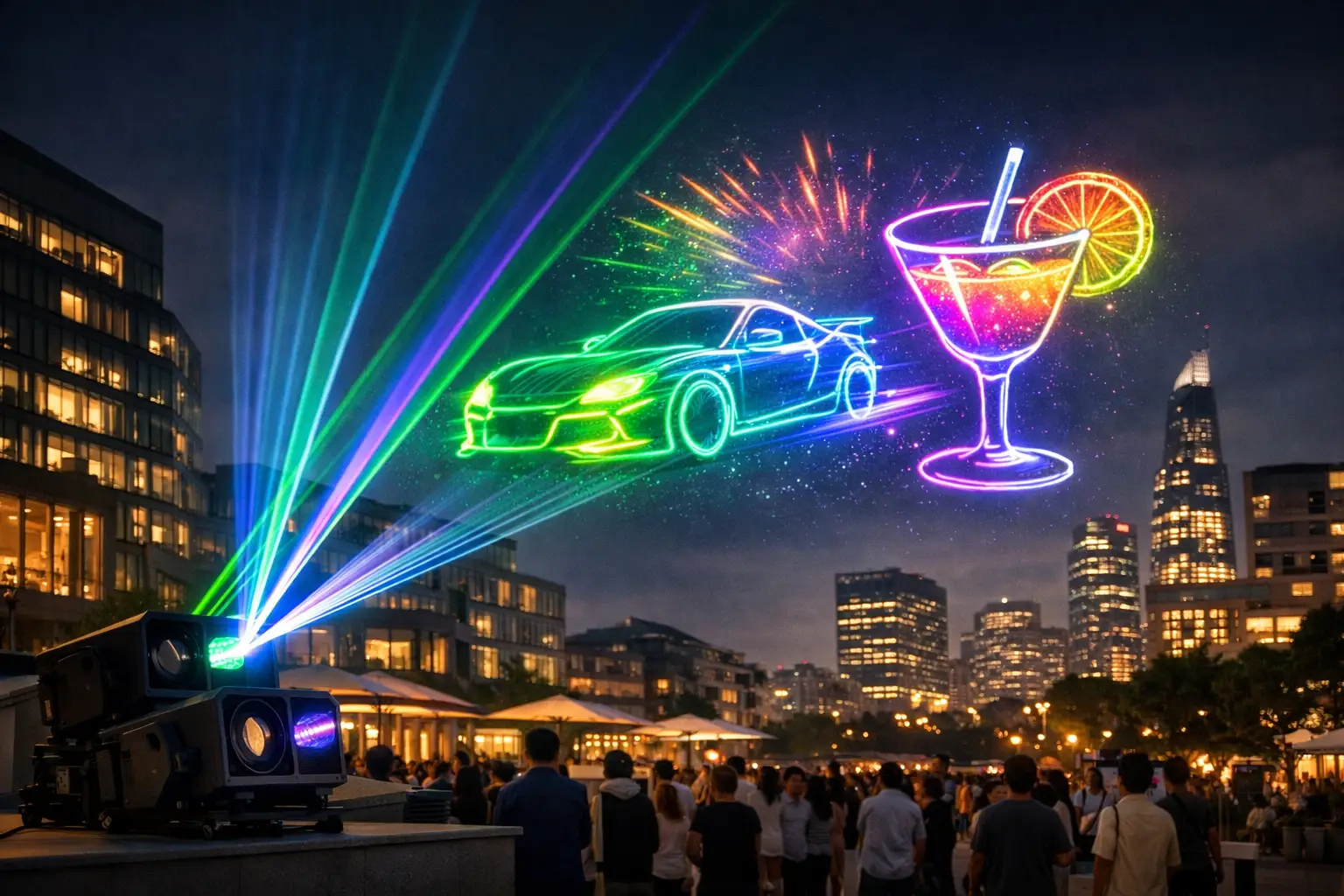
A product launch has one chance to make people stop scrolling, look up, and remember the name behind the moment. Laser advertising systems turn that opportunity into pure visual magic – vivid RGB color, oversized logos, animated graphics, and beams that transform a familiar venue into a branded spectacle. Done well, a laser display does not simply show an ad. It gives an audience a reason to film it, share it, and talk about it long after the event ends.
For marketers, event producers, and venue teams, that difference matters. A standard sign occupies space. A custom laser production can command the room, define the countdown, punctuate the reveal, and put the brand at the center of an unforgettable live experience.
What Laser Advertising Systems Actually Do
Laser advertising systems use professional RGB laser projectors and custom show programming to display branded visual content at an event or installation. Depending on the environment, that content may include animated logos, product outlines, messages, countdowns, moving aerial beams, and graphic effects synchronized to music or live show cues.
The strongest applications combine projection with performance. A logo can appear above a stage just before a keynote begins. A new vehicle silhouette can trace itself across a projection surface before the reveal. At a festival, laser graphics can carry a sponsor identity through the same high-energy visual language audiences expect from a headline concert.
This is why lasers work especially well for brands that need more than visibility. They create anticipation. They add movement and scale. And when the timing is right, they make a brand message feel like part of the entertainment rather than an interruption.
A Logo Is Only the Starting Point
Static logos have their place, but laser advertising becomes far more powerful when the creative is built for motion. A clean logo animation, a burst of color timed to music, or a product shape that builds line by line can create a far bigger emotional hit than simply placing a mark on a wall.
The creative approach should match the event. A luxury brand may want restrained, elegant animation and precise color treatment. A sports promotion may call for fast movement, bold beams, and a high-impact countdown. A municipal celebration may need sponsor recognition that feels festive without taking attention away from the main program.
The message must also be designed for the audience’s viewing distance. Fine text that looks perfect on a computer screen can disappear across a large venue. High-contrast artwork, simplified shapes, and short, readable messaging tend to deliver the clearest results when projected at scale.
Indoor and Outdoor Displays Need Different Thinking
Indoor laser advertising often has the advantage of controlled darkness, defined sightlines, haze effects, and a captive audience. Ballrooms, theaters, nightclubs, arenas, convention spaces, and product-launch environments can all support brilliant branded visuals when the projector position and projection surface are planned correctly.
Outdoor displays can feel even bigger, especially at festivals, fairs, sporting events, grand openings, and city celebrations. They also require more production planning. Ambient light, weather, surface color, viewing distance, local requirements, and airspace considerations can all affect what is possible. A dazzling outdoor concept should be evaluated on-site before anyone promises a particular look or coverage area.
Choosing the Right System for the Show
The projector is not just a piece of equipment in the background. Its output, color performance, optics, scanning capability, and control setup shape the final result. A small indoor logo projection may need a very different solution than a stadium pre-show or a large outdoor branded activation.
Professional systems commonly range from high-powered 40-watt units to 200 watts or more for major outdoor productions. More wattage can deliver stronger visibility over distance and in challenging conditions, but it is not automatically the right answer. An oversized projector in a smaller room can be unnecessary, while an underpowered unit at a sunlit outdoor event may leave the creative looking weak.
The right question is not, “What is the biggest laser available?” It is, “What system will create the intended visual impact safely in this exact environment?” That answer depends on the venue, the show design, the audience position, and the desired moment.
Color, Projection Surfaces, and Atmosphere
RGB laser projectors can produce saturated color that cuts through an event environment with remarkable intensity. Yet color alone does not guarantee a great advertising display. The projection surface matters just as much. Smooth, light-colored surfaces generally give graphic content the clarity it needs. Architectural features can also become part of the design, provided the artwork is programmed around them rather than fighting them.
Atmospheric haze can add another dimension by making aerial beams visible in the air. This is a spectacular option for concerts, nightclub environments, and indoor launches, where the audience can see a tunnel of light or a canopy of moving color. But haze is not always appropriate. A corporate meeting, historic venue, or outdoor activation may require a graphics-first approach with little or no atmospheric effect.
A skilled production team balances all of these elements so the show feels intentional. The audience should see a bold, polished experience, not a collection of technical effects competing for attention.
Safety Is Part of the Spectacle
High-impact laser advertising is professional production work, not a plug-and-play lighting add-on. Powerful laser systems require trained operators, careful placement, controlled programming, and a clear understanding of the venue and audience environment.
A proper plan addresses projector mounting, beam paths, safe audience separation, emergency procedures, power distribution, weather protection where needed, and applicable local, federal, venue, or airspace requirements. For outdoor events, the timeline should allow for any needed coordination well before show day. Last-minute planning can limit creative options and add avoidable risk.
This is also where experienced operators make a visible difference. They know how to preserve the wow factor while respecting safety boundaries. The result is a display that feels massive, immersive, and confident because every cue has been engineered and executed with precision.
Connecticut Laser Productions brings more than 20 years of laser-production experience to these decisions, with licensed and insured operators and scalable professional systems for events ranging from private celebrations to major public audiences.
Build the Campaign Around a Moment Worth Capturing
The most effective laser advertising is tied to a specific audience moment. It may be the final seconds before a launch, a sponsor reveal between performances, the opening of a new venue, or a branded finale that sends guests outside with their phones already recording.
Start by defining what the audience should feel. Excitement before a reveal? Pride at a hometown event? High energy at a concert? Then determine what they need to see in order to feel it. That process leads naturally to the creative treatment, music timing, messaging, projector placement, and show length.
A laser sequence does not need to run for an hour to make an impression. Often, a focused 30- to 90-second branded reveal with exceptional timing hits harder than a longer sequence without a clear story. Repetition can be useful at a festival or retail activation where guests arrive throughout the evening, but the content still needs variation and pacing to stay fresh.
Plan Early Enough to Make It Custom
Custom programming is where a laser production becomes a signature brand experience. It takes time to prepare logo artwork, convert it for laser display, create animations, synchronize cues, test visibility, and adapt the show to the venue.
Bring the laser team in while the event layout is still flexible. That gives production, marketing, and venue stakeholders time to choose the strongest projection surfaces, establish sightlines, coordinate lighting and video, and protect the branded moment from competing visual distractions.
If the event has a production schedule, treat the laser reveal as a featured cue, not an afterthought. Give it the music, lighting blackout, emcee setup, and audience attention it deserves. The difference between “a logo appeared” and “the room erupted” is often just a few seconds of disciplined show timing.
Make the Brand Impossible to Ignore
Laser advertising systems are at their best when they support a live moment people genuinely want to experience. Choose the right system for the environment, keep the creative bold and readable, and put experienced professionals in charge of safety and execution. When the countdown reaches zero, your audience should not just see the brand. They should feel like they were there for something extraordinary.
No responses yet