
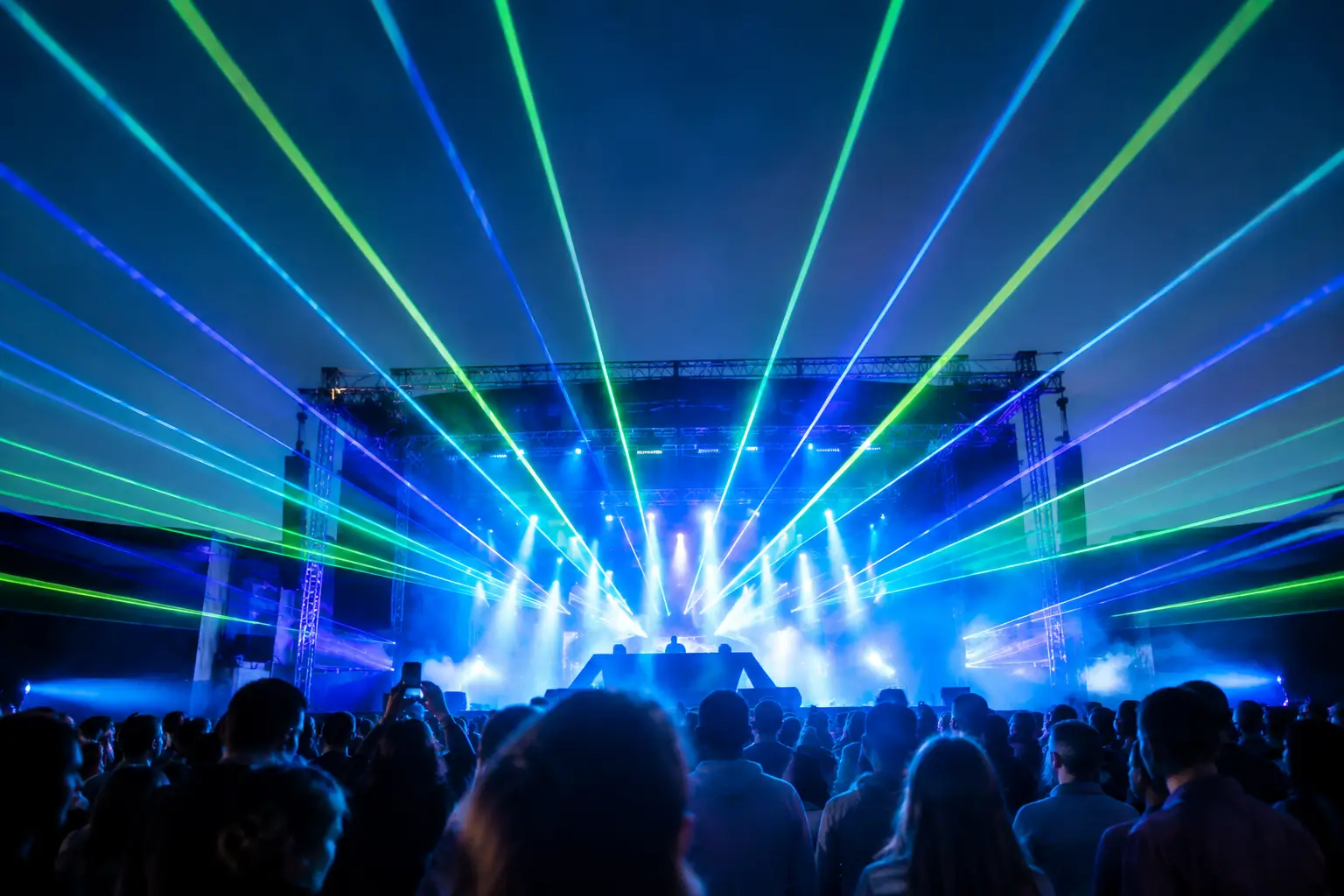
A 5-watt laser can transform a dark ballroom. A 100-watt system can cut through the night above a packed fairground. So, how bright are event lasers? The honest answer is that wattage matters, but it is only one part of what makes a laser show look massive, sharp, and impossible to ignore.
A professional event laser is not judged the way a household light bulb is judged. Its impact comes from concentrated beams of RGB light, precise optics, atmospheric conditions, viewing distance, projection surfaces, and expert programming. The right system creates pure visual magic – aerial beams, sweeping tunnels, animated logos, and music-synchronized moments that make an audience stop looking at their phones and look up.
How Bright Are Event Lasers in Real Event Conditions?
Professional laser projectors are commonly measured in watts of optical output. More watts generally mean a more visible beam over longer distances and greater ability to compete with ambient light. But “more” is not automatically “better.” A properly selected 20-watt projector can look spectacular in the right indoor environment, while a poorly placed 80-watt system can lose impact without haze, thoughtful angles, or a suitable projection field.
For event production, the practical range is broad. Smaller indoor celebrations may call for lower-output professional systems designed around the room, ceiling height, and audience layout. Concert stages, large ballrooms, clubs, theaters, and corporate launches often benefit from higher-output RGB projectors that maintain vivid color and beam definition across a larger footprint. Outdoor festivals, stadium events, municipal celebrations, and long-throw branded projections may require 40 watts, 80 watts, 100 watts, or 200 watts and beyond.
That difference is not subtle. High-powered lasers can project intensely visible beams across enormous outdoor spaces, paint architectural surfaces with oversized graphics, and create aerial effects that feel larger than the stage itself. Yet the goal is never to bring the biggest projector available just for the number on its label. The goal is to deliver the biggest visual impact for the conditions of the show.
Watts Measure Output, Not the Whole Experience
Laser wattage refers to optical power, not a direct equivalent to lumens. Lumens are useful for many conventional lighting fixtures because they measure visible light as perceived by the human eye. Lasers are different: their light is highly collimated, meaning it stays concentrated in a narrow beam over distance rather than spreading broadly like a wash light.
That concentration is why a laser beam can remain visibly defined far from its source. It is also why professional laser design requires experience, controlled geometry, and compliant operation. A powerful laser projector is precision entertainment equipment, not a plug-and-play party accessory.
Brightness perception also changes by color. Green is typically perceived as especially bright to the human eye, while blue and deep red may require more output to feel equally forceful. A full-color RGB projector blends red, green, and blue laser sources to create rich color palettes, but the color balance must be engineered well. A show filled with clean whites, electric blues, vivid greens, and saturated magentas needs both power and calibration to look polished.
Beam brightness versus graphic brightness
Aerial beams and projected graphics use laser power differently. A beam effect concentrates light into lines, fans, cones, tunnels, and sweeping aerial patterns. It can look enormous with the help of haze because tiny particles in the air reveal the path of the beam.
Graphics, text, logos, and animations spread the available output across a larger scanned image. A crisp company logo projected onto a wall may need more power than a single beam cutting across the same room, especially if the projection surface is distant or ambient lighting is high. Complex animations also require fast, accurate scanners and clean programming. Brightness alone cannot rescue distorted artwork or a poorly designed cue.
What Makes Lasers Look Brighter at an Event?
The environment can make a dramatic difference. Indoors, controlled darkness and a carefully managed haze level let even moderate-power systems create jaw-dropping depth. In a nightclub, theater, wedding reception, or bar mitzvah, beams can form a ceiling of color, frame a dance floor, or burst outward during a key musical moment.
Outdoors, there is more competition. Streetlights, video walls, stage washes, parking-lot lighting, moonlight, and surrounding buildings all influence what the audience sees. Longer throw distances also demand more power. A laser effect that dominates a 100-foot indoor room may disappear against a brightly lit outdoor sky if it is expected to travel hundreds of feet.
Haze is another major factor. Without particles in the air, an audience mostly sees where a laser lands, not the beam traveling through space. With the right amount of professional haze, the beam becomes a three-dimensional feature of the show. Too little haze and the effect lacks body. Too much haze and the room can look cloudy, reducing the clarity of lighting, video, and the audience experience. The sweet spot is controlled atmosphere, not fog for fog’s sake.
Projection distance, surface color, and surface texture matter as well. A white building façade reflects graphics differently than brick, glass, trees, or a dark stage backdrop. A custom production team evaluates these realities before show day, then programs content around what will actually look exceptional in the venue.
Choosing the Right Laser Power for Your Venue
A small private party does not need stadium-scale output to feel extraordinary. In fact, oversizing the system can create unnecessary cost, operational complexity, and visual imbalance. The best laser shows feel intentional: every beam, color change, graphic, and musical hit belongs in the room.
For intimate indoor events, a compact professional RGB system can create a high-end dance floor experience, reveal names or monograms, and deliver powerful aerial looks. Mid-size corporate events and theater productions may need more output and multiple projector positions to cover a wider room, larger stage, or audience entrance sequence.
For outdoor fairs, concerts, sporting events, and city celebrations, high-powered projectors create the scale audiences expect. Multiple laser positions can widen the field of view, create synchronized crossfire effects, or frame a stage from several angles. At this level, show design becomes a coordinated production discipline involving lasers, lighting, video, sound, timing, sightlines, weather planning, and safety management.
Connecticut Laser Productions scales systems from intimate celebrations to major public spectacles, including high-powered RGB projectors in the 40-watt to 200-watt-plus range. That range exists for a reason: each event has its own visual target, physical footprint, and production demands.
Bright Enough Must Also Mean Professionally Safe
The same qualities that make event lasers thrilling – concentrated power, long reach, and razor-sharp definition – demand professional control. Licensed and insured laser operators assess projector placement, beam termination, audience areas, reflective surfaces, aircraft considerations for outdoor productions, and applicable federal, state, and local requirements.
This is especially critical when planners ask for audience scanning, rooftop projection, outdoor sky effects, or installation in a venue with mirrors, glass, low ceilings, or unusual architecture. These effects may be possible under specific controlled conditions, but they should never be improvised. A compliant show is designed from the beginning around the venue and the effect, not adjusted after guests arrive.
Professional operation also protects the creative result. When technicians have planned the geometry, programmed the cues, and tested the system, the laser show feels effortless to the audience. They see a breathtaking visual spectacle. Behind the scenes, they are seeing careful engineering, experienced operators, and a production team making thousands of precise decisions.
The Better Question to Ask
Rather than asking only, “How many watts do we need?” ask what you want people to feel when the room goes dark or the headline act takes the stage. Do you want an elegant first-dance reveal, a branded product-launch moment, a nightclub-style dance floor, a concert-sized beam barrage, or a citywide finale that turns a familiar skyline into a living canvas?
Those answers determine the right laser power, projector count, haze plan, programming style, and operational approach. When the system matches the moment, event lasers do more than look bright. They create the kind of high-energy, camera-ready memory guests talk about long after the final beam fades.
No responses yet