
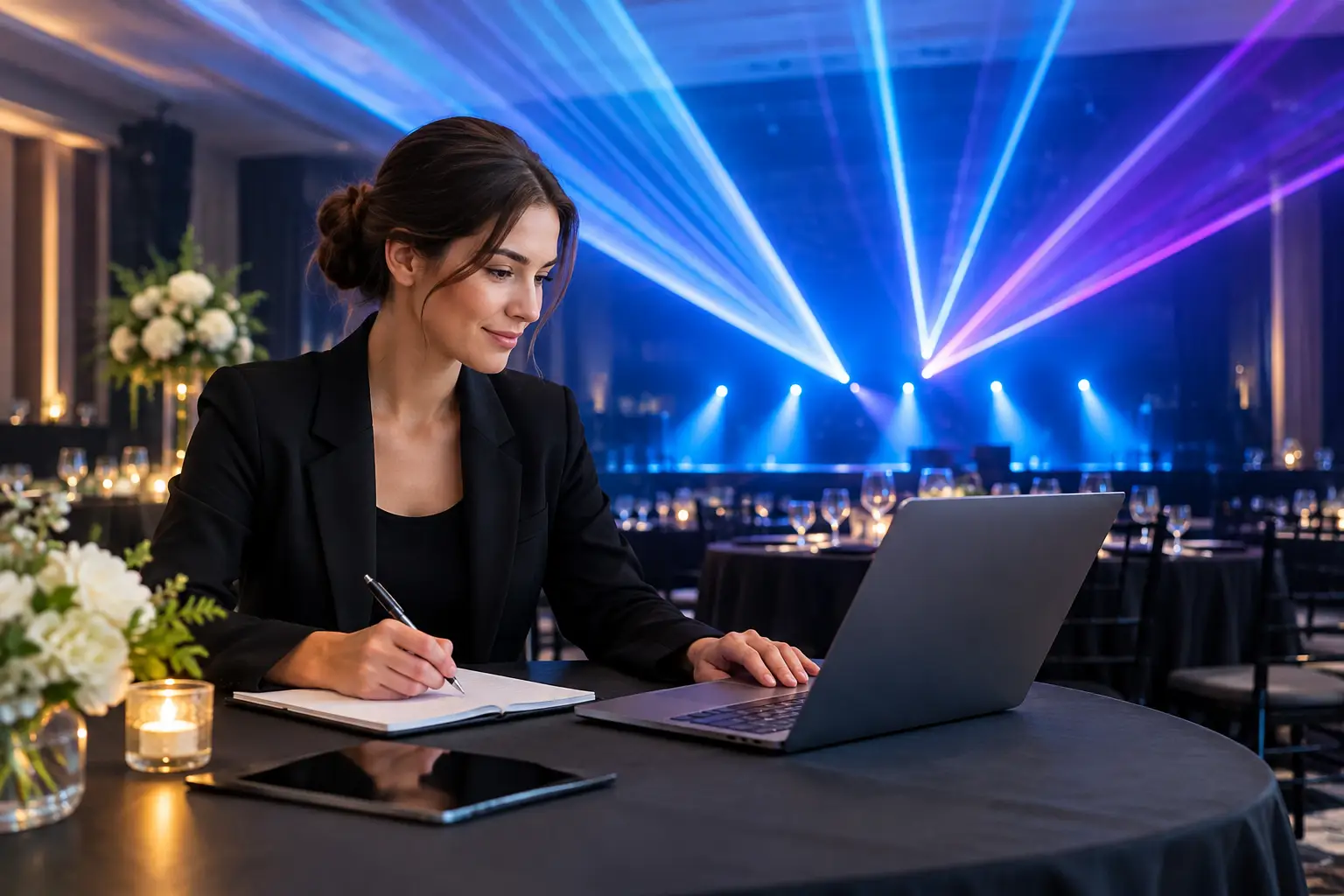
A gala budget can disappear fast into florals, table settings, entertainment, and catering, then leave the room feeling visually flat once the lights go down. Knowing how to budget gala lasers lets you reserve funds for the moment guests will film, post, and remember: an immersive burst of color, movement, music, and pure visual magic.
Laser production is not a decorative add-on pulled from a warehouse. A properly designed show is a live visual system shaped around your venue, audience, program, music, sightlines, and safety requirements. The right budget starts by deciding what you want the room to feel like, then matching the production scale to that vision.
Start With the Gala Moment You Need to Own
Not every gala needs a full-length laser spectacular. Some events need a dramatic opening look as guests enter the ballroom. Others need a 60-second award walk-on that turns a donor recognition moment into a show. A fundraising gala may build toward a high-energy live-auction reveal, while a brand gala may need custom laser graphics that put the campaign identity in the air.
This decision has more impact on cost than almost anything else. A tightly programmed entrance, reveal, or finale can create a massive WOW factor with a controlled production footprint. A multi-act production that runs throughout dinner, features several music cues, and includes evolving animations requires more creative programming, crew time, equipment, and rehearsal coordination.
Before requesting a quote, define the centerpiece. Is the laser show there to launch the event, support a performance, elevate an awards presentation, reveal a product, or send guests out on a high note? One clear answer prevents spending money on effects that are impressive but disconnected from the evening’s purpose.
How to Budget Gala Lasers by Scale
The most useful way to budget is to think in production tiers, not a single equipment price. Two galas with the same guest count can require completely different systems. A 250-person black-tie dinner in a low-ceiling ballroom is not the same technical job as a 1,500-person gala in an aircraft hangar, museum courtyard, arena floor, or outdoor tent.
A focused ballroom package generally allocates budget toward a professional RGB laser projector, a licensed operator, safety planning, show control, haze or atmospheric support where allowed, and a concise custom sequence. This approach is ideal when the goal is high-impact beams, elegant color, and a major featured moment without building an all-night concert environment.
A larger gala production may add multiple projectors, higher-wattage systems, custom logo animation, synchronized content, additional operators, longer programming, truss or elevated placement, and more extensive site coordination. At the top end, large indoor venues and outdoor gala environments may call for 40-watt through 200-watt-plus laser systems designed to cut through big spaces and command attention across long viewing distances.
Do not assume more watts automatically means a better event. Power must suit the room, ambient light, beam distance, and desired effect. A powerful system placed in the wrong position can be less effective than a precisely selected projector with clean sightlines and smart programming. The goal is not to fill the quote with maximum hardware. The goal is to make the room erupt at the right moment.
Budget for the Elements That Actually Create the Spectacle
A laser quote is shaped by more than the projector. The production value guests experience comes from the complete system behind it.
Custom programming is often where a gala becomes distinctive. Music-synchronized beams, animated monograms, sponsor recognition, donor names, product outlines, countdowns, and themed graphics take planning and programming time. If branded visuals are central to the event, provide approved logos, fonts, color standards, and messaging early. Late creative changes can affect both schedule and cost.
Venue conditions also matter. Lasers are most visible when the environment supports them. Ballroom lighting, scenic LED walls, window walls, ceiling height, stage orientation, haze restrictions, and room turn times can all change the design. A bright room with heavy architectural lighting may need a different visual strategy than a dark theater or outdoor nighttime gala.
Music synchronization is another budget decision. If the show must hit exact cues in a live band arrangement, a keynote walk-on, or a choreographed performance, account for advance audio planning and rehearsal time. A perfectly timed 90-second sequence can feel more expensive than an hour of generic visual effects because it is built to land with precision.
If your gala has several production departments, put lasers into the same early conversation as lighting, audio, video, staging, and scenic design. This avoids paying later to relocate fixtures, solve blocked sightlines, or revise a design that another vendor has unintentionally covered.
Treat Safety and Compliance as Core Line Items
High-powered laser effects demand professional operation. That is not the place to bargain hunt.
Your budget should include qualified operators, appropriate safety processes, properly maintained equipment, and coordination with the venue and local authorities when required. Indoor and outdoor laser shows involve different planning considerations, and public-facing events can introduce additional review requirements. Rooflines, aircraft activity, reflective surfaces, balconies, audience zones, and camera positions all affect the final plan.
A credible production partner will ask questions about the site before promising a specific setup. That is a good sign. Safety-compliant design protects guests, protects the venue, and protects the visual impact of the show. It also gives planners confidence that the spectacular moment will not become a last-minute operational problem.
Connecticut Laser Productions brings more than 20 years of laser-production experience to this process, with licensed and insured operation built around custom show design rather than one-size-fits-all effects.
Separate Must-Haves From Nice-to-Haves
When budgets tighten, protect the elements guests will notice most: the right projector power for the environment, a professional operator, safe placement, and programming built around a major event cue. These are the foundation of the experience.
Then identify enhancements that can be adjusted. Additional laser positions, extended show length, complex custom animation, multiple branded sequences, scenic integration, and expanded rehearsal windows can all be valuable, but they are not equally necessary for every gala. A short, meticulously designed reveal may deliver more emotional impact than a longer show with too many competing ideas.
Be candid about your ceiling early. A professional production team can often propose a concept that respects it, such as concentrating resources on an opening or finale rather than spreading the system thin across the entire event. The best production design creates the feeling of excess without wasting spend where the audience will not see it.
Plan Early Enough to Keep Options Open
Gala laser budgets get harder to control when the show is considered after the venue is contracted, the stage plot is locked, and the lighting package is already installed. Early planning gives the production team more flexibility with placement, rigging, power, crew calls, and creative development.
Aim to begin the conversation as soon as your date, venue, and broad event concept are in place. You do not need every song or speech finalized. You do need the basics: guest count, room or outdoor footprint, event schedule, desired laser moment, entertainment plan, brand assets, and any venue restrictions you already know.
Ask for a proposal that clearly separates the core production from optional upgrades. That makes approvals easier and helps stakeholders understand what each investment changes on the floor. It also gives you a practical contingency path if a sponsor comes aboard, attendance grows, or the creative vision expands.
A gala is built from details, but its biggest memory usually comes from one extraordinary moment. Put the laser budget behind that moment, give the creative team the information they need, and let the room see what your event is capable of.
No responses yet