


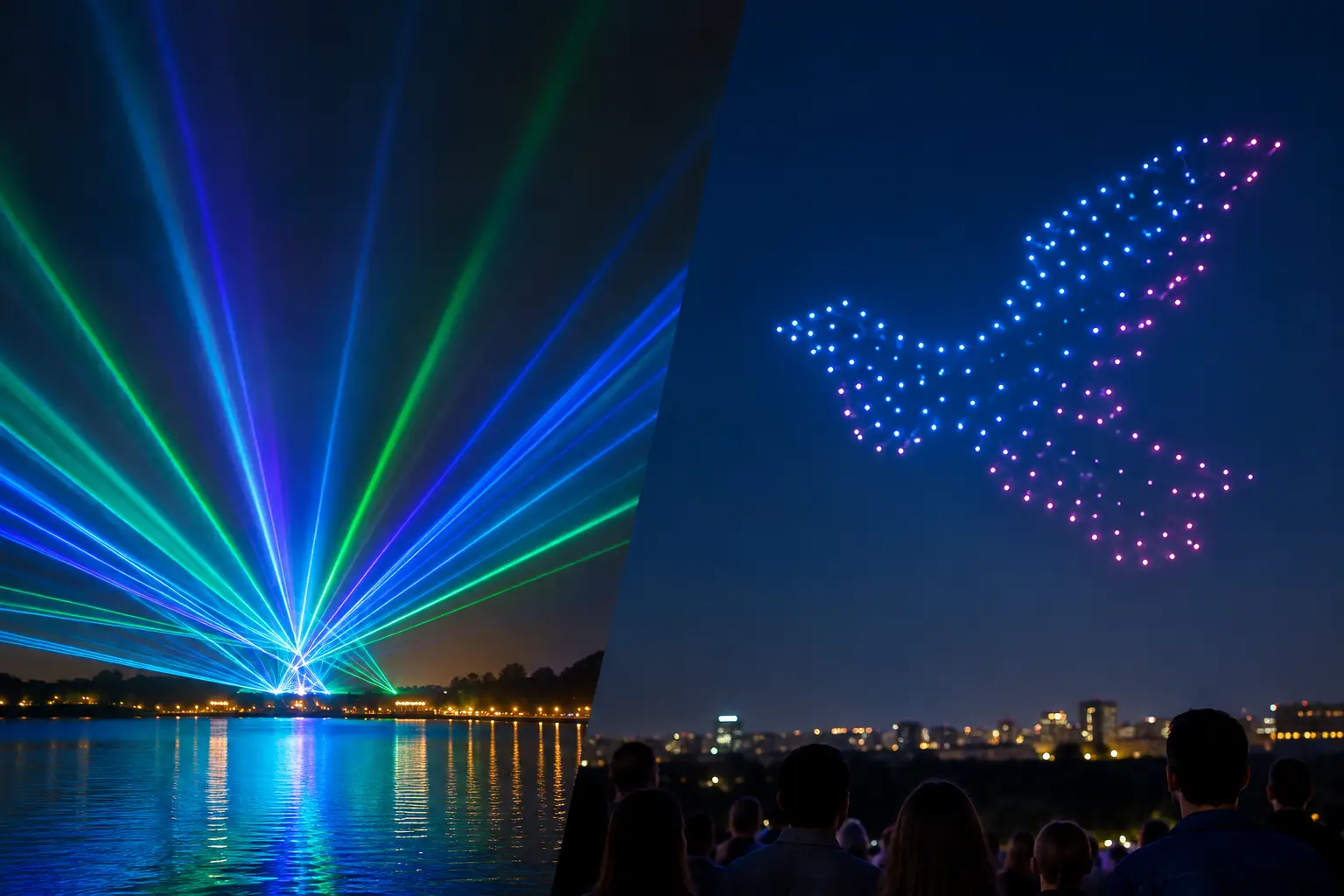
A stadium goes dark. Music rises, and the first cue hits: either hundreds of illuminated points lifting into a skyline image or razor-sharp color slicing through the air above the crowd. Laser beams versus drone shows is not simply a question of which technology looks cooler. It is a production decision that affects your creative possibilities, venue plan, budget, safety process, weather exposure, and the way guests feel inside the moment.
For the right event, either option can create a breathtaking visual spectacle. The deciding factor is whether you need a picture in the sky or a full-sensory environment around the audience.
Laser Beams Versus Drone Shows: The Core Difference
A drone show is built from individual aircraft carrying LED lights. Those points of light move into formations to create logos, characters, messages, flags, and large-scale animated pictures against an open night sky. It is aerial choreography, viewed primarily from a distance.
A laser show uses precisely controlled beams of RGB light to draw graphics, create volumetric aerial effects, sweep an arena, frame a stage, and synchronize color, movement, and animation to music. With the right haze or atmospheric effects, lasers turn empty space into a living visual canvas. Instead of watching a display above the venue, the crowd can feel surrounded by it.
That distinction matters. If your headline idea is a giant aerial logo over a waterfront, a drone fleet may be the better creative vehicle. If you want a concert opener that hits with massive energy, a corporate reveal that transforms a ballroom, or a nightclub environment pulsing with every beat, high-powered lasers deliver a more immediate, immersive punch.
When Laser Shows Create the Bigger WOW Factor
Lasers excel when the audience is close to the action. A beam can appear to stop in midair, fan across a stage, form a canopy over a dance floor, or explode into fast-moving geometric patterns timed to a musical drop. That is pure visual magic in an indoor venue, under a festival tent, across a concert stage, or at a sporting event where the show needs to ignite the crowd before the main moment.
The emotional advantage is speed and intensity. Laser cues can shift from elegant and cinematic to full-throttle in a fraction of a second. They can support a speaker entrance, trace a product silhouette, fill a room for a wedding first dance, or create mind-blowing animations behind a touring artist. A professional system can also be scaled to fit the room and viewing distance, from intimate celebrations to stadium audiences.
Power matters, but it is not the only factor. A 40-watt system may be a strong fit for certain indoor productions, while outdoor concerts, municipal celebrations, and major festival environments may call for 100-watt, 200-watt, or larger systems. Projector placement, beam layout, ambient light, haze, surface material, music programming, and sightlines all shape the final result.
Lasers are especially effective for events that already have a stage, truss, lighting package, or production infrastructure. They integrate naturally with lighting, video, pyrotechnics where permitted, scenic elements, and sound design. The result is not a separate attraction added at the end of the night. It becomes part of the show itself.
Where Drone Shows Have a Real Advantage
Drone shows have a visual language that lasers cannot duplicate: recognizable images floating at great height over a large outdoor landscape. For a city anniversary, destination event, waterfront celebration, or brand activation with a wide-open viewing area, a fleet can create an unmistakable aerial logo or a story told through animated formations.
They also offer a strong alternative in locations where fireworks are restricted or where the organizer wants a lower-noise visual feature. A drone performance can be thoughtful, elegant, and highly shareable, particularly when the crowd is gathered at a distance with an unobstructed view of the sky.
Still, a drone show is not automatically the better choice for every outdoor event. Its imagery is typically most powerful from the designated viewing zone. Guests positioned far to the side, behind structures, or beneath tree cover may not see the formation as intended. Lasers can be designed around stages, facades, fields, and audience zones, creating impact from multiple angles when the production plan supports it.
Venue and Weather Can Make the Decision for You
Indoor venues strongly favor lasers. Drone operations indoors are possible only in very controlled circumstances and are generally impractical for packed ballrooms, theaters, convention spaces, and live concert rooms. Lasers, by contrast, thrive in these settings because darkness, controlled haze, and close audience proximity enhance the effect.
Outdoors, both options need careful planning. Drone shows require suitable launch and landing areas, a protected operational perimeter, adequate airspace clearance, and coordination with local authorities and aviation requirements. Wind, rain, lightning, and visibility can delay or cancel a flight plan. Battery management and fleet logistics also affect timing.
Outdoor lasers have their own realities. They look best after dark, and their visibility depends on ambient light and atmospheric conditions. Light haze can make aerial beams look enormous, while heavy rain or fog can complicate operations and visibility. Skyward laser effects require proper regulatory coordination and professional safety planning. A serious laser provider evaluates the site before deciding what effects can be safely and legally delivered.
Neither technology should be booked on a mood board alone. A site survey and a real conversation about audience placement, show time, surrounding lighting, nearby roads, airport considerations, and backup plans will protect the experience you are paying for.
Cost Is About More Than the Show Runtime
A drone show can involve a sizable logistical footprint before the first aircraft lifts off. The fleet size, custom animation, travel, flight crew, permits, security, operational area, and weather contingency all contribute to the final number. For a landmark outdoor moment, that investment can make perfect sense.
Laser productions can also range widely in cost, especially when they include custom programming, multiple projectors, large outdoor beam systems, projection surfaces, haze equipment, truss, labor, and synchronization with a full lighting or video package. The difference is that a laser show can often be built in layers. A client may begin with a focused stage effect and expand into a venue-wide spectacle as the event scale grows.
For corporate teams and private hosts, this flexibility can be decisive. You do not need a stadium budget to create a dramatic entrance, reveal, or dance-floor transformation. For major public events, multiple high-output projectors can deliver a massive visual signature without requiring the airspace and ground footprint of a drone fleet.
Safety Is Part of the Spectacle
The best visual effects are the ones guests can enjoy without thinking about the technical work happening behind them. That means qualified operators, correctly positioned equipment, approved beam paths, controlled audience areas, documented procedures, and equipment suited to the environment.
Professional laser production is not the same as placing a consumer projector near a stage. High-powered lasers demand trained, safety-compliant operation. The system must be designed so beams, scanning effects, termination points, and audience exposure are properly managed. Experienced teams also understand how to preserve the visual impact without compromising the safety plan.
Drone productions require equally disciplined procedures: trained flight crews, aircraft inspection, geofencing or operational boundaries, secure launch zones, crowd management, and weather monitoring. A polished show depends on preparation long before showtime.
Choose the Story You Want Guests to Feel
Choose drones when the event needs a giant aerial image, a skyline-scale logo, or a carefully choreographed outdoor feature viewed from a broad central area. They are built for visual storytelling in the sky.
Choose lasers when you want the audience inside the visual moment: beams racing over a concert crowd, animated graphics erupting behind a product launch, color and movement transforming a ballroom, or a stadium entrance that feels electric from the first note. Connecticut Laser Productions builds that kind of custom, music-synchronized impact with scalable professional systems and experienced operators.
For some major events, the strongest answer is not either-or. A drone display can own the distant sky while lasers energize the stage, grounds, or crowd below. But if the budget supports only one, let the venue and the feeling you want to create lead the decision. Start with the moment guests should remember when they pull out their phones, then build the technology around that moment.
No responses yet