


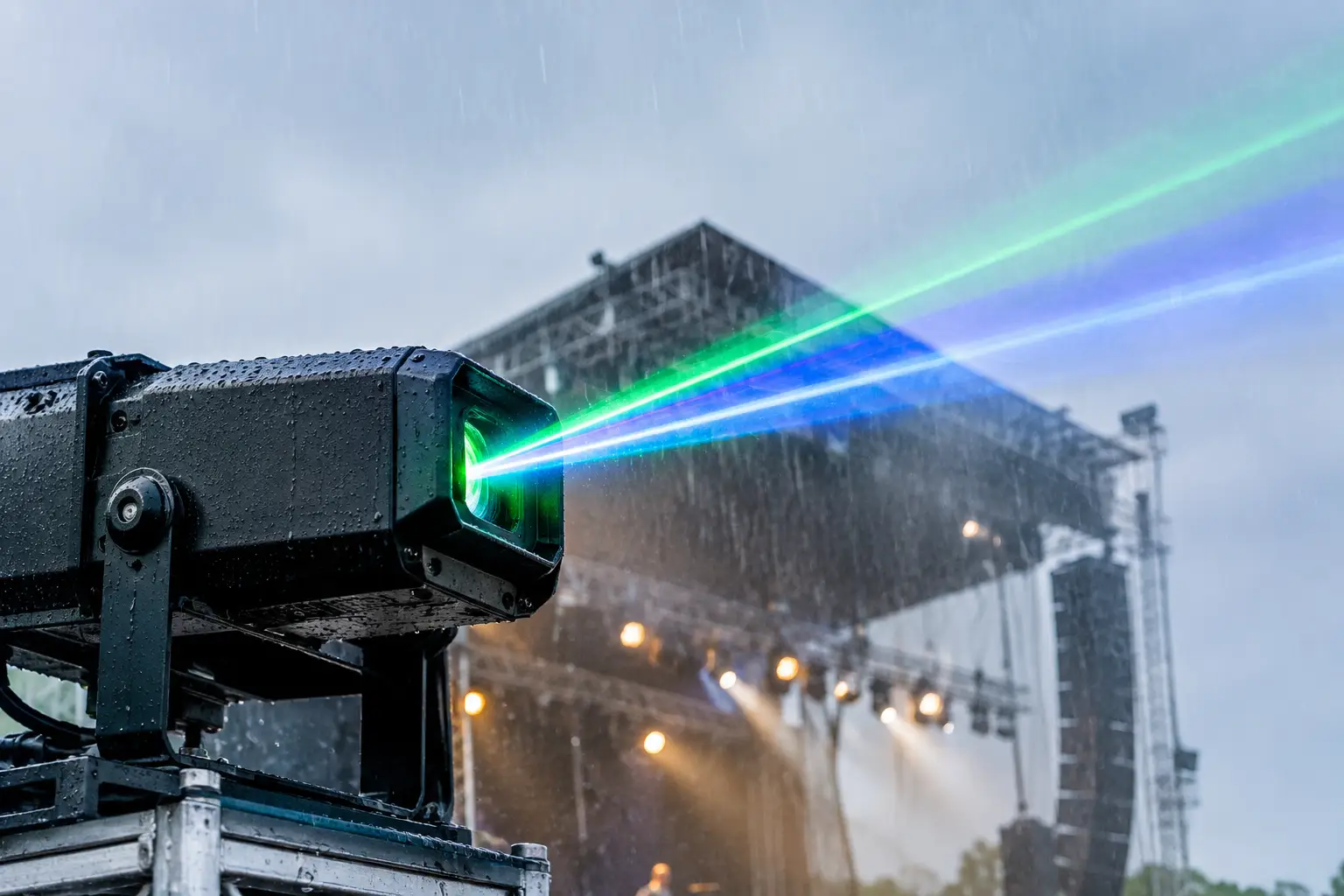
A laser show can turn an outdoor finale, festival stage, or stadium entrance into pure visual magic – until rain starts falling. So, can lasers operate in rain? The practical answer is: not exposed in the rain, unless the equipment and installation are specifically engineered for wet-weather operation. For event planners, the real question is not whether a beam can be seen through rain. It is whether the entire system can remain safe, dry, and ready to deliver the high-impact experience your audience expects.
A professional outdoor laser production is never just a projector pointed at the sky. It is a coordinated system of high-powered laser equipment, power distribution, control hardware, operators, safety zones, weather protection, and custom programming. Rain affects each part of that system differently. Smart planning keeps a weather issue from becoming a show-stopping surprise.
Can Lasers Operate in Rain Without Damage?
Laser light itself can travel through rain. A beam does not suddenly switch off because droplets are in the air. In fact, light interacting with moisture can make an outdoor effect look dramatic, creating sparkling shafts and movement that add texture to the sky.
The limitation is the hardware. Professional RGB laser projectors contain precision optics, scanners, electronics, cooling components, and high-voltage power systems. Standard show projectors are not designed to sit unprotected in a downpour. Water entering a projector, power connection, control line, or distribution box can damage equipment and create unacceptable electrical and operational risks.
That is why professional crews do not treat rain as an inconvenience to ignore. They assess the equipment’s environmental rating, the intensity and direction of precipitation, the venue layout, wind conditions, available cover, and the timing of the forecast. A brief light shower and a sustained thunderstorm are two completely different production scenarios.
For many outdoor events, the answer is to deploy projectors in properly designed weatherproof enclosures or under substantial, purpose-built cover. These solutions must protect the system while preserving airflow, access, beam clearance, and safe cable management. Throwing a tarp over a laser projector is not weather protection. It can trap heat, obstruct ventilation, interfere with the beam path, and make it impossible for an operator to monitor the system properly.
Rain Changes the Look of an Outdoor Laser Show
Rain does more than create a risk to equipment. It changes the visual environment. Laser beams need particles in the air to become visible from the audience perspective. In clear conditions, professional productions often use approved atmospheric effects to give beams their bold, aerial presence. Rain introduces natural moisture particles, but not always in a flattering or predictable way.
Light rain can add an energetic shimmer to large aerial beams, especially around a stage, building facade, or open festival field. Heavy rain, however, can scatter the beam so aggressively that projected graphics, logos, and crisp animations lose definition. What looked razor-sharp in programming may appear softer at a distance. Low clouds and mist can also reflect light back toward the production area, changing the apparent brightness and reach of the show.
Wind is often the bigger visual wildcard. It can drive rain directly into openings, move atmospheric effects away from the audience sightline, and alter conditions from one song to the next. A laser show built around massive sky effects may need a different cue structure if visibility drops. That is where custom programming and experienced live operation matter. A professional show can be adjusted to emphasize effects that still read powerfully in the conditions rather than forcing a sequence that no longer delivers the WOW factor.
Weatherproof Does Not Mean Weather-Proof Everything
Some professional laser systems and enclosures are built for outdoor installation or temporary wet-weather deployment. Others are strictly intended for dry indoor use. The distinction matters, especially when comparing projector specifications or planning a show around high-wattage equipment.
An outdoor-rated enclosure may protect a projector from rain, but the production still depends on properly protected power, signal distribution, networking, mounting, and operator positions. It must also control heat. High-output laser systems can generate significant thermal load, and sealing a projector inside a box without engineered ventilation can cause overheating or automatic shutdown.
For permanent installations, outdoor equipment selection should account for more than rain. Temperature swings, condensation, salt air, dust, insects, snow load, direct sun, and long-term maintenance all affect performance. A projector that works beautifully for a one-night concert under a covered stage may not be the right choice for a year-round architectural installation.
For temporary events, crews should use equipment and protection methods appropriate to the venue, duration, and forecast. This is not the place for improvised gear or a last-minute rental that was never designed for the environment.
Safety Takes Priority Over the Spectacle
A great laser show is thrilling because it feels enormous, immersive, and precisely controlled. That control is non-negotiable when weather moves in.
Rain can create slick surfaces around truss bases, generators, cable paths, and operator positions. It can reduce visibility for the crew and audience, particularly at night. Lightning introduces a separate and immediate concern. No visual effect is worth keeping people on an exposed field, rooftop, waterfront, or open stage during dangerous electrical weather.
Professional laser operation also requires continuous attention to beam paths and audience exposure. Wet surfaces can become reflective, including stages, pavement, metal structures, vehicles, and signage. The production team must evaluate the environment as conditions change. A compliant show is not a set-it-and-forget-it production.
This is why licensed, insured, experienced operators are central to a successful outdoor show. They understand when a system can continue under protected conditions, when cues should be modified, and when the correct decision is to pause or shut down. The best production teams protect the audience, the client, the venue, and the equipment while keeping the event moving wherever possible.
Build a Rain Plan Before Load-In
The strongest outdoor productions treat weather planning as part of creative design, not a backup conversation held five minutes before doors. When a client says they want a breathtaking laser finale, the production conversation should include where the projectors will be positioned, what cover exists, whether the event has a rain date or indoor option, and what the decision timeline will be if conditions shift.
A practical weather plan should establish who has authority to pause the show, what forecast thresholds trigger a change, and how the audience will be managed if lightning or severe weather arrives. It should also identify a protected place for the laser system and control position. If an event uses a large-scale projector package, moving gear after the rain begins may not be realistic.
For weddings, private celebrations, and smaller outdoor events, a tented performance area or covered projection position can preserve the impact of the show while adding protection. For municipal fairs, stadiums, and festivals, the plan may include purpose-built outdoor enclosures, redundant systems, alternate cue lists, and coordinated communication with the stage manager and public safety team.
Connecticut Laser Productions approaches outdoor shows with this level of preparation because a 40-watt feature for a private celebration and a 200-watt-plus stadium-scale production do not have the same weather needs. The creative ambition may be huge in both cases. The protection, logistics, and safety plan must match the actual scale of the event.
What Event Planners Should Ask Their Laser Provider
Before booking an outdoor laser show, ask whether the proposed projector system is rated for the expected environment or will be operated from an appropriate weather-protected position. Ask how the crew will protect power and control equipment, how heat will be managed inside any enclosure, and what happens if rain begins during the performance.
You should also ask about severe-weather procedures, insurance, laser safety compliance, and the operator’s experience with outdoor events. A qualified provider will welcome these questions. They should be able to explain the plan clearly without reducing the conversation to vague promises that the show will be “fine.”
It also helps to talk honestly about what matters most to your event. If a sharply defined logo projection is essential, heavy rain or mist may compromise that specific effect even when equipment remains protected. If the goal is a massive, music-synchronized burst of color and aerial beams, the show may have more flexibility. Clear priorities let the production team design alternatives that still feel intentional and unforgettable.
The Right Call Can Still Create a Big Finish
Rain does not automatically cancel the possibility of lasers, but it does demand the right equipment, experienced judgment, and a production plan built for reality. Under controlled, protected conditions, an outdoor show may continue and look spectacular. Under unsafe conditions, pausing is the professional decision.
Give your laser team the forecast, the venue details, and the creative vision early. That preparation creates the best chance of delivering the color, energy, precision, and crowd-stopping finale your event deserves – whatever the sky decides to do.
No responses yet