
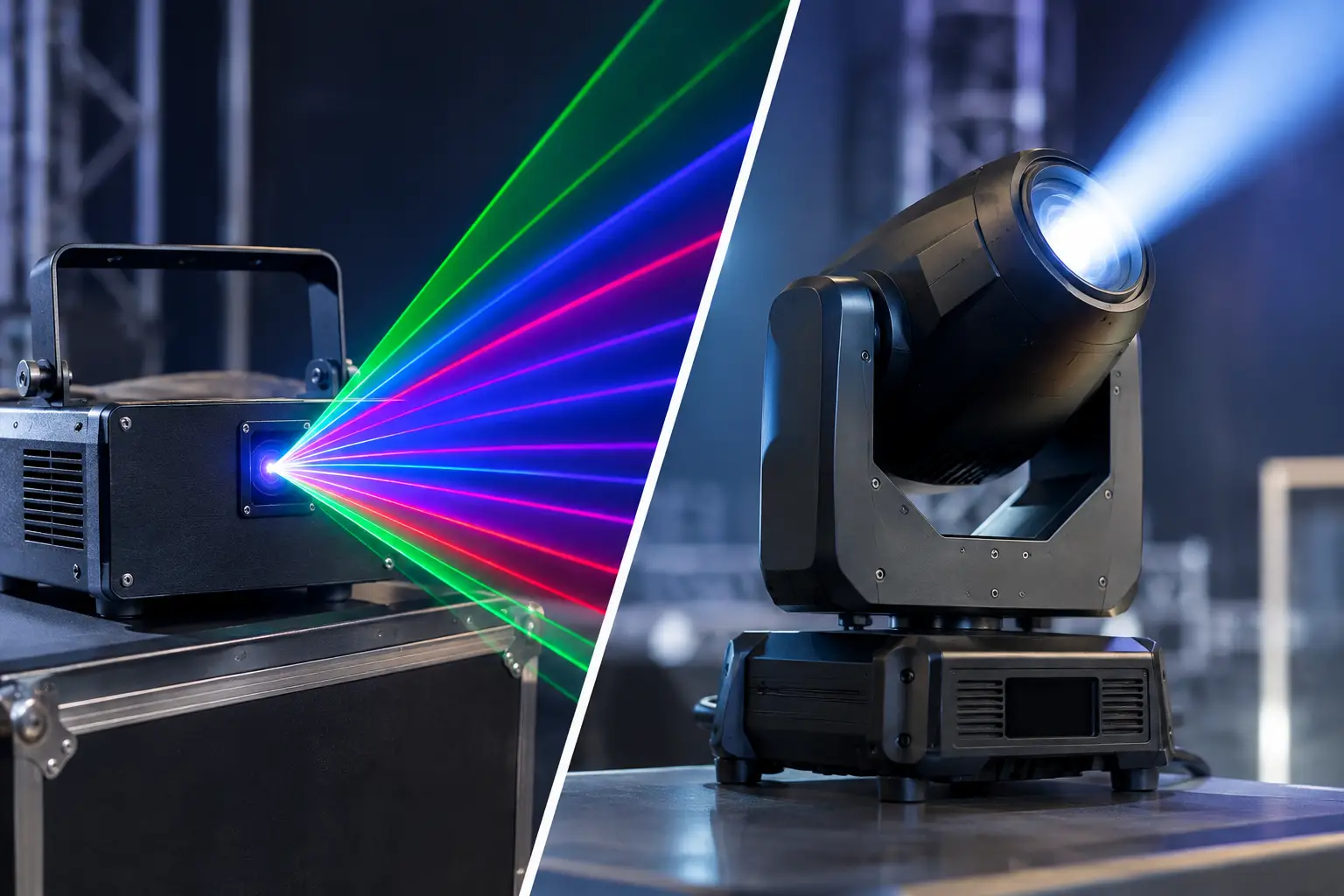
A great lighting package can fill a room. A great laser show can make the entire room feel like it has disappeared. That is the real decision behind laser projector versus moving heads: are you building atmosphere around the stage, or are you creating a visual event that reaches across the audience, architecture, and night sky?
Both tools earn their place in professional production. Moving heads bring motion, texture, and flexible stage coverage. RGB laser projectors produce razor-sharp aerial beams, animated graphics, tunnels, logos, and geometry with an intensity that turns a concert, launch, wedding, or municipal celebration into pure visual magic. The better choice depends on the scale of your vision, the environment, the audience sightlines, and how much of a WOW moment the event demands.
Laser Projector Versus Moving Heads: The Core Difference
Moving heads are intelligent lighting fixtures. They pan, tilt, change color, zoom, rotate gobos, create washes, and send beams across a room or stage. They are the workhorses of concert lighting because they can shift from a tight spotlight to a wide wash in seconds. A lighting designer can use them to frame performers, reveal a backdrop, build a dramatic cue, or keep a dance floor alive all night.
A laser projector is a precision optical system. Rather than projecting light through a lamp, lens, and gobo, it uses scanned laser beams to draw controlled lines, shapes, animations, and effects at extremely high perceived brightness. Those beams can slice through haze in a dense fan, form an overhead canopy, create a kinetic tunnel, or write a brand name in the air.
The distinction matters because moving heads illuminate objects and spaces. Lasers create visual structures in space itself. One is not automatically better than the other, but they produce a completely different emotional result.
When Moving Heads Are the Right Call
Moving heads are usually the practical foundation for a stage-focused event. If the priority is seeing speakers clearly at a corporate meeting, lighting musicians from multiple angles, changing the color of a ballroom, or creating a polished nightclub look, they provide extraordinary flexibility.
They also work well in venues where haze is limited or unavailable. Lasers need atmospheric haze or fog for their aerial beams to become fully visible. Moving heads benefit from haze too, especially for beam looks, but their washes, gobos, and front-light functions still deliver value without it.
For touring productions and theaters, moving heads can be a smart choice when the show needs a broad visual vocabulary. A fixture can paint the stage in saturated color, throw a textured gobo onto scenery, follow a musical build, then snap into fast beam movement for the chorus. They are equally at home at a wedding reception, where elegant warm washes and energetic dance-floor beams can come from the same fixture family.
There are trade-offs. Moving-head beams spread over distance, especially when used as wide washes. Their output can look spectacular, but it does not have the edge definition or long-distance punch of a professional laser system. They also cannot draw custom animation, precise line art, or aerial laser graphics.
When a Laser Projector Takes Over the Room
A laser projector is the move when the visual centerpiece needs to feel bigger than the stage. Concert crowds react to beams that sweep above them, split into grids, explode into multicolor fans, and pulse to the beat. A product launch gains instant authority when an animated logo appears in light. A stadium entrance, city celebration, or festival finale becomes a shared spectacle when thousands of people can see the same vivid effect at once.
Laser systems are particularly powerful for nighttime outdoor events and large indoor environments with controlled haze. At a municipal fair, sporting event, outdoor concert, or grand opening, high-powered RGB lasers can project across extraordinary distances while preserving clean, saturated color. For a more intimate event, a carefully programmed laser package can transform a dance floor, tent, or ballroom into a kinetic environment without needing a massive lighting rig.
Graphics are another major advantage. Moving-head gobos can project recognizable images, but lasers create animated logos, names, dates, abstract patterns, and music-synchronized artwork with remarkable sharpness. For a bar or bat mitzvah, that might mean a custom name animation and high-energy aerial effects. For a corporate event, it can mean brand elements that feel integrated into the show rather than simply displayed on a screen.
Power is not a simple bigger-is-better contest, yet it matters. A 40-watt professional laser system can deliver dramatic results in the right venue, while outdoor productions, large festivals, and stadium-scale applications may call for 100 watts, 200 watts, or more. The right output depends on viewing distance, ambient light, projection surface, weather conditions, beam effects, and the size of the audience.
Visibility, Venue Conditions, and Scale
The environment often makes the decision for you. In a bright daytime setting, neither moving-head beams nor laser aerials will show at their nighttime best. Projected laser graphics may still be possible on appropriate surfaces, but the deep-beam spectacle people associate with major laser shows comes alive after dark or in a properly darkened room.
For indoor concerts, nightclubs, theatrical productions, and tented celebrations, haze is the secret ingredient. It gives light a surface to travel through, making every beam visible from the audience perspective. A thoughtful production team balances haze output with venue rules, HVAC behavior, camera needs, and guest comfort.
Outdoors, lasers gain a dramatic edge after sunset. Their tight beams maintain definition across distances where conventional moving lights can lose visual impact. That is why lasers are a natural fit for fireworks alternatives, city anniversaries, festival finales, stadium entrances, and large public gatherings. Wind, rain, nearby air traffic, audience placement, and local regulations still need to be part of the plan from the beginning.
Safety Is Not an Add-On
High-impact laser production is not a plug-and-play lighting effect. Professional laser systems must be designed, positioned, programmed, and operated with audience safety at the center of every creative decision. That includes proper scanning practices, safe projection zones, site evaluation, equipment selection, operator training, and compliance with applicable requirements.
This is especially critical for audience scanning, outdoor shows, and high-powered systems. A powerful RGB projector in skilled hands can produce breathtaking visual spectacle. The same equipment handled carelessly can create unacceptable risk. Event organizers should look for licensed, insured operators with real laser-production experience, not simply a rental company adding a laser unit to a standard lighting package.
Moving heads have their own operational demands, including safe rigging, power distribution, heat management, cable runs, and programming. But laser safety requires a separate level of technical knowledge. The creative concept and safety plan should be developed together, not treated as two unrelated tasks.
The Strongest Shows Often Use Both
The most memorable productions do not always force a choice. Moving heads and lasers can work together beautifully because each solves a different visual problem. Moving heads establish color, movement, performer visibility, and scenic depth. Lasers deliver the high-definition aerial moments that make guests pull out their phones and look up.
Picture a concert opening with moving heads building anticipation through deep color and slow, sweeping movement. On the first major drop, the lasers ignite in synchronized fans, tunnels, and graphics that extend the stage design into the audience. Or imagine a wedding reception where elegant lighting warms the room through dinner, then laser effects transform the dance floor when the party begins.
This layered approach also gives designers more control. Lasers can be reserved for the moments that deserve maximum impact rather than running continuously until the effect feels ordinary. The contrast between a restrained lighting look and a sudden laser reveal is often what creates the loudest reaction.
How to Choose for Your Event
Start with the moment you want people to remember. If it is a performer stepping into a beautifully lit stage picture, moving heads may be the primary investment. If it is a massive countdown, a custom logo reveal, a music-synchronized finale, or a sky-filling nighttime spectacle, a laser system should lead the conversation.
Then consider the audience size, venue dimensions, ceiling height, time of day, haze permissions, available rigging, power, budget, and local operating conditions. A private celebration does not need stadium-level wattage to feel extraordinary, and a large outdoor festival should not be approached with the same equipment plan as a ballroom dance floor.
Connecticut Laser Productions builds shows around that exact balance of creative ambition and technical reality. Whether the brief calls for an intimate custom production or a 200-watt public spectacle, the goal is the same: make the visual experience feel intentional, powerful, and impossible to forget.
The right fixture is the one that serves the story of your event. Choose moving heads when the room needs color, movement, and flexible stage light. Choose lasers when the event needs to become the spectacle people talk about long after the final cue fades.
No responses yet