
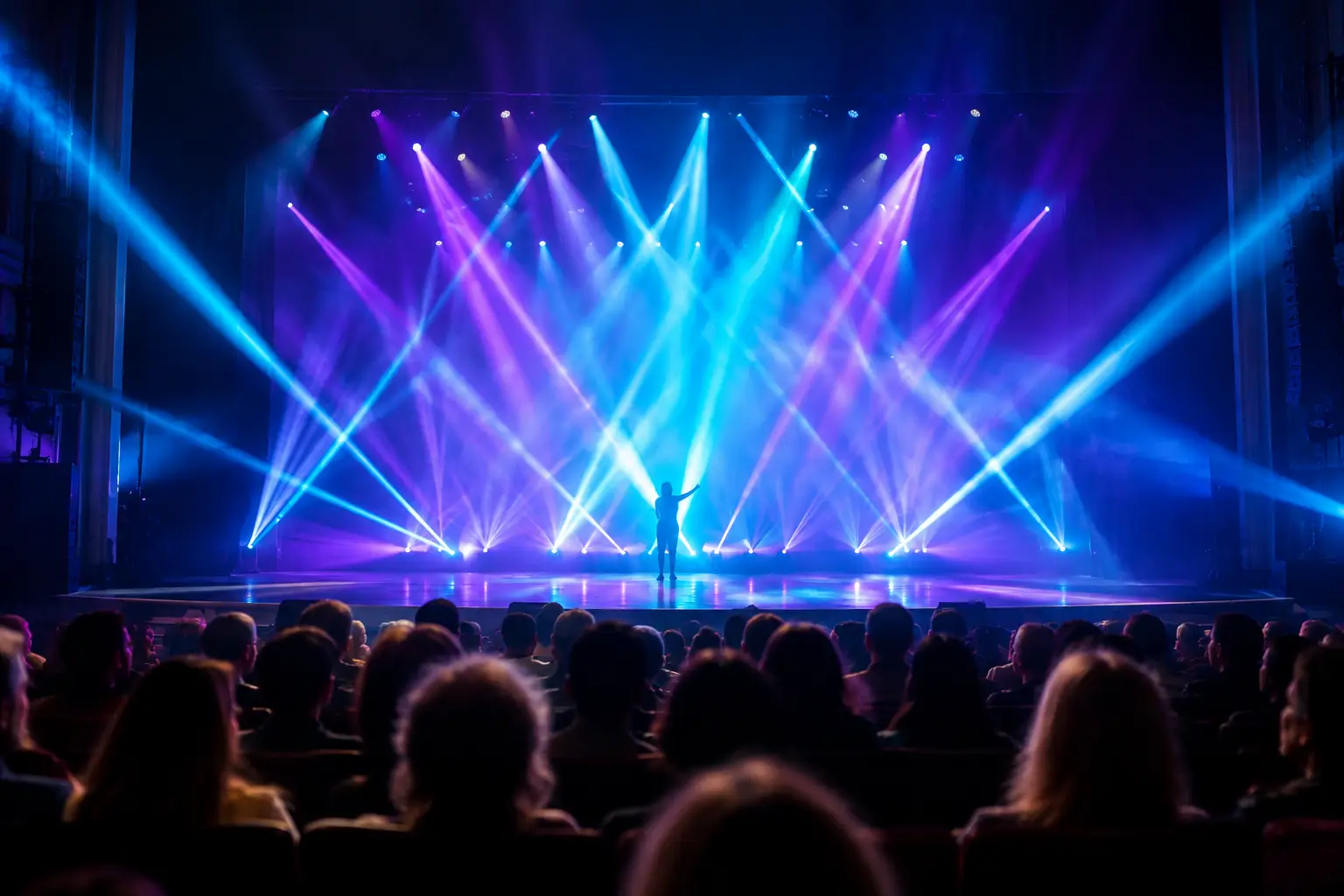
A laser show for theater production should never feel like an effect dropped in at the last minute. At its best, laser becomes part of the story: a blade of color that reveals a character, a tunnel of light that pulls the audience into another world, or a breathtaking finale that earns the roar after curtain call.
The difference is design. Theater has pacing, sightlines, scenery, performers, music, and emotion already in motion. A professional laser production has to honor all of it while delivering the pure visual magic audiences remember long after they leave the venue.
Why Laser Changes the Scale of a Theater Moment
Conventional lighting fills a stage. Lasers can define the air above it, carve graphic lines across architecture, create animated worlds behind performers, and make a proscenium feel larger than the room itself. That added dimension is especially powerful when a production needs to shift locations quickly or move from intimacy to full-scale spectacle without stopping the action.
For a musical, laser can lock to the downbeat and amplify a chorus number with color, movement, and kinetic energy. For dramatic theater, a precisely placed fan or geometric effect can signal a dream sequence, a technological environment, a supernatural entrance, or a major emotional break. In dance, the beam itself becomes choreography, framing movement with exceptional precision.
The goal is not to put lasers into every scene. Constant intensity loses its impact. The strongest shows use contrast: quiet darkness before a reveal, a restrained single-color cue beneath a monologue, then a wall of RGB color when the story reaches its peak. That control is what makes the big moment feel huge.
Designing a Laser Show for Theater Production
Every successful theater laser show begins with the script, score, scenic concept, and cue structure. A production team needs to understand what the audience should feel at each key beat before deciding whether that moment calls for beams, graphic animation, atmospheric texture, or no laser at all.
Start with the dramatic purpose
Ask what the laser effect must accomplish. Is it establishing location? Supporting an entrance? Creating a transition that avoids a scenery change? Building anticipation before a final number? Once the purpose is clear, laser programming can serve the production rather than compete with it.
A futuristic musical may call for sharp cyan and magenta geometry, animated grids, and synchronized beam choreography. A holiday production might use elegant snowflake graphics, star fields, and warm gold aerial effects. A rock-inspired stage show can take a more aggressive direction with rapid sweeps, multicolor fans, and music-synced animations. Each approach uses the same medium differently because each show tells a different story.
Match the system to the room
A black-box theater, a historic auditorium, and a large performing arts center have very different technical needs. Ceiling height, stage depth, balcony positions, projector throw distance, existing rigging, audience layout, and available power all affect the design.
Projector power matters, but more watts do not automatically mean a better show. A compact indoor theater may benefit from a carefully placed professional RGB system that produces clean, vivid effects without overpowering the stage picture. A larger venue, outdoor amphitheater, or theatrical event with thousands of guests may require high-powered systems in the 40-watt to 200-watt range or beyond to deliver the intended visual impact at distance.
Beam quality, color balance, scanner speed, optic selection, and projector placement are equally important. The audience sees the finished illusion, not the specification sheet. A properly engineered system makes that illusion crisp, bright, and intentional.
Build cues around music and movement
Theater lives on timing. Laser cues should be programmed to the exact musical phrase, dialogue trigger, choreography count, or stage-management call. A half-second late can turn a dramatic reveal into a distraction. A cue that lands on the final drum hit can make the same moment feel explosive.
This is why generic auto programs rarely belong in a polished theatrical production. Custom programming gives the creative team control over color, shape, speed, fades, and transitions. It also allows effects to work alongside lighting, video, scenic automation, and performers instead of fighting for attention.
Atmosphere Is Part of the Canvas
Lasers become most visible when there is a light atmospheric medium in the room, typically haze. Without it, an audience may see laser graphics on a surface but miss the aerial beams that make a theater feel transformed.
Haze must be used with restraint. Too little, and the beams disappear. Too much, and the stage can look cloudy, interfere with cameras, or make performers and audience members uncomfortable. The right level depends on the venue’s HVAC system, room volume, fire policies, production schedule, and the visual language of the show.
A professional team coordinates haze with the lighting designer and venue staff. That includes understanding detector systems, ventilation cycles, rehearsal needs, and how the atmosphere reads from the front row, mezzanine, and balcony. What looks incredible from the booth may need adjustment for the people who bought premium seats.
Safety Is a Creative Requirement, Not a Footnote
A powerful laser system demands trained operation and disciplined planning. In theater, the challenge is heightened by performers moving through changing stage pictures, scenic elements entering and exiting, and audience members seated at multiple elevations.
Professional laser design accounts for beam paths, projection zones, access points, reflective materials, sightlines, and the potential movement of cast and crew. Mirrors, glossy set pieces, metallic costumes, glass, and video surfaces all deserve attention during advance planning. A cue that is safe with an empty stage may not be safe after a scenic shift or a performer changes position.
Depending on the system and application, regulatory requirements and venue policies may also apply. Licensed, insured operators who understand compliant professional operation bring more than equipment to the room. They bring the experience to identify risks early, coordinate with the venue, and keep the creative plan moving forward without compromising safety.
Audience scanning is a separate decision that requires careful engineering and appropriate safety controls. It is not a casual add-on for a theater cue. In many productions, elevated beams, projected graphics, and stage-contained effects can create more than enough WOW factor while maintaining clear separation from the audience.
Where Lasers Deliver the Biggest Payoff
Lasers are especially effective when they solve both a creative and practical production problem. A rapid scene transition, for example, may need visual momentum while crew resets the stage. Animated laser graphics can hold the audience’s attention and reinforce the story while that change happens.
They also excel at moments where scenery alone would be expensive or impossible. A digital cityscape, cosmic portal, cathedral window, abstract dream world, or branded theatrical backdrop can appear with extraordinary speed and disappear just as cleanly. For touring productions, that flexibility can reduce the need to transport large physical scenic pieces while preserving a high-impact look.
For galas, benefit performances, corporate theater events, and product launches staged in performance venues, lasers can carry branding in a more dramatic way than a static logo. Custom animated graphics, projected names, and music-driven beam effects make the opening feel like an event, not a presentation.
The Rehearsal Is Where Spectacle Becomes Theater
The best time to discover a blocked sightline, a reflective costume detail, or a missed cue is not during the first public performance. Laser should be integrated into technical rehearsals early enough for directors, lighting designers, choreographers, stage managers, and operators to shape the sequence together.
A good rehearsal process also reveals when to pull back. Sometimes a performer needs a cleaner visual field for a key lyric. Sometimes video needs the visual priority. Sometimes the laser moment works better three beats later. These are not failures of the concept. They are the refinements that make a production feel intentional.
Connecticut Laser Productions brings two decades of show experience to this process, pairing custom programming with professional RGB laser systems and experienced operators who understand both spectacle and show discipline. From an intimate stage production to a major theatrical event, the system should scale to the venue while the creative idea stays sharp.
The most memorable theater laser moments do not announce themselves as technology. They make the audience feel that the room has changed, the story has expanded, and for one perfectly timed cue, anything is possible.
No responses yet