
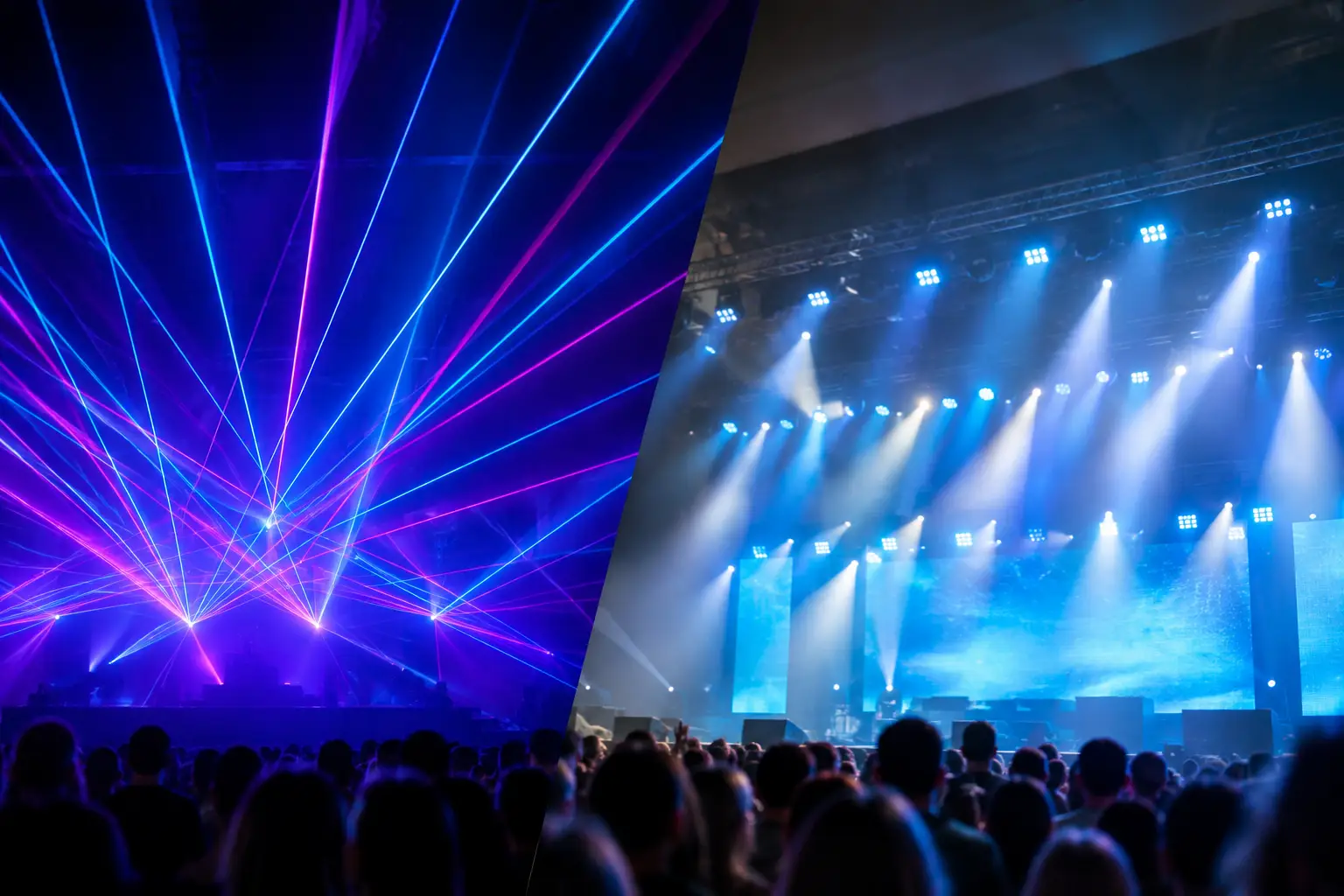
A packed dance floor, a stadium countdown, and a grand product reveal all need light. But lasers versus LED lighting is not really a battle over which technology is better. It is a creative decision about what the audience needs to feel when the lights go down.
LED fixtures can fill a room with rich color, frame a stage, and make performers look fantastic on camera. Lasers can slice through the atmosphere with razor-sharp beams, animated graphics, and aerial effects that make a crowd look up, lean in, and pull out their phones. The most unforgettable productions often use both, but understanding where each source excels helps you spend your production budget where it will create the biggest WOW factor.
Lasers Versus LED Lighting: Different Visual Jobs
The biggest difference is not simply brightness. It is how each technology puts light into the room.
An LED fixture creates a broad source of illumination. Wash lights, moving heads, battens, uplights, and video walls spread color over people, architecture, scenic pieces, and performance areas. They establish mood. They can take a blank ballroom from elegant amber to nightclub blue in seconds, or give a concert stage the layered depth it needs for a big visual look.
A professional RGB laser projector creates an extraordinarily tight, coherent beam. Rather than filling every surface with light, it draws lines, tunnels, fans, cones, waves, and graphics with incredible precision. In the right atmosphere, a laser beam appears suspended in midair. That is why a programmed laser moment can feel less like lighting and more like pure visual magic.
Neither outcome replaces the other. If guests need to see a speaker clearly, LEDs are doing essential work. If the goal is to make a room erupt at the musical drop, a laser sequence can deliver a visual punch that conventional fixtures cannot duplicate.
When Laser Systems Create the Bigger Moment
Lasers are built for impact, motion, and distance. A high-powered system can project vivid aerial effects across a large ballroom, outdoor fairground, arena, or stadium environment. The beam remains remarkably narrow over long distances, which gives laser productions their signature scale.
That scale matters at events where the audience is spread out. At a municipal celebration, for example, a laser show can create a shared focal point visible to a massive crowd. At a concert, precisely timed beam choreography can turn a chorus or guitar solo into a peak moment. At a product launch, animated laser graphics can introduce a logo or message with far more drama than a static projection surface alone.
Laser animation is another major advantage. Galvo-scanned laser systems can create text, logos, geometric patterns, and music-synchronized motion with crisp, high-energy lines. For branded events, this makes lasers especially valuable when the goal is to put a visual identity into the air, not merely onto a backdrop.
Outdoor applications deserve special attention. Powerful laser systems can create spectacular long-throw effects after dark, but outdoor planning comes with additional variables: viewing angles, surrounding light, weather, site layout, airspace considerations, and local requirements. A system that looks explosive at a nighttime festival may not be the right choice for a sunset reception with no atmospheric haze and a short program window.
Where LED Lighting Has the Advantage
LED lighting earns its place in nearly every professional event package because it is so versatile. It can light faces for speeches, create a polished stage wash, transform walls with uplighting, and support video content without demanding the same atmospheric conditions that make aerial lasers shine.
For daytime events, camera-heavy programs, conferences, and theatrical scenes with performers, LEDs often carry the visual foundation. A speaker cannot deliver a keynote from inside a dark laser tunnel. They need clean front light, controlled backlight, and color that supports the room without overpowering the presentation.
LED fixtures are also excellent for texture. Moving-head lights can sweep a venue with broad shafts, gobos, and color changes. Pixel fixtures can chase patterns through truss or scenic elements. LED walls can display video, live camera feeds, branded content, and detailed imagery that lasers are not intended to reproduce.
For a wedding or bar and bat mitzvah, LED uplighting may provide more value over a full evening because it enhances the venue from cocktail hour through the final dance. Add a short laser feature for the grand entrance, first major dance set, or finale, and the result feels elevated without treating every moment as a stadium show.
The Atmosphere Question: Haze Changes Everything
A laser beam needs particles in the air to become visible from the side. That usually means professional haze, used thoughtfully and in coordination with the venue. Without it, guests may still see projected graphics and beam endpoints, but the massive aerial architecture people associate with a laser show will be much less pronounced.
LED beams also benefit from haze, especially moving heads, but they retain more visual utility without it. Their wash and color effects still work on walls, stages, décor, and people.
This is one of the most practical deciding factors in the lasers versus LED lighting conversation. If a venue prohibits haze, has highly sensitive fire detection procedures, or requires an exceptionally clean-air environment, an LED-forward design may be the smarter choice. If haze is permitted and the room can be darkened, lasers gain the space they need to become breathtaking.
Brightness Is More Than a Wattage Number
It is tempting to compare a laser’s wattage with an LED fixture’s wattage, but those numbers do not translate directly. A 40-watt RGB laser projector and a 40-watt LED light are not producing the same type of output, covering the same area, or serving the same visual purpose.
Laser power matters because it helps determine how clearly beams and graphics can read across a given distance and against ambient light. Large outdoor spaces, arena environments, and high-ambient-light settings may call for substantially more power than a dark private venue. Professional systems can range from 40 watts into 200 watts or more depending on the production requirements.
With LEDs, output is usually discussed through fixture type, beam angle, photometric performance, and how many fixtures are needed to cover the space. A dozen well-positioned LED fixtures can make a room feel immersive. One high-powered laser may create the signature centerpiece. The right design depends on whether you need coverage, spectacle, or both.
Safety and Control Are Part of the Show
Laser effects are thrilling precisely because they are so concentrated. That concentration demands professional planning, properly maintained equipment, compliant operation, and experienced technicians who understand venue geometry, audience areas, scanning zones, and show programming.
A professional laser production is not a plug-in party effect. The operator must account for projector placement, beam paths, termination points, audience scanning decisions, emergency controls, and applicable rules for indoor or outdoor operation. For certain outdoor shows, airspace coordination may also be required. The safest laser show is not the one with the most beams. It is the one designed with precision from the first cue to the final blackout.
LED lighting has its own operational demands, including power distribution, overhead rigging, heat, cable management, and glare control. Still, it typically involves fewer restrictions around beam exposure. That can make LEDs a simpler fit for venues with tight setup times, low ceilings, or strict operational limits.
Connecticut Laser Productions brings licensed, insured operators and two decades of show experience to the planning process, because a mind-blowing visual requires more than impressive equipment. It requires the right system, the right crew, and the discipline to execute every cue safely.
Choosing the Right Mix for Your Event
For many events, the answer is not lasers or LEDs. It is a visual design that lets each technology do what it does best.
A concert tour may use LED wash and moving lights to reveal the band, support cameras, and shape every song, then use lasers for the biggest drops and finale moments. A corporate launch may combine clean LED stage lighting with a laser logo reveal. A festival may use large-scale LED systems for all-night coverage and high-wattage lasers to create landmark moments that audiences can see across the grounds.
Private events can scale the same idea. A refined lighting package can make the venue feel beautiful all night. A custom laser feature can turn one key moment into the story guests tell afterward. The production does not need to be enormous to feel enormous. It needs to be designed around the room, the schedule, the audience, and the emotion you want to create.
Before choosing a fixture list, picture the exact moment you want people to remember: the doors opening, the name reveal, the beat drop, the newlyweds’ entrance, or the final countdown. Build the lighting for everything around that moment, then give it the visual force it deserves.
No responses yet