
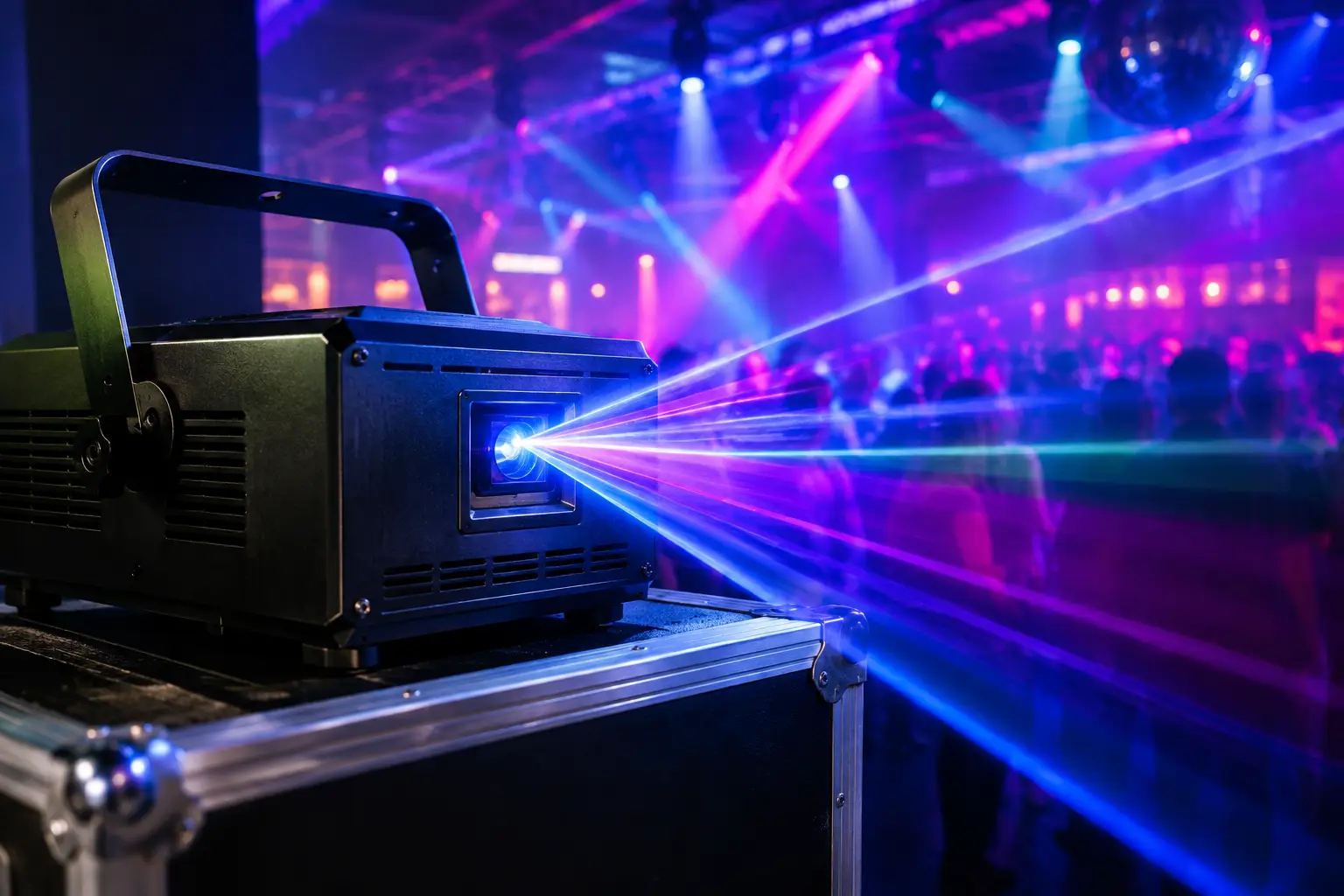
A laser projector for nightclubs is not background lighting. It is the moment the room changes: beams cut through haze, color races above the crowd, and the drop lands with a visual hit people remember long after last call. Choosing the right system means balancing that pure visual magic with the realities of ceiling height, ambient light, programming, sightlines, and professional laser safety.
What a Nightclub Laser System Must Do
Nightclubs demand more from a projector than a one-time party or small private event. The system may run for hours, work beside moving heads and LED walls, and perform in a room that shifts from a lightly populated lounge to a packed dance floor in minutes. It has to stay bright, responsive, and visually sharp without overwhelming the space.
The first decision is not simply wattage. It is the effect you want guests to feel. A tight, intimate venue can become an immersive tunnel of aerial beams with a properly specified RGB laser and haze. A larger multi-room club may need wider projection coverage, stronger output, and zoning that gives each area its own personality. The best installations are designed around the venue, not pulled from a generic equipment list.
A professional RGB system brings red, green, and blue sources together to create a full spectrum of saturated color. That matters in a club environment where deep blues, electric magentas, vivid greens, and bright whites all need to hold their own against existing lighting. Single-color effects can have a place in a concept-driven room, but they cannot deliver the same creative range as a full-color laser show.
Start With the Room, Not the Spec Sheet
A laser projector for nightclubs should be selected after looking closely at the room’s dimensions and operating conditions. Ceiling height, projector mounting position, booth location, reflective surfaces, windows, and the distance to guests all affect what the system can safely and effectively do.
A low ceiling can create dramatic overhead beam effects, but it also leaves less room for error. A projector mounted above the DJ booth might offer a strong central look, while a rear truss position can send beams across the entire dance floor and frame the stage. In some venues, multiple projectors produce the biggest WOW factor: one system builds aerial atmosphere while another handles graphics, logos, or laser animations on a dedicated surface.
Ambient light is another factor that gets underestimated. Lasers are exceptionally visible in darkness and haze, but a club with bright architectural lighting, large LED displays, or constant white strobe looks may need more output to retain impact. Higher power is not automatically better. It needs to be matched with beam quality, scan speed, color balance, and a show design that gives the laser moments to own the room.
How Much Laser Power Does a Club Need?
There is no universal wattage number because the right answer depends on the venue and the visual ambition. A compact nightclub with controlled lighting may achieve impressive results with a lower-powered professional RGB system. A large club, concert-style venue, or outdoor-adjacent space typically needs substantially more power to create bright aerial effects and readable graphics at distance.
Professional systems in the 40-watt range and beyond are built for a different level of production value than entry-level party lasers. At the high end, systems reaching 100 watts, 200 watts, or more can support massive rooms, festival environments, stadium-scale moments, and exterior projections. That capability is thrilling, but it also comes with a greater responsibility for correct engineering, placement, control, and compliance.
For a permanent nightclub installation, the smartest investment is often a system with room to grow. A projector that looks adequate on a quiet walkthrough can feel underpowered once the room is filled with haze, LED fixtures, video content, and 800 people moving beneath it. Spec the equipment for peak nights and special-event programming, not only for the most restrained operating condition.
Beam Effects, Graphics, and the Scan-Speed Question
Aerial beams are the classic nightclub laser look. They fan, rotate, sweep, and pulse with the music, turning atmospheric haze into sculpted light. Graphics and animations are different. They require accurate scanning to draw logos, text, geometric patterns, and custom visuals with clean lines.
If your concept includes branded event nights, artist names, sponsor messaging, or a signature venue logo, scanner performance matters as much as optical power. A projector built for crisp graphics can create a polished visual identity above the booth or on a projection-safe surface. For a pure beam-driven dance floor experience, the programming and placement may matter more than elaborate graphics capability.
Control Is Where the Show Comes Alive
A powerful projector without intelligent control is just expensive light. The nightclub experience becomes unforgettable when laser cues are synchronized with music, DJ sets, lighting scenes, timecode, and special effects.
For a resident venue, a programmed show library can give the lighting operator fast access to looks for opening, peak hour, VIP arrivals, artist walk-ons, countdowns, and closing sets. For touring DJs and live acts, flexible control integration allows the laser system to follow the production rather than fight it. The goal is not to run every possible effect all night. It is to create contrast, build anticipation, and make the biggest moments hit harder.
Custom programming also separates a real show from repetitive pattern playback. Music-synchronized beams can snap to percussion, expand with a vocal rise, and explode across the room at the drop. Mind-blowing animations can support a themed event without distracting from the performer. A disciplined operator knows when to fill the room and when to pull back, leaving space for the next visual surprise.
Haze Is Part of the System
Lasers need particles in the air to reveal their full three-dimensional form. Without haze, guests may see bright points or projected graphics, but they will not see the floating tunnels, fans, sheets, and shafts of color that make a laser show feel physical.
That does not mean filling a club with thick fog. A quality hazer produces a fine, consistent atmosphere that supports beam visibility while preserving sightlines and guest comfort. HVAC patterns, ceiling fans, door traffic, and room size all affect haze behavior. A system should be tested during real operating conditions, not only in an empty venue.
The best result is controlled atmosphere: enough haze to make every beam look massive, not so much that the room feels cloudy or the lighting loses definition.
Safety Is Not an Add-On
High-powered entertainment lasers are professional equipment, not plug-and-play decorations. A properly designed nightclub system accounts for audience separation, projector mounting, beam termination, scanning zones, emergency stop capability, access control, and the requirements that apply to the installation and operation.
In the United States, laser show equipment and operation may involve federal requirements as well as venue, fire marshal, and local authority considerations. The exact process depends on the equipment, show design, and location. This is why licensed, insured, safety-qualified professionals are essential, especially when a venue wants powerful aerial effects near crowded public spaces.
Avoid treating audience scanning as a casual feature or assuming that a projector’s preset modes make it safe for public use. Professional show design uses calculated zones, appropriate hardware, tested safety settings, and trained operators. The audience should experience the intensity of the show, not the risk of an improvised setup.
Buy a Projector or Bring in a Production Team?
For a venue that wants a permanent visual signature and has experienced technical staff, purchasing a professional RGB laser projector can make sense. It gives the club control over its schedule, recurring programming, and long-term creative direction. The installation should still include proper commissioning, operator training, and a plan for maintenance and compliance.
For a grand opening, major artist appearance, New Year’s Eve production, or one-night brand launch, turnkey laser production may be the stronger choice. A production team can scale the system to the event, provide custom programming, handle setup and safety operations, and bring the extra impact that a special night demands.
Many leading venues use both approaches. A permanent system supplies consistent atmosphere every weekend, while a larger temporary package transforms the room for headline events. Connecticut Laser Productions can support either path with professional Luminance RGB projector systems and custom laser productions built around the room, the music, and the scale of the moment.
Make the First Look Count
The right nightclub laser installation should feel like part of the venue’s identity, not an effect switched on at random. Start with a detailed look at the room, choose power and projection capability that fit the real environment, and insist on professional control and safety design. When the lights drop and the first laser cue cuts through the haze, guests should know they are somewhere worth talking about.
No responses yet