
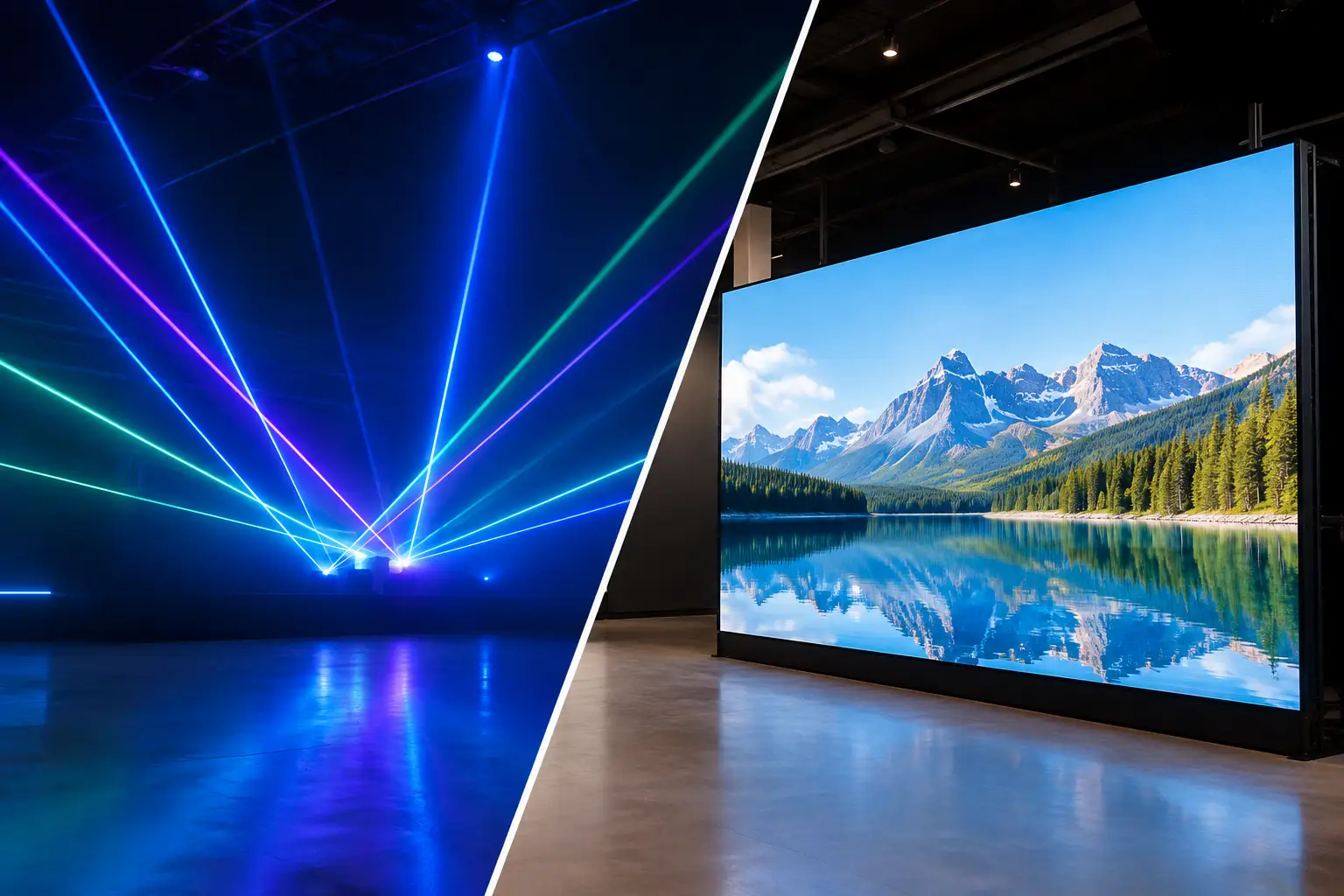
A blank building facade can become a living story. A stage can erupt with razor-sharp beams, kinetic color, and graphics that appear to float in midair. That is the real decision behind laser mapping versus LED walls: not which technology is more impressive on paper, but which one gives your audience the biggest possible reason to look up, pull out a phone, and remember the moment.
Both can command attention. Both can support branded content, show visuals, and major announcements. But they create impact in very different ways, and the right choice depends on the venue, daylight conditions, audience distance, creative concept, budget, and production timeline.
Laser Mapping Versus LED Walls: The Core Difference
LED walls are physical display surfaces built from modular panels. They produce bright, direct light, so they can display video, graphics, camera feeds, presentations, and sponsor content with excellent clarity. For conferences, broadcasts, product demos, and indoor events with a lot of close-range viewing, that control is hard to beat.
Laser mapping uses precision-programmed laser light to trace, animate, and transform architectural features, scenic pieces, stages, and open space. Instead of bringing in a giant rectangular screen, the show uses the environment itself as the canvas. Columns, rooftops, arches, truss, scenery, and even the sky can become part of the visual language.
An LED wall says, “Look at this screen.” Laser mapping says, “Look at what this entire space has become.” Neither approach is automatically better. They solve different creative problems.
When LED Walls Are the Better Choice
LED is the practical powerhouse when content must stay legible under difficult lighting conditions. Daytime festivals, trade show floors, corporate general sessions, televised events, and bright indoor ballrooms often benefit from the brightness and predictability of a quality LED display.
If a CEO needs to present detailed charts, a sponsor requires logos at exact dimensions, or a concert needs live camera magnification for fans far from the stage, LED walls deliver a familiar and highly effective format. Video playback is straightforward, text remains readable, and the image does not depend on haze, darkness, or a projection surface.
They are also valuable for events where the visual plan changes frequently. A show caller can switch from a walk-in loop to presentation slides, then to a live camera shot in seconds. That flexibility matters when the show is content-heavy and driven by speakers, video packages, or real-time programming.
The trade-off is physical presence. An LED wall requires a supporting structure, power distribution, cable management, processing, labor, and enough room to install it safely. It can look spectacular, but it remains a screen. In a distinctive venue, it may cover the very architecture your guests came to experience.
Where Laser Mapping Creates the Bigger WOW Factor
Laser mapping shines when the event needs atmosphere, transformation, and pure visual magic. It is especially powerful after dark, in controlled indoor environments, and at outdoor celebrations where a building, stage, or landmark can become a feature of the show.
For a city anniversary, grand opening, festival finale, concert entrance, sporting event, wedding reception, or bar or bat mitzvah, lasers can turn the room into the entertainment. Beams can sweep overhead in time with music. Animated graphics can trace the shape of a venue. Custom logos can appear with scale and motion that feels less like a presentation and more like a live spectacle.
The emotional difference is significant. Audiences do not merely watch a mapped laser sequence. They feel surrounded by it. With the right haze and sightlines, color becomes dimensional, movement gains depth, and every musical hit can land with a visual punch.
This is where experienced programming matters. A strong laser production is not a collection of random effects. It is a designed sequence that responds to the music, the architecture, the event’s pacing, and the audience’s position. Connecticut Laser Productions builds that kind of impact with custom programming, professional RGB laser systems, and experienced licensed operators who understand how to make the spectacle feel huge without treating safety as an afterthought.
Brightness, Darkness, and the Reality of the Venue
Light is the first practical question. LED walls perform in daylight because they are engineered to be seen against ambient light. A laser show can still be visible before sunset, especially with high-powered equipment and targeted effects, but its full depth and brilliance arrive as the environment gets darker.
That makes timing critical for outdoor events. A late-afternoon municipal fair may use LED for daytime content, then transition to lasers for a dramatic sunset reveal or nighttime finale. A rooftop product launch may favor an LED wall for presentations, followed by a laser sequence that sends the audience outside with a memorable final image.
Indoors, room conditions matter just as much. Lasers thrive in ballrooms, theaters, nightclubs, arenas, and tented events where lighting can be controlled. Haze helps reveal the beam paths and creates that immersive tunnel-of-light effect. Yet haze may not be suitable for every setting, especially venues with strict fire policies, sensitive attendees, or limited ventilation. Professional planning identifies those limits early and adapts the creative plan accordingly.
Content: Screens Tell, Lasers Transform
An LED wall is usually the better medium for dense information. If guests must read schedules, compare product specifications, follow a keynote, or see close-up video, use the display technology designed for it. No one should be squinting at a laser-rendered spreadsheet.
Lasers excel at high-impact visual storytelling. Think bold logos, kinetic line art, elegant monograms, geometric worlds, countdowns, aerial effects, and music-synchronized moments. Laser mapping also rewards creative use of shape. A historic facade can appear to crack open with light. A stage portal can pulse as if it is alive. A brand mark can grow across a building in color and motion before a new product is revealed.
For many premium events, the strongest answer is not an either-or decision. It is a coordinated production where LED handles information and live video while laser mapping delivers the moments people talk about afterward. The wall supports the message. The lasers create the release of energy around it.
Budget and Logistics: Compare the Full Production, Not the Day Rate
A simple rental comparison can be misleading. LED-wall cost is influenced by screen size, pixel pitch, indoor or outdoor rating, processor requirements, rigging, ground support, labor, and video content. A large wall can quickly become a substantial line item, particularly when the venue requires structural engineering or the setup window is tight.
Laser-mapping cost depends on the desired scale, projector wattage, creative programming, venue access, outdoor throw distance, safety zones, haze, control systems, and crew. A small indoor effect package and a 200-watt outdoor architectural spectacular are not remotely the same production.
The smarter question is: what must the visual system accomplish? If the event needs continuous readable content for eight hours, LED may provide more value. If the goal is a six-minute finale that turns a waterfront, stadium, or historic building into a breathtaking visual spectacle, lasers may deliver more emotional impact per minute.
Also account for setup reality. A laser show can often produce enormous visual scale with far less physical footprint than a wall of panels, but it still needs disciplined site planning. Safe projection paths, audience boundaries, aircraft considerations for outdoor shows, power, weather contingencies, and venue approvals are all part of professional execution.
Safety Is Part of the Show Design
High-powered lasers are not decorative party lights. They demand qualified operators, compliant equipment, proper scanning practices, controlled audience exposure, and a clear understanding of the venue. That is especially true for public events, concerts, sporting venues, and outdoor productions with large crowds.
A professional production team evaluates sightlines, projector placement, beam termination, emergency procedures, local requirements, and the practical behavior of an audience that may be moving, filming, or gathering in unexpected areas. Those details protect guests and preserve the visual effect. A show that is designed correctly feels effortless to the audience because the technical discipline is already built in.
Choose the Experience Your Event Needs
Choose LED walls when clarity, daylight visibility, live cameras, presentations, and detailed video content drive the event. Choose laser mapping when the goal is immersion, architectural transformation, music-synced energy, and an unforgettable nighttime visual moment. Combine them when your event needs to communicate with precision and then explode into spectacle.
The best production starts with the feeling you want to create when the lights drop. Build from that moment, and the right technology becomes much easier to see.
No responses yet