
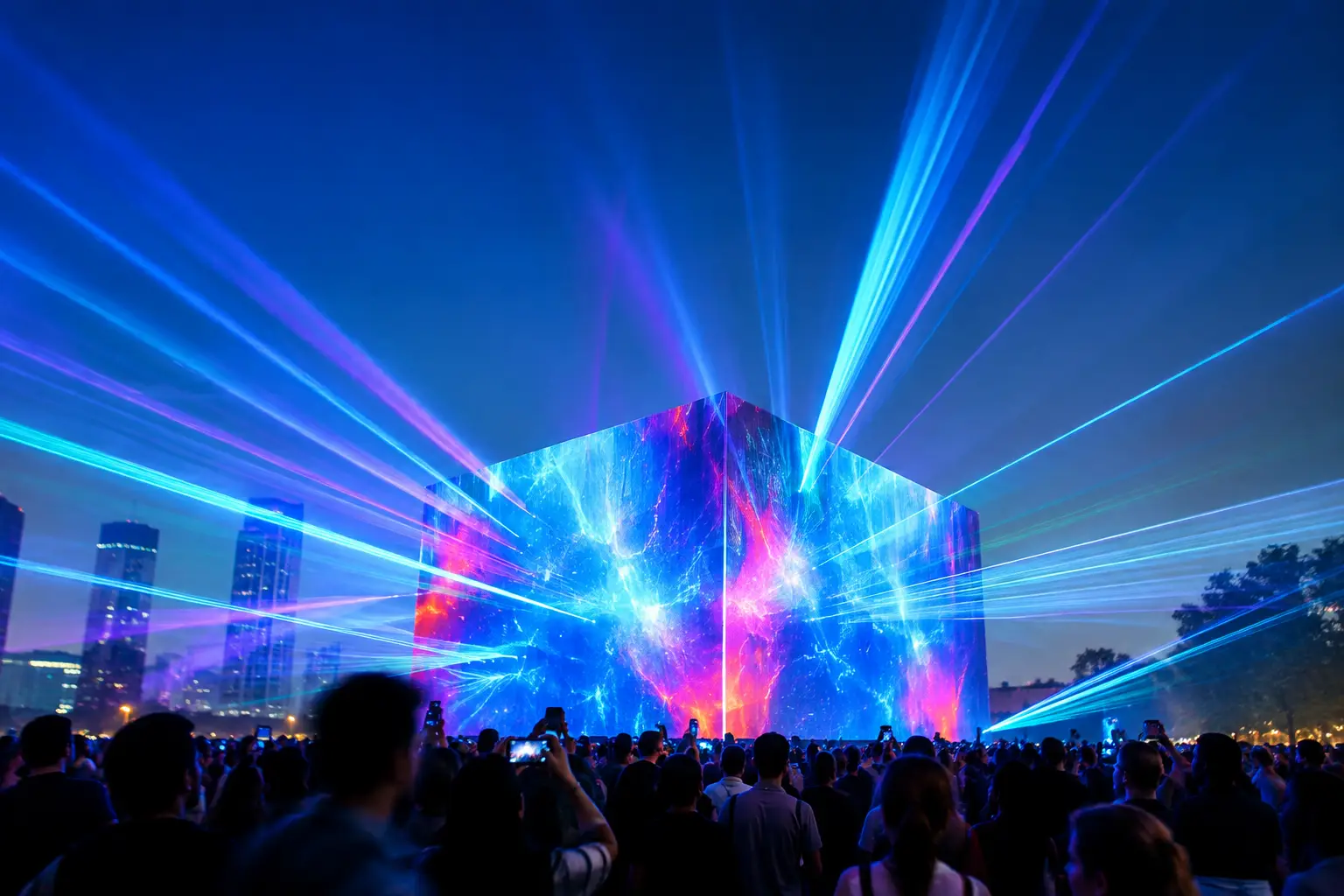
A branded step-and-repeat disappears into the background the moment guests walk past it. A laser message cutting through haze above a launch crowd does not. The best brand activation laser examples turn a logo, product benefit, or campaign idea into a live visual moment people stop to film, post, and talk about after the event.
Lasers are not simply bright graphics projected into a room. With the right creative direction, music timing, atmospheric effects, projection surfaces, and professional operation, they can make a brand feel larger than the venue itself. That can mean a precise logo reveal for 200 VIPs or a sky-filling sequence built for tens of thousands at a stadium, waterfront, or festival field.
What Makes a Laser Activation Work?
A successful activation has a clear job. It might build anticipation before a product reveal, create a shareable fan moment, direct traffic toward a sponsor zone, or give a city celebration a signature visual. The laser content should support that job rather than repeat a logo on a loop.
Scale also matters. A compact indoor projector can create razor-sharp graphics above a nightclub dance floor or inside a ballroom. A high-powered RGB system, paired with haze or outdoor beam design, can command an arena, field, facade, or open-air crowd. The visual language changes with the environment, but the principle stays the same: give the audience a moment they can feel.
10 Brand Activation Laser Examples for Live Events
1. Product Launch Countdown and Reveal
For a vehicle, technology, beverage, beauty, or apparel launch, the room should not feel like it is waiting for a presentation. It should feel like it is charging toward a reveal. Start with abstract color, movement, and campaign-inspired laser textures, then build a synchronized countdown across the ceiling, stage scrim, or architectural backdrop.
At zero, the brand mark can transform into product outlines, key features, or a custom animation timed to the first appearance of the product. The strongest version is short and decisive. A 60-second sequence with a hard musical payoff will create more energy than five minutes of unrelated effects.
2. Stadium Entrance for a Sponsored Team Moment
Sports audiences respond to rhythm, scale, and anticipation. A sponsor can own the walkout, halftime, player introduction, or post-win celebration with a laser sequence that integrates team colors and campaign messaging without slowing the action.
Picture the venue lights dropping, laser beams sweeping the bowl, and animated marks hitting in time with the announcer and music. The trade-off is sightline control. Stadium activations need a production plan that respects broadcast positions, athletes, spectators, and the speed of the event. The best result feels massive but never interferes with the game-day operation.
3. Festival Sponsor Portal or Entry Moment
A festival entrance is often an underused brand opportunity. Instead of placing a logo banner near the gate, create a laser-powered arrival experience that signals guests have entered a different world. Beams can frame an arch, trace overhead geometry, or animate a brand pattern across a scenic gateway.
This works especially well after sunset, when the experience becomes part of the festival’s social content engine. Keep the message simple. Guests should understand the brand connection in seconds, not have to stand still and decode an advertising statement while a line moves behind them.
4. Interactive-Looking Logo Animation at a Trade Show
Trade show floors are crowded with screens, printed booths, and competing sound systems. A laser animation can give a booth vertical presence, sending crisp branded graphics above the traffic line where conventional signage cannot compete.
The content can respond visually to a product demo, a scheduled presentation, or a crowd-gathering countdown. It does not need to be technically interactive to feel alive. A programmed sequence that changes with music, presenter cues, or guest milestones can create the same sense of momentum while remaining dependable over long show hours.
5. Branded Laser Sky Show for a Municipal Event
City anniversaries, waterfront festivals, fairs, holiday programs, and community celebrations offer brands a chance to become part of the memory rather than a name on a sponsorship board. A laser sky show can blend civic pride, sponsor recognition, and entertainment into one shared spectacle.
This format needs careful planning because outdoor conditions affect visibility. Fog, rain, wind, competing lighting, nearby airspace, and viewing distance all influence the design. When the setting is right, high-powered lasers can send color and motion across a huge viewing area with a level of precision that traditional fireworks cannot provide for logos and animation.
6. Nightclub Takeover for a Beverage or Fashion Brand
For a one-night brand takeover, the room itself can become the campaign canvas. Custom laser graphics above the dance floor can feature a product silhouette, a tagline fragment, a monogram, or a visual motif that reappears throughout the night.
The key is restraint. Club guests do not want to feel trapped inside a commercial. Use the brand identity as part of the visual art direction, then let the beams, color, and music carry the mood. A few perfectly timed logo hits will land harder than constant repetition.
7. VIP Gala Arrival and Step-and-Repeat Upgrade
The traditional photo backdrop has a limitation: it looks nearly identical in every guest post. A laser-powered arrival sequence can add movement and drama before attendees ever reach dinner. Projected monograms, event names, or sponsor graphics can animate across a facade, hedge wall, scenic entrance, or interior architectural surface.
For black-tie events, the creative should favor elegance over sensory overload. Fine-line gold effects, controlled movement, and clean logo treatment can feel premium. For a younger audience or a high-energy fundraiser, the same setup can shift into bold RGB color and music-synchronized beams after the program.
8. Retail Grand Opening Window or Facade Moment
A grand opening gets one first impression. Rather than rely only on balloons and a ribbon, use laser imagery to turn the storefront into a countdown destination. Brand graphics, product animations, and a reveal sequence can build anticipation as the opening time approaches.
Facade work depends on surface color, ambient light, viewer position, and local operating conditions. A bright sunlit afternoon may call for a different approach than a twilight event. Evening openings generally provide the strongest visual impact, especially when the final reveal is paired with an emcee cue, music sting, or celebratory moment.
9. Fan Zone Challenge, Giveaway, or Social Prompt
A laser can do more than announce a logo. It can direct participation. At a fan zone, a campaign can use projected prompts such as “Make Some Noise,” a QR callout, contest timing, or a hashtag graphic as guests move through a branded area.
The creative should be legible from the actual viewing distance, not just on a designer’s monitor. Large type, short phrases, high contrast, and timed repetition matter. If a call to action requires guests to scan a code or enter a contest, place that interaction at an accessible physical station and use the laser as the dramatic attention-getter.
10. Concert Tour Sponsor Integration
Tour sponsorship is often caught between two needs: the artist’s visual identity must lead, while the sponsor needs meaningful visibility. Custom laser programming can bridge that gap through a pre-show moment, a dedicated sponsor transition, a VIP experience, or a carefully placed sequence during a set change.
The best integration respects the artist’s world. A sponsor graphic can inherit the tour’s shapes, palette, and movement vocabulary instead of arriving as an unrelated advertisement. This requires collaboration between creative teams, video, lighting, laser, and tour management, but the payoff is a branded moment that feels designed into the show.
Turning an Idea Into a Show-Ready Activation
Start with the audience experience: where people will stand, what they should see first, and what they should remember. Then identify the production conditions. Indoor shows often rely on haze to make aerial beams visible, while outdoor activations may need higher output, broader coverage, and a design that reads from long distances.
Do not choose laser power by guessing. A 40-watt system may be a compelling fit for a controlled indoor production, while a major outdoor crowd may require 100, 150, or 200 watts or more. Venue ambient light, screen or facade size, viewing distance, weather, and show timing all affect the equipment recommendation.
Custom programming is where an activation stops looking generic. The show should be built around approved brand assets, exact colors where practical, event music, reveal cues, and the physical space. A professional laser team also handles the part guests should never have to think about: licensed operation, insured production, audience-safe positioning, and compliance planning.
Connecticut Laser Productions builds these moments from concept through show execution, with scalable systems and custom laser programming for intimate celebrations, branded launches, festivals, arenas, and major public events.
The most effective activation is not the one with the most graphics. It is the one that gives your audience a reason to look up, pull out a phone, and feel that your brand just made the night bigger.
No responses yet